

SYLLABUS
GS-3: Achievements of Indians in science & technology; indigenization of technology and developing new technology and awareness in the fields of IT and Computers.
Context: India’s first indigenous quantum computing testing facility at SRM University in Amaravati was launched on 14 April 2026 by Andhra Pradesh Chief Minister, with the establishment of the Amaravati Quantum Reference Facility (AQRF) aimed at enabling the Amaravati Quantum Valley to emerge as an international hub for quantum computing.
More on the News
• AQRF was launched on World Quantum Day (14 April), marking the establishment of India’s open sovereign quantum infrastructure, and features two distinct platforms—the 1Q testbed at Medha Towers and the 1S testbed at SRM University, Amaravati.
• It was launched under the Andhra Pradesh government’s flagship quantum technology hub, which is under India’s National Quantum Mission.
• Developed under a national consortium, the project involves premier institutions such as the Tata Institute of Fundamental Research (TIFR), Indian Institute of Science (IISc), IIT Bombay, and DRDO, along with contributions from industry players like Qubitech and Qbit Force.
• It will host an IBM 133-qubit quantum computer and has established 80+ industry and academic partnerships, positioning it among leading global quantum hubs.
• The launch of AQRA adds an indigenous hardware component, complementing existing quantum cloud, skilling, and innovation infrastructure within the ecosystem.
About National Quantum Mission (NQM)
• Approved on 19th April 2023 by the Union Cabinet, the mission is set to span from 2023–24 to 2030–31, with a budget allocation of ₹6,003.65 crore.
• It aims to seed, nurture and scale up scientific and industrial R&D and create a vibrant & innovative ecosystem in Quantum Technology (QT).
• NQM is one of the nine initiatives under the Prime Minister’s Science Technology Innovation Advisory Council (PMSTIAC), aimed at positioning India as a global leader in quantum technology.
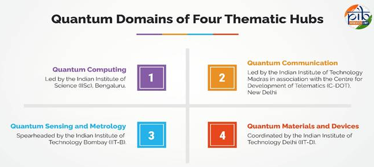
• As part of this mission, four Thematic Hubs (T-Hubs) have been set up, bringing together 14 Technical Groups across 17 states and 2 Union Territories.
Objectives of the NQM
• Quantum Computing Development: Build intermediate-scale quantum computers in a phased manner—20–50 qubits (3 years), 50–100 qubits (5 years), and 50–1000 qubits (8 years)—across platforms such as superconducting and photonic technologies.
• Satellite-Based Quantum Communication: Enable quantum-secured communication between ground stations over a range of 2000 km within India, with future expansion for international secure links.
• Inter-City Quantum Key Distribution (QKD): Establish secure communication networks over 2000 km using trusted nodes and wavelength division multiplexing on existing optical fiber infrastructure.
• Multi-Node Quantum Networks: Develop scalable quantum networks (2–3 nodes) using quantum memories, entanglement swapping, and synchronized quantum repeaters.
• Quantum Sensing and Atomic Clocks: Develop high-precision devices including magnetometers (1 femto-Tesla/√Hz in atomic systems; better than 1 pico-Tesla/√Hz in NV centers), gravity sensors (better than 100 nano-meter/second²), and atomic clocks with 10⁻¹⁹ fractional instability.
• Quantum Materials and Devices: Design and synthesize advanced materials such as superconductors, novel semiconductor structures, and topological materials, along with components like qubits, single-photon sources/detectors, and entangled photon systems for computing, communication, and sensing applications.
Initiatives under the National Quantum Mission
• Quantum-Safe Ecosystem Framework: A concept paper has been developed to provide a strategic roadmap for securing and strengthening India’s digital infrastructure against quantum threats.
• DRDO Initiatives: DRDO is leading projects to design and test quantum-resilient security schemes, along with quantum-safe symmetric and asymmetric key cryptographic algorithms.
• Advancements by SETS: The Society for Electronic Transactions and Security (SETS) under the Office of the Principal Scientific Adviser (PSA) is advancing Post-Quantum Cryptography (PQC) research. It has implemented PQC algorithms for applications such as Fast IDentity Online (FIDO) authentication tokens and Internet of Things (IoT) security.
• C-DoT Innovations: The Centre for Development of Telematics (C-DoT) under the Department of Telecommunications (DoT) has developed solutions including Quantum Key Distribution (QKD), Post-Quantum Cryptography (PQC), and Quantum Secure Video IP Phones.
Global Competitiveness and Strategic Impact
• The NQM has the potential to transform India’s technology ecosystem and make it globally competitive.
• It will drive advancements in communication, healthcare, finance, and energy, with applications in drug discovery, space exploration, banking, and security.
• It will also strengthen key national missions such as Digital India, Make in India, Skill India, Stand-up India, Start-up India, Self-Reliant India, and the Sustainable Development Goals (SDGs).
Core Concepts in Quantum Technology
| Core Concepts | Explanation |
| Quantum Computing | It uses special units called qubits to store and process information. Unlike regular computers where bits are either 0 or 1, qubits can exist in both 0 and 1 simultaneously. |
| Quantum Technology | It involves the development of necessary hardware, software, algorithms, and protocols for designing and building quantum computing devices like quantum computers. |
| Principles of Quantum Technology | It works on the principles of quantum mechanics, including superposition, quantum entanglement, and interference, to achieve higher efficiency in large-scale computations. |
| Superposition | It refers to a quantum system existing in multiple states at the same time until it is measured. Once observed, it collapses into a single state. |
| Entanglement | It is a phenomenon where two subatomic particles become interlinked regardless of distance, so that a change in one particle is instantly reflected in the other. It supports secure quantum communication by linking sender and receiver qubits. |
| Interference | It is a wave-like superposition of quantum states that affects the probability of outcomes during measurement. It can be constructive or destructive, helping improve accuracy in quantum algorithms by reducing less probable outcomes and enhancing more probable ones. |