
SYLLABUS
GS-2: India and Its Neighbourhood—Relations.
Context: The 30-year India-Bangladesh Ganga Water Sharing Treaty, signed on 12 December 1996, is set to expire on 12 December 2026, making its renewal a significant bilateral issue amid growing concerns over water security, climate change and equitable sharing of transboundary river resources.
About the Ganga Water Sharing Treaty (1996)
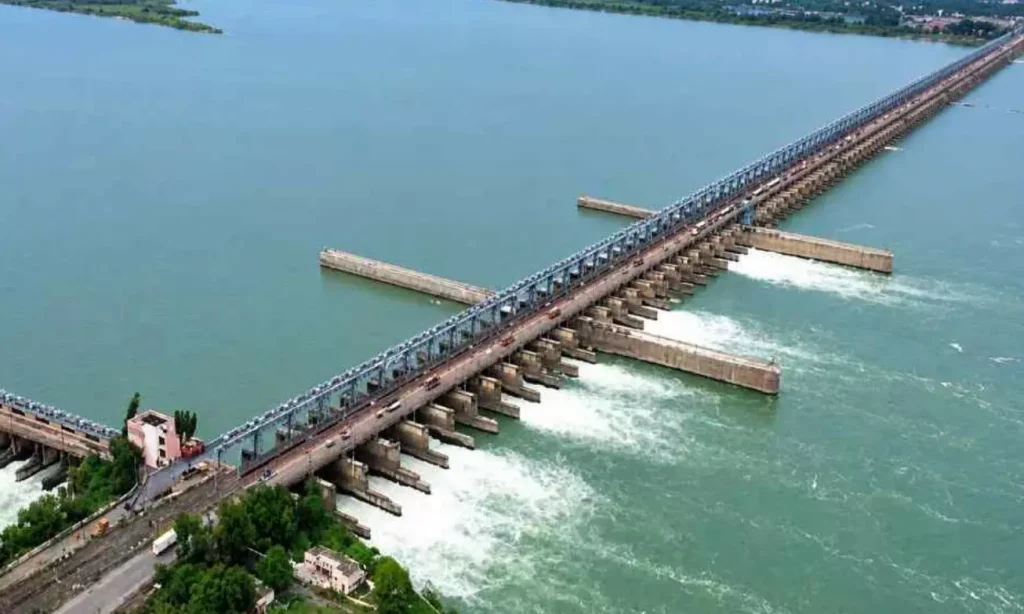
- Background: Disputes over Ganga water sharing emerged in the 1950s after India proposed constructing the Farakka Barrage in West Bengal, approximately 18 km from the present India-Bangladesh border.
- Farakka Barrage: Construction began in 1961 and the barrage was commissioned in 1975 to divert Ganga water into the Hooghly River to flush out silt and maintain the navigability of Kolkata Port.
- Farakka Long March (1976): Maulana Bhashani led a protest against India’s water diversion policy, alleging that reduced downstream flows were affecting the Padma River in Bangladesh.
- Interim Agreements: India and Bangladesh signed temporary water-sharing arrangements in 1977, 1982 and 1985, but these failed to provide a lasting solution.
- Signing of Treaty: On 12 December 1996, Prime Ministers H.D. Deve Gowda (India) and Sheikh Hasina (Bangladesh) signed the Ganga Water Sharing Treaty in New Delhi.
- Duration: The treaty established a 30-year water-sharing framework, renewable by mutual consent.
- Objective: To ensure equitable sharing of Ganga waters during the lean season and promote cooperation in water-resource management.
Key Provisions of the Ganga Water Sharing Treaty (1996)
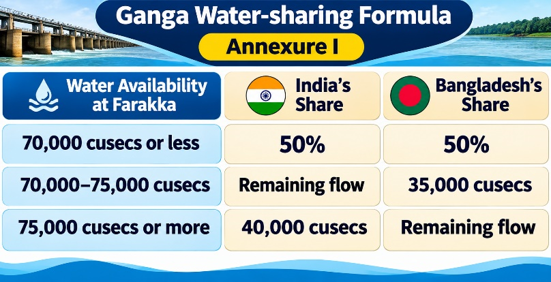
- Water-sharing Mechanism: Regulates Ganga water sharing at Farakka from 1 January to 31 May in ten-day periods, based on average flows recorded during 1949–1988.
- Special Allocation: Between 11 March and 10 May, both countries receive 35,000 cusecs each during alternate three ten-day periods.
- Emergency Provision (Article II): If flow falls below 50,000 cusecs in any ten-day period, both countries must consult immediately and make adjustments based on equity, fair play and no harm.
- Minimum Release (Article XI): If post-review adjustments are not mutually agreed upon, India must release at least 90% of Bangladesh’s formula-based share until mutually agreed flows are decided.
- Other important provisions
- Article III: India cannot reduce the water released to Bangladesh below Farakka, except for reasonable uses not exceeding 200 cusecs.
- Article IV: Establishes a Joint Committee with equal representation from both countries to monitor water flows.
- Article VI: The Joint Committee submits collected data and annual reports to both governments.
- Article VII: Disputes are first referred to the Joint Committee, then to the Joint Rivers Commission (JRC), and ultimately to both governments.
- Article VIII: Recognises the need for cooperation to augment Ganga flows during the dry season.
- Article IX: Encourages water-sharing agreements concerning other common rivers.
- Article X: Provides for treaty reviews every five years or earlier, if requested by either country.
- Article XII: The treaty remains in force for 30 years and can be renewed through mutual consent.
Significance of the Treaty
- Bilateral Relations: Resolved a decades-old water-sharing dispute through diplomacy and strengthened India-Bangladesh relations.
- Water and Food Security: Established a predictable lean-season (January–May) sharing mechanism, supporting irrigation, agriculture and livelihoods.
- Economic Significance: Helped maintain Hooghly River navigability and Kolkata Port operations through water diversion at Farakka Barrage.
- Institutional Cooperation: Established a Joint Committee for water monitoring and implementation, supported by the Joint Rivers Commission (1972).
- Regional Cooperation: Provided a framework for managing shared water resources and promoting cooperation over 54 transboundary rivers.
Major Concerns and Challenges in Treaty Renewal
- Minimum Water Guarantee: Bangladesh seeks a stronger guarantee similar to the 1977 agreement, while India opposes rigid commitments that may increase its burden during water shortages.
- Climate and Ecological Concerns: The treaty relies on 1949–1988 flow data and lacks adequate climate-adaptive and environmental-flow provisions, affecting river health, fisheries and delta ecology.
- Domestic Interests: Bangladesh seeks a 40,000 cusecs guarantee, while Bihar opposes renewal in its present form and West Bengal seeks continued Farakka diversion for Kolkata Port.
- Geopolitical Tensions: Sheikh Hasina’s ouster (2024), her extradition issue, Bangladesh’s growing engagement with China and India’s abeyance of the Indus Waters Treaty (2025) have complicated negotiations.
Way Forward
- Climate-Resilient Treaty: Update historical hydrological data and incorporate climate change, glacier retreat, rainfall variability and future water requirements.
- Ecological Sustainability: Introduce environmental-flow provisions to protect river health, biodiversity, fisheries and sediment transport.
- Scientific Cooperation: Promote real-time hydrological data sharing, satellite-based monitoring and joint scientific verification.
- Basin-Wide Cooperation: Extend cooperation beyond the Ganga to other shared rivers, particularly the Teesta and Brahmaputra, and explore Nepal’s participation.
- Institutional Strengthening: Empower the Joint Rivers Commission with technical and dispute-resolution mechanisms, consider interim arrangements and ensure equitable sharing while protecting both countries’ interests.