SYLLABUS
GS-2: Issues relating to development and management of Social Sector/Services relating to Health, Education, Human Resources.
Context: According to the WHO Global Tuberculosis Report 2026, India recorded a 38% decline in TB mortality between 2015 and 2025, exceeding the global reduction of 35%, while continuing to account for nearly one-fourth of the global TB burden.
Key Findings of the Report
- India-specific Findings:
- High disease burden: India accounted for approximately 25% of global TB cases in 2025, retaining the highest TB burden worldwide.
- Declining mortality: TB mortality declined by 38% between 2015 and 2025, compared to the global decline of 35%.
- The estimated mortality rate fell from 28 deaths per lakh population in 2015 to 18 in 2025.
- Share in global deaths: India accounted for approximately 23% of global TB deaths in 2025.
- Reported cases and deaths: India reported 25.3 lakh diagnosed TB cases and 2.63 lakh deaths in 2025. These are reported figures, not WHO-estimated incidence.
- Treatment success: India achieved a 94% treatment success rate among patients with drug-susceptible TB.
- Domestic funding: Around 96% of India’s TB programme funding requirements were met through domestic resources.
- Drug-resistant TB: India, China, the Philippines and the Russian Federation together accounted for more than half of the estimated global cases of rifampicin-resistant TB (RR-TB) in 2025.
- WHO high-burden country lists: India is included in all three WHO high-burden country lists for 2026–2030:
- TB high-burden countries.
- TB/HIV high-burden countries.
- Multidrug/rifampicin-resistant TB (MDR/RR-TB) high-burden countries.
- Incidence estimates under review: WHO has not published India’s estimated TB incidence for 2010–2025 in this report.
- The estimates are under review following the completion of district-level sentinel surveillance. Updated estimates are expected in early 2027.
- Screening Progress under TB Mukt Bharat Abhiyaan:Government-reported progress during the intensified campaign period (7 December 2024–8 November 2026):
- More than 25 crore people were brought under intensified screening.
- Over 11 crore chest X-rays and 3 crore molecular tests were conducted.
- Around 48.64 lakh TB cases were detected, including 14.97 lakh asymptomatic cases.
Global Findings:
- Global burden: An estimated 10.6 million people developed TB in 2025, while 1.13 million died from the disease.
- Incidence: The global TB incidence rate declined by 14% between 2015 and 2025, reaching 129 cases per lakh population in 2025.
- Major contributors: The eight countries with the highest burden accounted for about two-thirds of global cases. Besides India (25%), these included Indonesia (10%), the Philippines (6.8%), China (6.5%), Pakistan (6.4%), Nigeria (4.9%), the Democratic Republic of the Congo (3.9%) and Bangladesh (3.7%).
- Mortality: Global TB deaths declined by 35% between 2015 and 2025, achieving the first End TB Strategy mortality milestone five years late.
- Demographic distribution: Men accounted for 54% of new TB cases, women 35% and children 11%.
- Funding gap: Low- and middle-income countries received US$6.6 billion for TB prevention, diagnosis and treatment in 2025, against the global target of US$22 billion annually by 2027.
About Tuberculosis (TB)
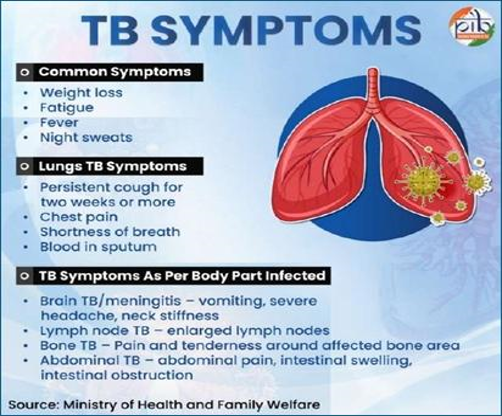
- Tuberculosis is an infectious disease caused by bacteria belonging to the Mycobacterium tuberculosis complex.
- It primarily affects the lungs but can also affect the brain, kidneys, bones and lymph nodes.
- It spreads through the air when a person with active pulmonary TB coughs, sneezes or spits.
- TB is preventable and curable with appropriate treatment.
Types of Tuberculosis
- Based on the site of infection:
- Pulmonary TB: Affects the lungs and is the most common form.
- Extrapulmonary TB: Affects organs outside the lungs, such as the brain, bones, kidneys and lymph nodes.
- Based on bacterial activity:
- Latent TB infection: Bacteria remain inactive in the body. The person has no symptoms and cannot transmit the infection.
- Active TB disease: Bacteria multiply and cause illness. Pulmonary TB can spread to others.
- Based on drug resistance:
- Drug-susceptible TB: Responds to standard first-line anti-TB medicines.
- Rifampicin-resistant TB (RR-TB): Resistant to rifampicin, a key first-line medicine.
- Multidrug-resistant TB (MDR-TB): Resistant to at least rifampicin and isoniazid.
- Pre-extensively drug-resistant TB (Pre-XDR-TB): MDR/RR-TB with additional resistance to any fluoroquinolone.
- Extensively drug-resistant TB (XDR-TB): MDR/RR-TB with resistance to any fluoroquinolone and at least one of bedaquiline or linezolid.