
SYLLABUS
GS-2: Government policies and interventions for development in various sectors and issues arising out of their design and implementation.
GS-3: Role of media and social networking sites in internal security challenges.
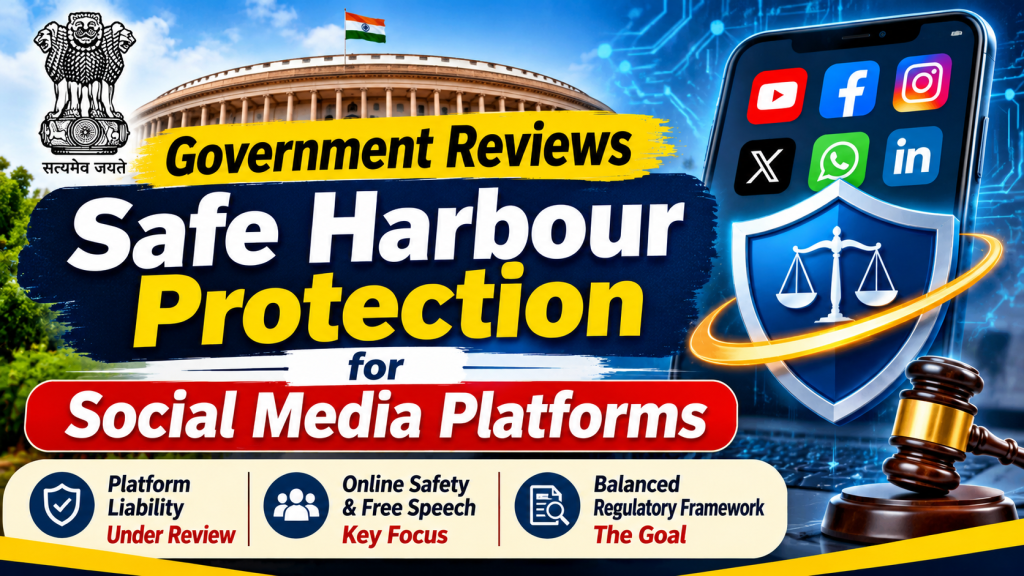
Context: The Ministry of Electronics and Information Technology (MeitY) is exploring changes to the safe-harbour protection available to social media platforms under Section 79 of the Information Technology Act, 2000.
Understanding the Existing Legal and Regulatory Framework
- Section 79 of the IT Act, 2000: Provides conditional immunity to intermediaries from liability for third-party information hosted or transmitted through their platforms, subject to prescribed due-diligence requirements.
- IT Rules, 2021: Prescribe due-diligence obligations, grievance-redressal mechanisms and user-safety requirements. Significant Social Media Intermediaries (SSMIs) must appoint designated compliance officers and publish periodic compliance reports.
- 2025 Amendment: Strengthened safeguards for removal of unlawful online content through senior-level authorisation, reasoned intimations and periodic review of government directions.
- 2026 Amendment: Introduced a framework to regulate synthetically generated information (SGI), including realistic deepfakes, through user declarations, technical verification, content labelling and traceable metadata.
- Revised Compliance Timelines: The amended framework provides for removal within 3 hours of specified legal directions, 2 hours for complaints involving specified intimate or impersonation-related content, 36 hours for certain removal-related grievances and 7 days for general grievances.
Constitutional and Legal Dimensions
- Freedom of Speech: Regulation of online content must remain consistent with Article 19(1)(a) and the reasonable restrictions under Article 19(2) of the Constitution.
- Judicial Safeguards: In Shreya Singhal v. Union of India (2015), the Supreme Court read down Section 79(3)(b), linking the obligation to remove unlawful content to a court order or notification by the appropriate government or its agency, rather than private complaints alone.
- Platform Accountability: In Just Rights for Children Alliance v. S. Harish (15 October 2026), the Supreme Court emphasised intermediaries’ obligations to remove and report child sexual exploitation and abuse material (CSEAM) under the POCSO framework.
- It also called for consideration of exemplary monetary penalties, including disgorgement of profits from paywalled CSEAM, and treated withdrawal of safe-harbour protection as a last resort for serious violations.
Why is the Government Reconsidering the Framework?
- Changing Nature of Platforms: Social media companies increasingly use algorithms to rank, recommend and amplify content, going beyond the role of passive intermediaries.
- Content Moderation Concerns: Platforms enforce their own community guidelines, which may not always align with Indian laws, raising questions about their responsibility for content they actively promote.
- Growing Online Risks: Misinformation, deepfakes, impersonation, online abuse and child sexual exploitation have intensified demands for greater platform accountability.
- Proposed Reorientation: The Government is examining whether safe harbour should primarily protect services that merely transmit information, such as internet and telecom service providers, rather than platforms actively curating and recommending content.
Concerns and Challenges
- Chilling Effect: Fear of legal liability may encourage excessive removal of lawful content, undermining freedom of expression.
- Regulatory Overreach: Broad or ambiguous content-removal directions may enable arbitrary restrictions and weaken procedural safeguards.
- Compliance Burden: Increased liability may raise operational costs, disproportionately affecting smaller platforms and digital-service providers.
- Defining Liability: Distinguishing passive intermediaries from platforms exercising algorithmic control over content may be legally and technically complex.
Way Forward
- Role-Based Regulation: Calibrate liability according to the nature of the intermediary and its degree of control over content.
- Legal Clarity: Clearly define the grounds and circumstances for loss of safe-harbour protection to prevent arbitrary enforcement.
- Procedural Safeguards: Ensure reasoned removal directions, transparency, effective grievance redressal and independent review mechanisms.
- Balanced Approach: Strengthen accountability against harmful content while protecting freedom of expression, privacy and digital innovation.