
SYLLABUS
GS-3: Various Security forces and agencies and their mandate; Security challenges and their management in border areas.
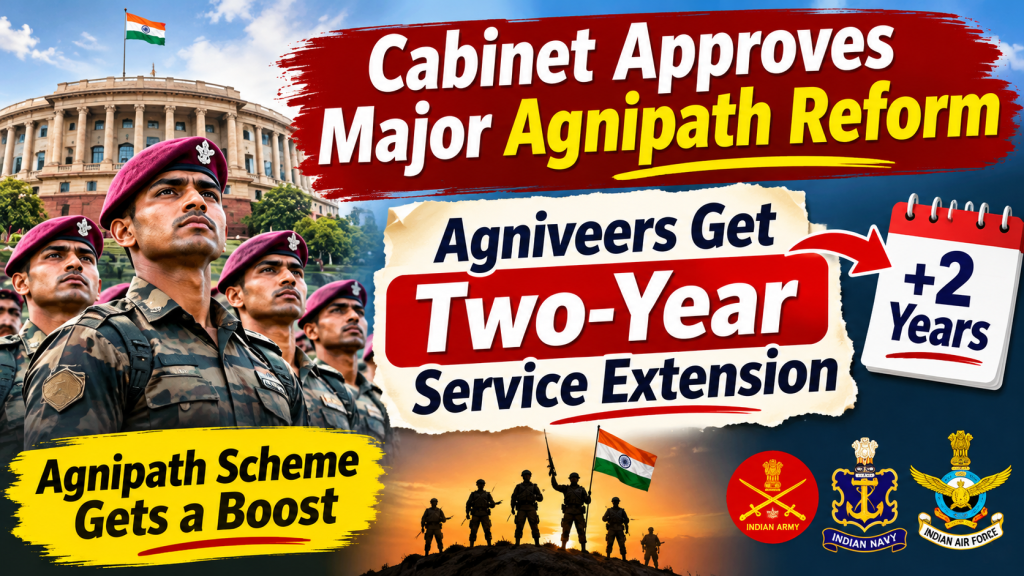
Context: The Union Cabinet recently approved a revised framework under the Agnipath Scheme, offering Agniveers not selected for regular enrolment after their initial four-year tenure an additional two-year engagement and a further opportunity for regular service.
More on the News
- First Batch Nearing Completion: The decision comes ahead of the completion of the first batch’s four-year engagement, with around 18,300 Agniveers expected to complete their initial tenure in December 2026.
- Performance Assessment: The decision follows a four-year assessment by the Defence Services, which reported positive feedback on Agniveers’ skills, physical fitness, motivation, morale and technological adaptability.
- Services’ Recommendations: Based on the assessment and organisational requirements, the three Services recommended an additional engagement period.
About the Agnipath Scheme
- Launch: Introduced on 14 June 2022, the scheme provides for recruitment of personnel below officer rank into the Indian Army, Navy and Air Force as Agniveers.
- Objective: To create a younger, fitter and more technologically equipped Armed Forces, while imparting military skills and discipline to young people.
- Eligibility: The original age bracket is 17.5–21 years, subject to prescribed educational, physical and medical standards. The upper age limit was relaxed to 23 years for the 2022 recruitment cycle.
- Tenure: Agniveers are enrolled under the respective Service Acts for four years, including training, and hold a distinct rank in the Armed Forces.
- Regular Enrolment: Up to 25% of each batch may be selected for regular enrolment based on merit, performance and organisational requirements. Those selected serve a further minimum period of 15 years under the applicable regular service conditions.
- Pay and Seva Nidhi: The monthly package ranges from ₹30,000 in the first year to ₹40,000 in the fourth year. Agniveers contribute 30% of their monthly package to the Seva Nidhi corpus, matched by an equal Government contribution.
- Exit Benefits: Agniveers completing four years receive a Seva Nidhi package of approximately ₹11.71 lakh, including accrued interest. They are also provided non-contributory life insurance cover of ₹48 lakh during engagement. Those exiting after four years are not entitled to pension or gratuity.
Key Changes under the Revised Framework
- 25% Retention at Four Years: The existing provision of selecting up to 25% of each batch for regular enrolment on merit continues unchanged.
- Second Engagement for Remaining 75%: Agniveers not selected in the first stage will be offered an additional two-year engagement, subject to their willingness and recommendations of the Defence Services.
- Further Opportunity for Regular Enrolment: After completing six years in total, the remaining Agniveers will be offered enrolment as regular soldiers, subject to willingness and meeting the prescribed selection criteria.
- Enhanced Benefits during Second Engagement:
- Higher Remuneration: Monthly remuneration will increase to ₹43,500 in the fifth year and ₹47,500 in the sixth year.
- Enhanced Seva Nidhi: The Government’s contribution will increase to 70% of the contribution for Agniveers completing the additional engagement and opting to exit.
- Seniority Benefits: The additional engagement will carry cumulative seniority benefits. Detailed service-wise rules governing seniority and career progression will be important for implementation.
- Continuation of Agnipath: The original four-year recruitment framework remains in place. The reform adds a second engagement and a further opportunity for regular enrolment rather than replacing the scheme.
Implications for Defence Manpower and Force Management
- Retention of Trained Personnel: The additional engagement can help the Services retain trained personnel and benefit from their acquired skills and experience, particularly in technically specialised roles.
- Balance between Youth and Experience: The reform retains the entry of young recruits while allowing the Services to retain experienced personnel for longer, addressing concerns about losing trained manpower after a relatively short tenure.
- More Flexible Selection: The two-stage pathway provides another opportunity to assess an Agniveer’s performance and suitability before regular enrolment, rather than making the four-year point the only selection stage.
- Continuity in Units: Longer engagement may help preserve institutional knowledge, technical proficiency and team cohesion, particularly in roles requiring sustained training and operational experience.