
SYLLABUS
GS-1: Salient Features of World’s Physical Geography.
GS-3: Conservation, Environmental Pollution and Degradation, Environmental Impact Assessment.
Context: The first global assessment of coral reef ecosystems under the International Union for Conservation of Nature (IUCN) Red List of Ecosystems has warned that 96% of assessed shallow-water coral reef ecoregions face an extremely high risk of collapse by 2075 under projected climate conditions.
Key Findings of the Assessment
- Global Coverage: The assessment examined 127 tropical and subtropical ecoregions, encompassing approximately 188,362 sq. km of coral reefs across more than 80 countries and territories.
- It was released at the 17th Conference of the Parties to the Convention on Biological Diversity (CBD COP17) in Yerevan, Armenia.
- Extent of Risk: With projected climate impacts included, 96% of assessed ecoregions were classified as Critically Endangered, indicating an extremely high risk of ecosystem collapse by 2075.
- Observed Decline versus Future Risk: Based on observed changes over the preceding 50 years alone, 24% of the assessed ecoregions were classified as Critically Endangered.
- The increase to 96% reflects the additional risk associated with projected climate change.
- The assessment used IPCC’s “middle-of-the-road” scenario projecting approximately 2.7°C of global warming by 2100 relative to pre-industrial levels.
- Climate Change as the Dominant Threat: Human-induced ocean warming and marine heatwaves were identified as the most dominant and consistent threats.
- Other Major Pressures: Overexploitation of key fish groups, including parrotfish and groupers, threatens 63% of coral reef ecosystems. Pollution, coastal and industrial development, excessive tourism, aquaculture and other pressures further contribute to reef degradation.
Understanding Coral Reef Ecosystems
- What are Coral Reefs?
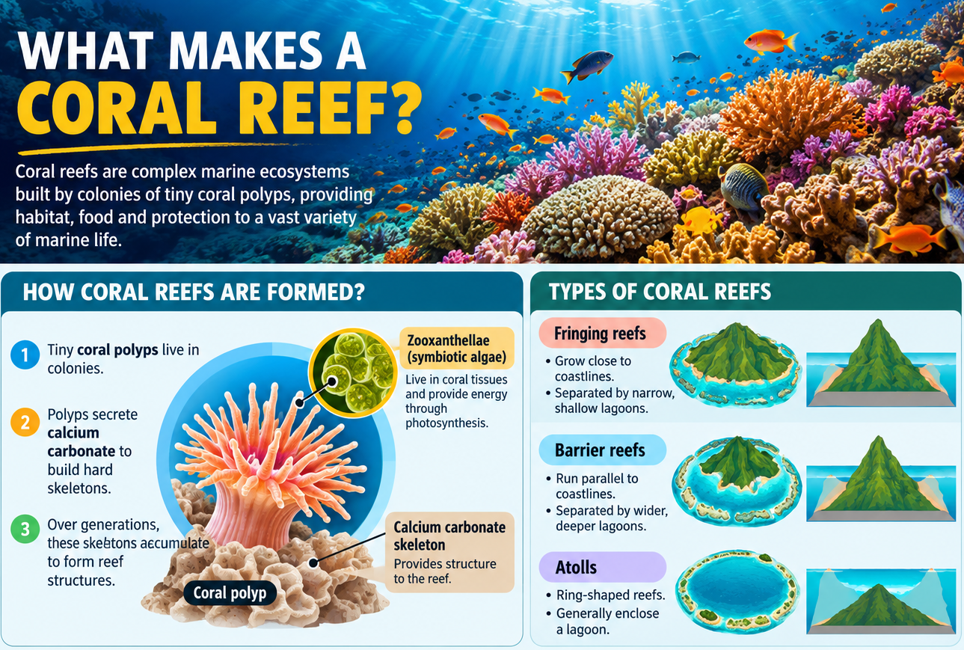
- Coral reefs are underwater structures formed primarily by calcium carbonate skeletons secreted by reef-building corals, which are marine animals belonging to the phylum Cnidaria.
- Over time, successive generations of corals build complex reef structures that support diverse marine life.
- Coral–Algae Symbiosis: Reef-building corals host microscopic algae called zooxanthellae, which provide much of their energy through photosynthesis. Heat stress can cause corals to expel these algae, resulting in coral bleaching; prolonged stress can lead to coral mortality.
- Conditions for Growth: Most shallow-water reef-building corals thrive in warm, clear, sunlit waters with suitable water quality. Excessive sedimentation and pollution can disrupt their growth and survival.
- Types of Coral Reefs:
- Fringing reefs develop close to coastlines;
- Barrier reefs lie farther offshore, separated from land by lagoons; and
- Atolls are ring-shaped reef structures that generally enclose lagoons.
Significance of Coral Reef Ecosystems
- Marine Biodiversity: Coral reefs cover less than 1% of the ocean floor but support at least 25% of marine species, making them among the most biodiverse ecosystems on Earth.
- Food Security and Livelihoods: Reef-associated fisheries provide food and income to coastal populations, while reef tourism supports employment and local economies. More than half a billion people depend on reefs for food, income and protection.
- Coastal Protection: Reef structures dissipate wave energy, helping protect coastlines from erosion, storm impacts and flooding, particularly in low-lying coastal and island regions.
- Economic and Medicinal Value: Coral reefs support fisheries, tourism, coastal protection and the discovery of medicinal compounds.
- UNEP estimates the value of their goods and services at approximately US$2.7 trillion annually.
Major Threats to Coral Reef Ecosystems
- Climate Change: Rising ocean temperatures and increasingly intense marine heatwaves cause mass bleaching and coral mortality. Repeated bleaching events can occur before reefs recover, reducing coral cover and weakening their capacity to regenerate.
- Overfishing and Ecological Imbalance: Overexploitation of herbivorous fish, such as parrotfish, reduces the grazing that controls algal growth. Depletion of key fish populations disrupts marine food webs and weakens reef recovery.
- Pollution and Sedimentation: Sewage, agricultural runoff, plastics and other pollutants degrade water quality, while sediment from land clearing and construction can reduce sunlight and smother corals. Ocean acidification, driven by the absorption of atmospheric carbon dioxide, also threatens the formation of coral skeletons.
- Coastal Development and Other Pressures: Dredging, destructive fishing, poorly managed tourism, aquaculture and industrial development can damage reef habitats. Storms, disease outbreaks and crown-of-thorns starfish outbreaks can further compound the effects of climate stress.
Way Forward
- Climate Action: Rapidly reduce greenhouse gas emissions to limit ocean warming, the principal global driver of coral reef decline. Local conservation cannot fully compensate for continued global warming.
- Targeted Ecosystem Protection: Strengthen marine protected areas, sustainable fisheries management and controls on coastal pollution and destructive development. Protecting herbivorous fish populations can also help maintain ecological balance.
- Science-Led Conservation: Strengthen long-term reef monitoring, protect resilient coral populations, and support scientifically assessed restoration. Restoration must complement—not substitute for—emissions reductions and the control of local pressures.
- Community Participation: Involve coastal communities in reef management, sustainable fisheries and responsible tourism while safeguarding livelihoods dependent on healthy reefs.