
SYLLABUS
GS-3: Science and Technology- developments and their applications and effects in everyday life; Awareness in the fields of IT, Space, Computers, robotics.
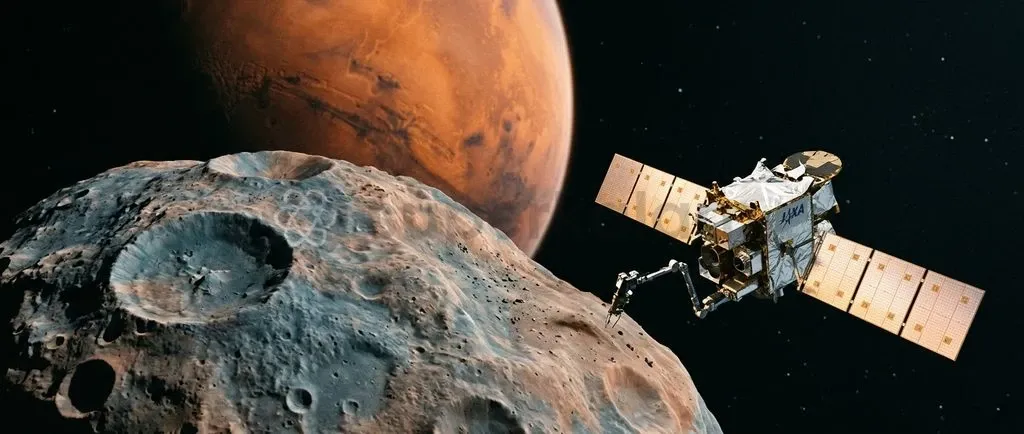
Context: Japan Aerospace Exploration Agency (JAXA) recently launched the Martian Moons Exploration (MMX) spacecraft to investigate Mars’s moons and return a sample from Phobos to Earth.
About the MMX Mission
- Objectives: Investigate the origin of Mars’s moons Phobos and Deimos and understand the evolution of the Martian system and the early Solar System.
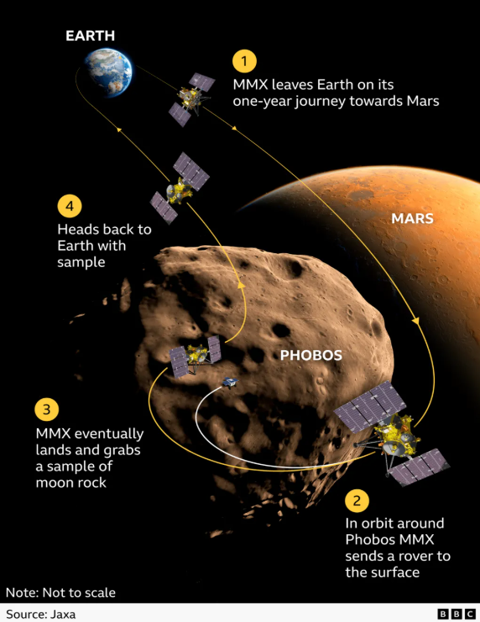
- Mission timeline: The spacecraft is expected to reach Mars in 2027, study Phobos and Deimos, collect samples from Phobos, and return them to Earth in 2031.
- Spacecraft and instruments: It comprises three main modules—propulsion, exploration and sample return—and carries 13 mission instruments, including cameras, spectrometers, sampling equipment and the IDEFIX rover.
- Sample collection: MMX aims to return at least 10 grams of material from Phobos. It will enter a quasi-satellite orbit around Phobos to map its surface and select a landing site. The IDEFIX rover will be deployed first, followed by the main spacecraft’s sampling operation.
- International collaboration: Led by JAXA, the mission involves NASA, the European Space Agency (ESA), France’s CNES and Germany’s DLR.
- The IDEFIX rover was jointly developed by CNES and DLR, while NASA contributes the MEGANE instrument to study Phobos’s elemental composition.
Understanding Mars’s Moons: Phobos and Deimos
- Uncertain origin: Mars has two moons, Phobos and Deimos. The leading hypotheses suggest that the moons are either asteroids captured by Mars’s gravity or formed from debris following a giant impact on Mars.
- These moons were discovered in August 1877 by Asaph Hall.
- Phobos: The larger and closer of Mars’s two natural satellites, orbiting the planet in approximately 7 hours and 39 minutes. It is the primary target for sample collection.
- Deimos: The smaller and more distant moon, which MMX will study through remote observations and a flyby; samples will not be collected from it.
Scientific Significance
- Origin of the moons: Analysis of returned samples could help distinguish between the asteroid-capture and giant-impact hypotheses.
- Clues about Mars: Phobos may contain material ejected from Mars by ancient impacts, potentially offering indirect evidence about the planet’s geological history.
- Planetary evolution: Samples and observations may provide insights into the movement of water-bearing and organic materials through the early Solar System and the evolution of the Martian system.
- Future exploration: MMX will advance technologies for deep-space communication, autonomous navigation, landing and sample collection in extremely weak gravity. It will also help assess whether Phobos could serve as a potential staging point for future crewed missions to Mars.