

SYLLABUS
GS-3: Issues relating to development and management of Social Sector/Services relating to Health, Education, Human Resources.
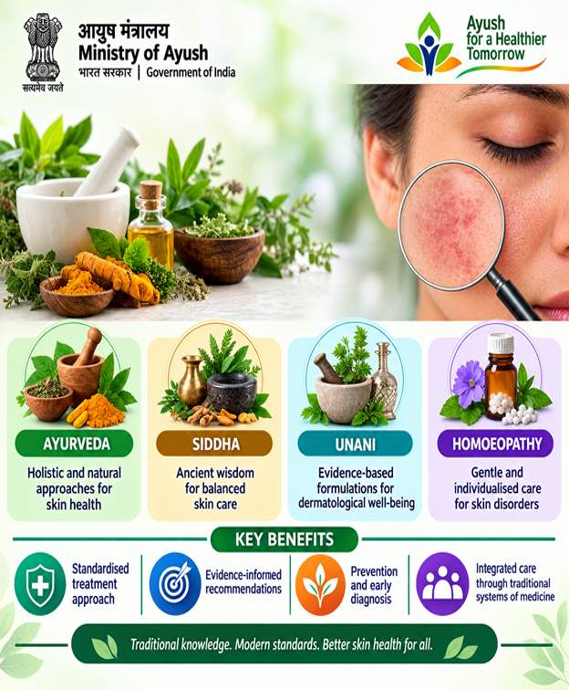
Context: The Ministry of Ayush has issued Standard Treatment Guidelines (STGs) for managing common dermatological disorders under Ayurveda, Siddha, Unani and Homoeopathy, with the inclusion of Yoga, to promote standardisation, quality assurance and evidence-informed clinical practice.
Key Guidelines on Management of Dermatological Disorders
- Scope and Coverage: Cover five common conditions—psoriasis, dermatitis, vitiligo, urticaria and dermatophytosis—with separate clinical guidance for Ayurveda, Siddha, Unani and Homoeopathy.
- Diagnosis: Include clinical features, diagnostic criteria, differential diagnosis and relevant investigations to confirm disease and assess complications.
- Treatment and Follow-up: Provide system-specific management protocols, severity assessment, dietary and lifestyle advice, and monitoring of treatment response.
- Referral: Specify referral criteria for severe or complicated conditions, diagnostic uncertainty, treatment failure and emergencies such as urticaria with anaphylaxis.
- Prevention and Yoga: Include preventive measures, skin-care advice, stress management, and relevant Yoga practices, breathing exercises and meditation.
- Development and Validation: Prepared through expert consultations involving Ayush research councils and modern medicine specialists, with reviews of classical texts and scientific evidence. Draft protocols were field-tested with medical officers in primary and secondary healthcare facilities in Delhi, and their feedback was incorporated.
- Expected Benefits: Promote uniformity, quality assurance, rational clinical decision-making, professional training and research, while strengthening Ayush integration into healthcare delivery.
About AYUSH (Ayurveda, Yoga and Naturopathy, Unani, Siddha and Homoeopathy)
- The Ministry of Ayush was established on 9 November 2014 to promote the development and propagation of traditional systems of healthcare in India.
- Its predecessor, the Department of Indian System of Medicine and Homoeopathy, was established in March 1995 and renamed the Department of Ayurveda, Yoga and Naturopathy, Unani, Siddha and Homoeopathy in November 2003.
- Major Systems under AYUSH
- Ayurveda: Aims to maintain the equilibrium of structural and functional entities in the body. Its fundamental concepts include Pancha Mahabhuta (five elements) and Tridosha (Vata, Pitta and Kapha).
- Yoga: A holistic discipline integrating physical practices, breathing techniques and mental regulation to promote physical health and mental well-being.
- Unani: Originated in Greece, was further developed by Arab and Persian scholars, and reached India in the medieval period. It emphasises individual temperament, dietary regulation and lifestyle management.
- Siddha: A traditional medical system originating in Tamil traditions of southern India. It emphasises the balance of three humours—Vatham, Pitham and Kabham—and considers the physical, physiological and psychological aspects of health.
- Homoeopathy: Developed by Samuel Hahnemann, it is based on the principle of similia similibus curentur (like cures like), individualisation and the use of highly diluted preparations.
- Naturopathy: A system of medicine based on healing through nature, using five natural elements—space, air, fire, water and earth (Pancha Mahabhuta)—to promote the body’s natural healing mechanisms and treat the whole person rather than merely the disease.
Regulation and Quality Assurance
- Legal Framework: The Drugs and Cosmetics Act, 1940, and the Drugs and Cosmetics Rules, 1945, provide the regulatory framework for Ayurveda, Siddha and Unani (ASU) drugs.
- Licensing and Quality Control: State Governments appoint licensing authorities to enforce relevant provisions governing the manufacture and sale of drugs.
- Statutory Advisory Bodies:
- Ayurveda, Siddha, Unani Drugs Technical Advisory Board (ASUDTAB): Advises on technical matters relating to ASU drugs.
- Ayurveda, Siddha, Unani Drugs Consultative Committee (ASUDCC): Helps promote uniform administration of the Act across States.