SYLLABUS
GS-2: Functions and responsibilities of the Union and the States, issues and challenges pertaining to the federal structure, devolution of powers and finances up to local levels and challenges therein.
GS-2: Statutory, regulatory and various quasi-judicial bodies.
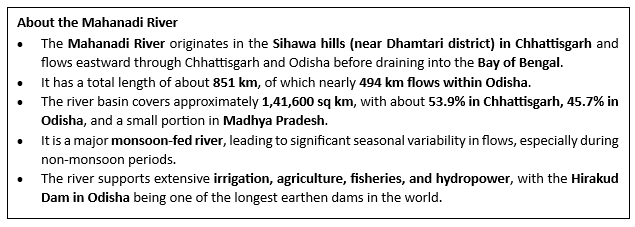
Context: The Mahanadi water dispute between Odisha and Chhattisgarh has gained fresh momentum, with both States pursuing a Central Water Commission-mediated settlement alongside proceedings before the Mahanadi Water Disputes Tribunal (MWDT).
More on the News
- The MWDT gave both States a final opportunity in May 2026 to reach an amicable settlement, warning of further adjudication if negotiations failed.
- Constituted on 12 March 2018 following Odisha’s complaint and Supreme Court intervention, the Tribunal is currently chaired by Justice Bela M. Trivedi.
- Despite renewed negotiations, the States have failed to agree on a mutually acceptable water-sharing formula.
- The next hearing is scheduled for 15 October 2026 to examine unresolved issues, including minimum non-monsoon flows and the Kalma barrage.
- The Union Government has extended the Tribunal’s tenure until 13 January 2027 to complete its proceedings.
About the Mahanadi Water Dispute
- The dispute began around 2016, when Odisha alleged that Chhattisgarh was constructing multiple barrages and dams upstream without consultation.
- Odisha, being the lower riparian state, claimed that these constructions reduced downstream water flow, affecting irrigation, drinking water, and power generation.
- Chhattisgarh, on the other hand, argued that it has the right to utilise water within its territory for development purposes.
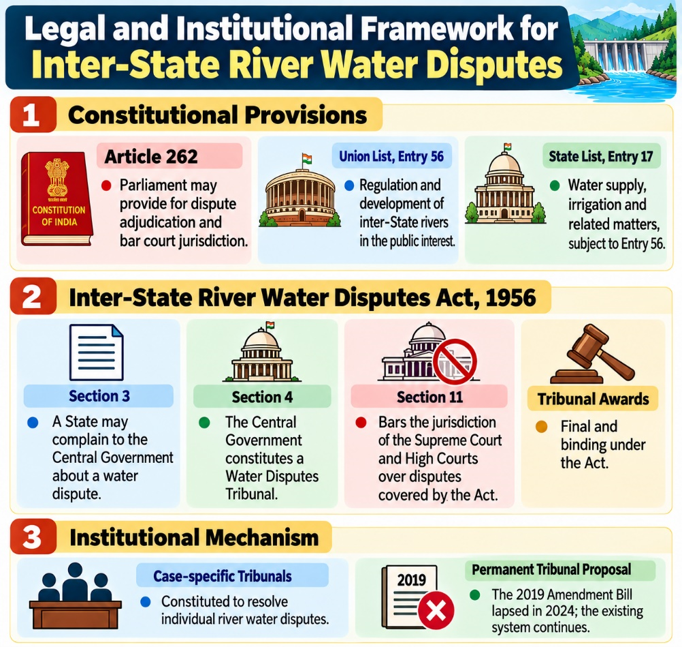
- In response to the Supreme Court’s directive, the Union Government constituted the MWDT in 2018 under the Inter-State River Water Disputes Act, 1956.
Key Issues in the Dispute
- Upstream–Downstream Conflict: Odisha contends that upstream projects reduce water flow during non-monsoon periods, while Chhattisgarh asserts its right to utilise water within its territory for development needs.
- Water Availability and Utilisation Disputes: Disagreement persists over mean annual flow (MAF), current usage, and future demand projections, which are critical for determining equitable water sharing.
- Data Sharing and Trust Deficit: Lack of credible and mutually accepted hydrological data has stalled negotiations, reflecting a deep trust deficit between the states.
- Federal and Governance Challenges: The prolonged nature of the dispute highlights issues of delayed adjudication, coordination failures, and implementation uncertainty, even after tribunal awards.
Way Forward
- Negotiated Settlement: Facilitate a mutually acceptable settlement between Odisha and Chhattisgarh through CWC-mediated negotiations, supported by independent hydrological assessments of water availability.
- Joint Monitoring: Install telemetry systems at the Kalma barrage to enable transparent monitoring of water flows by both States and the Central Water Commission (CWC).
- Permanent Tribunal Mechanism: Reintroduce the proposed permanent Inter-State River Water Disputes Tribunal, as envisaged in the 2019 Amendment Bill, to ensure time-bound adjudication of inter-State river water disputes.
- Basin-Level Management: Explore the establishment of a statutory Mahanadi Basin Management Board to promote equitable water sharing and coordinate basin-wide water management.