
SYLLABUS
GS-1: Indian culture will cover the salient aspects of Art Forms, Literature and Architecture from ancient to modern times.
Context: India’s UNESCO Tentative List has reached 78 sites with the addition of five new heritage proposals, strengthening the country’s efforts to secure global recognition for its diverse cultural heritage.
More on the News
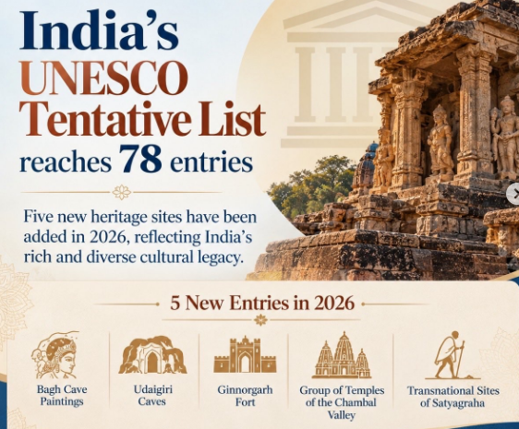
- The five additions are Bagh Cave Paintings, Group of Temples of the Chambal Valley, Udaigiri Caves, Ginnorgarh Fort and Sites of Satyagraha.
- Four are located in Madhya Pradesh, while the Sites of Satyagraha is a serial transnational proposal involving India and South Africa.
- The additions cover diverse aspects of India’s heritage, including Buddhist art, Gupta-era architecture, medieval temple architecture, Gond heritage and the evolution of Mahatma Gandhi’s Satyagraha.
New Sites
- Bagh Cave Paintings: A group of nine rock-cut Buddhist caves in Madhya Pradesh, mainly dating to the 4th–6th centuries CE.
- Their murals, particularly those in Cave 4, are important examples of post-Ajanta Buddhist paintings.
- Group of Temples of the Chambal Valley: Comprising Bateshwar, Padavali and Kakarmath, these are early medieval temples dating mainly to the 8th–11th centuries CE.
- They represent an important phase in the development of regional Nagara-style temple architecture.
- Udaigiri Caves: A Gupta-era rock-cut sacred ensemble developed mainly during the late 4th and early 5th centuries CE.
- It consists of 20 caves, with sculptures and inscriptions, including the famous Varaha form of Vishnu in Cave 5.
- Ginnorgarh Fort: A major political and administrative centre of the Gond kingdom from the early 16th to early 18th century.
- The complex includes palaces, stepwells, reservoirs, wall paintings and an advanced water-management system.
- Sites of Satyagraha: A serial transnational proposal of nine properties—seven in India (Mahatma Gandhi Satyagraha Smarak, Sabarmati Ashram, Mani Bhavan, Harijan Sevak Sangh, Sevagram Ashram, Aga Khan Palace and Gandhi Smriti) and two in South Africa (Pietermaritzburg Railway Station and Phoenix Settlement).
- It traces the evolution of Gandhi’s idea of Satyagraha from its origins in South Africa to its development and institutionalisation in India.
About the UNESCO Tentative List
- A Tentative List is an inventory of cultural and natural properties that a State Party considers suitable for potential nomination to the UNESCO World Heritage List.
- A site must be on the Tentative List before its nomination can be considered by the World Heritage Committee.
- The UNESCO World Heritage Centre, established in 1992, serves as the focal point and coordinator within UNESCO for World Heritage matters, including assisting States Parties in preparing site nominations and supporting the work of the World Heritage Committee.
- The State Party subsequently prepares a nomination, including a Preliminary Assessment and detailed nomination dossier.
- The proposal is evaluated by UNESCO’s Advisory Bodies—ICOMOS for cultural heritage and IUCN for natural heritage—before the World Heritage Committee takes the final decision.
- In India, the Archaeological Survey of India (ASI) and the Indian National Commission for Cooperation with UNESCO (INCCU) play important roles in the World Heritage process.
- Importantly, inclusion in the Tentative List does not mean that a site has become a UNESCO World Heritage Site.