SYLLABUS
GS 2: Issues relating to development and management of Social Sector/Services relating to Health, Education, Human Resources.
Context: A recent WHO–UNICEF Joint Monitoring Programme (JMP) report, Progress on Drinking Water, Sanitation and Hygiene in Schools 2015–2025, highlights India’s progress in school drinking-water coverage while also pointing to significant gaps in sanitation and hygiene services.
More on the News:
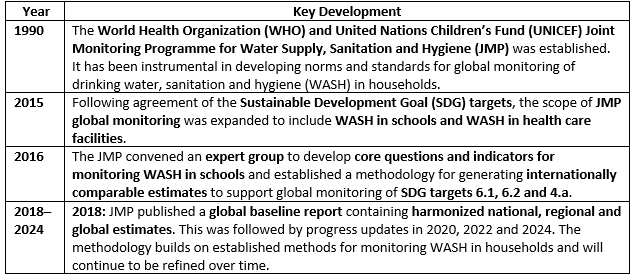
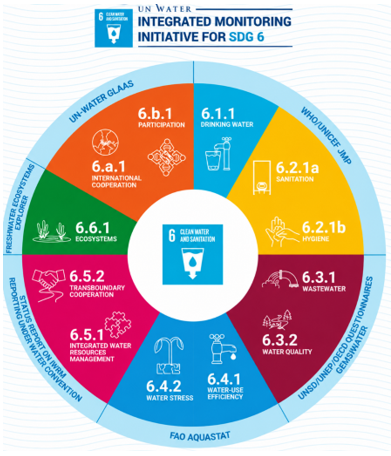
- WHO–UNICEF JMP provides internationally comparable estimates on drinking water, sanitation and hygiene (WASH) and monitors related SDG targets globally.
- The JMP updates WASH estimates in households in odd years and WASH in schools and health care facilities in even years.
- This report presents updated country, regional and global estimates for WASH in schools up to 2025.
- It also includes examples of national data on additional indicators that could support advanced monitoring of WASH in schools post-2030.
Key Findings: India’s School WASH Status
- Sanitation Remains a Major Challenge: In 2025, around 50 million Indian children had no sanitation service at their schools, out of a global total of 244 million children. India had the largest number of children without school sanitation services, followed by Nigeria (34 million), Ethiopia (26 million), the Democratic Republic of the Congo (11 million) and Indonesia (8 million).
- India recorded a 14% reduction in schools with no sanitation service, alongside the Swachh Bharat Mission, launched on 2 October 2014, which placed sanitation at the centre of India’s development agenda.
- Hygiene Services Continue to Require Attention: Globally, 362 million children had no hygiene service at school in 2025.Around 20 million of these children were in India.
- The report also highlights limitations in the availability of recent data for assessing hygiene coverage.
- For India and the Central and Southern Asia region, insufficient recent data meant that estimates could not be generated beyond 2024.
- Progress in School Drinking-Water Coverage: India has performed better on the basic drinking-water indicator.In 2025, 258 million children globally lacked drinking-water services at school.
- India accounted for 12 million of these children, approximately one in every 20 globally.
- India is among 28 of 62 countries that are on track to achieve universal coverage of basic drinking water in schools by 2030.
- India recorded an increase in basic drinking-water coverage of more than 4% per year over the period assessed.
- Panama, the Syrian Arab Republic, Togo and Tuvalu also recorded increases of more than 4% per year.
Global Progress on WASH in Schools
- Drinking Water in Schools: 142 countries and all SDG regions had estimates for basic drinking water services. Globally, 78% of schools had basic drinking water services, 9% limited services, and 13% no service.
- 429 million school-age children had no basic drinking water service, including 258 million whose school had no water service at all.
- Achieving universal access (>99%) by 2030 requires a fourfold increase in the current rate of progress.
- Sanitation in Schools: 146 countries and all SDG regions had estimates for basic sanitation services. Globally, 77% of schools had basic sanitation services, 11% limited services, and 12% no service.
- Achieving universal access by 2030 requires a fivefold increase in the current rate of progress.
- Hygiene in Schools: 136 countries and all SDG regions had estimates for basic hygiene services. Globally, 72% of schools had basic hygiene services, 9% limited services, and 18% no service.
- 545 million school-age children had no basic hygiene service, including 362 million whose school had no hygiene service at all.
- Achieving universal access by 2030 requires a fivefold increase in the current rate of progress.
JMP Methods