
SYLLABUS
GS-2: Bilateral, Regional, and Global Groupings and Agreements Involving India and/or Affecting India’s Interests.
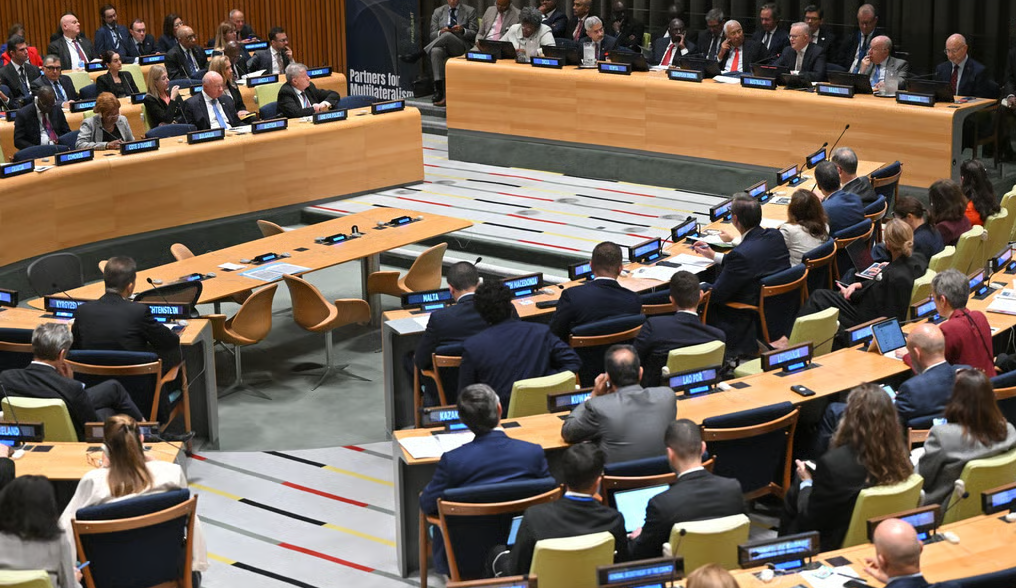
Context: The inaugural Partners for Multilateralism, International Law, Peace and Prosperity (P4M) Summit was held on 21 September 2026 on the sidelines of the 81st UN General Assembly High-Level Week in New York, with India among its initial co-sponsors.
More on the News
• Initial co-sponsors: Australia, Barbados, Brazil, Canada, the European Union, India and Kenya launched the initiative and adopted the P4M Declaration. External Affairs Minister S. Jaishankar represented India at the inaugural summit.
• Why P4M? The initiative comes amid growing geopolitical polarisation, conflicts, violations of international law, protectionism, coercion and disruptions to trade, supply chains and development finance, alongside global challenges such as climate change and emerging technologies.
• India’s emphasis: India called for countries sharing common objectives to work together on the ‘4F’ crisis—fuel, food, fertiliser and finance—and on supply-chain vulnerabilities, including through de-risking and diversification.
Understanding P4M
• Nature and objective: P4M is an open, flexible and practical framework, not another exclusive bloc or international bureaucracy. It seeks to enable countries from different regions and political traditions to build coalitions, bridge divides and work towards reform of multilateral institutions.
• Reforming, not replacing, multilateralism: The initiative seeks to strengthen the existing multilateral system, particularly the United Nations, making it more effective, representative, inclusive and fit for purpose.
- It supports initiatives such as UN80 aimed at strengthening and reforming the UN system.
• Foundational principles: P4M reaffirms sovereign equality, territorial integrity, peaceful settlement of disputes and prohibition of the threat or use of force, alongside international humanitarian law, human rights and fundamental freedoms.
Key Areas of Cooperation
• UN and institutional reform: Strengthening multilateral institutions, particularly through initiatives such as UN80, to improve their capacity to prevent conflicts, respond to crises and deliver sustainable development.
• Peace and international law: Promoting peaceful dispute settlement, respect for international law and international humanitarian law, and stronger collective responses to conflicts and crises.
• Economic resilience: Promoting diversified and resilient supply chains, reform of the multilateral trading system and an improved international financial architecture.
• Emerging global challenges: Coordinating on AI, digital transformation, climate change and global health, while supporting implementation of the Paris Agreement and 2030 Agenda for Sustainable Development.
Significance for India
• Advancing multilateral reform: P4M gives India an additional platform to advocate a more representative and effective UN-centred multilateral order, consistent with its longstanding position on reform of global institutions.
• Bridging diverse interests: With participants drawn from different regions and political traditions, the platform provides scope for India to connect Global South development concerns with broader international institutional reform.
• Economic and strategic resilience: Cooperation on supply-chain diversification, international finance, digital transformation and emerging technologies aligns with India’s interest in reducing vulnerabilities arising from economic interdependence and strategic disruptions.
• Issue-based coalition building: P4M allows India to build flexible partnerships around specific global challenges while continuing its engagement through established platforms such as the UN, G20 and BRICS.
• Shaping an emerging platform: As an initial co-sponsor, India has an opportunity to contribute to the evolution of P4M from a declaration-based initiative into a platform for regular dialogue, coordination and practical cooperation.