SYLLABUS
GS-3: Achievements of Indians in science & technology; indigenization of technology and developing new technology; Awareness in the fields of IT, Space.
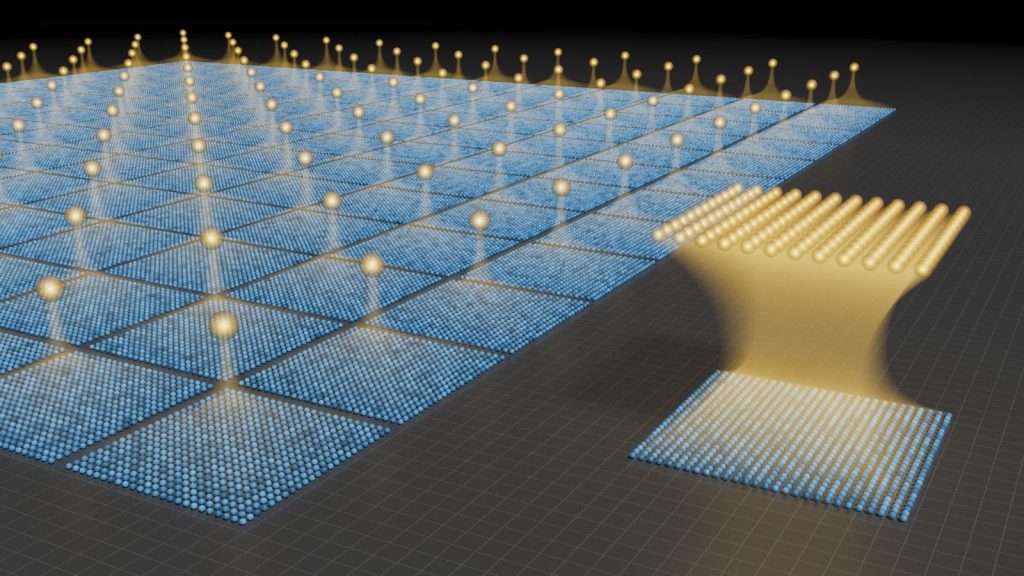
Context: Scientists at the Quantum Information and Computing (QuIC) laboratory, Raman Research Institute (RRI), Bengaluru, demonstrated a novel way to increase the stability of quantum states, potentially improving the reliability and integrity of quantum-computer calculations.
More on the News:
- Unlike traditional computers, which encode electrical states as 0s and 1s, quantum computers use the unique, counter-intuitive properties of the quantum world for computation.
- Quantum entanglement and superposition enable quantum computers to perform certain very complex computations efficiently.
About Quantum Computing
- An emerging field of computer science and engineering that uses quantum mechanics to solve problems beyond the capabilities of even the most powerful classical computers.
- At the smallest scales (quantum scales—the microscopic realm of atoms and subatomic particles), nature behaves differently from our everyday experience.
- Common Features: As per the California Institute of Technology, classical and quantum computers both usually have chips, circuits, and logic gates, operate through algorithms (sequential instructions), and use binary code of ones and zeros to represent information.
- Bits: Classical computers use physical objects to encode bits (binary digits) in two states—for example, a current is on or off, or a magnet points up or down.
- Qubits: Quantum computers use quantum bits, or qubits—the basic unit of information in quantum computing and the quantum equivalent of a traditional computer bit.
- Qubits can be made using atoms, ions, electrons, or artificial atoms such as superconducting circuits, nanoengineered using lithography.
- Superposition: While classical bits represent either one or zero, a qubit can be in a superposition of one and zero simultaneously until its state is measured.
- Exponential Growth: As qubits interact, the number of possible states grows exponentially; with just 300 quantum particles, possible configurations exceed the estimated number of atoms in the observable universe.
Common Types of Qubits
- Superconducting qubits: Made from superconducting materials at low temperatures; favored for speed and fine-tuned control.
- Trapped ion qubits: Use trapped ion particles; have long coherence times and high-fidelity measurements, but are slower than superconducting qubits.
- Quantum dots: Small semiconductors that capture a single electron as a qubit; offer potential for scalability and compatibility with existing semiconductor technology.
- Photons: Individual light particles used as qubits to transmit quantum information across long distances through optical fiber cables; used in quantum communication and quantum cryptography.
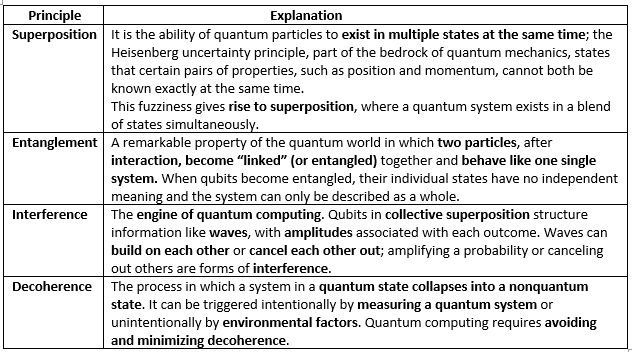
Four Key Principles of Quantum Mechanics
Why are Entanglement and Superposition Difficult to Maintain?
- Quantum State Fragility: Quantum states are exquisitely fragile. Tiny disturbances like thermal vibrations, stray fields, or cosmic rays can collapse superpositions and entanglement.
- Decoherence: An entangled state can disintegrate very quickly through interaction with the external environment, a phenomenon known as decoherence.
- Entanglement Sudden Death: Sometimes, entanglement vanishes abruptly, even before normal disintegration takes place. This is called “entanglement sudden death.”
- Coherence Time: Today’s qubits remain coherent for just 10⁻⁵ to 10⁻⁴ seconds before errors arise, whereas classical memory holds data intact for milliseconds to years.