SYLLABUS
GS-2: Functions and Responsibilities of the Union and the States, Issues and Challenges Pertaining to the Federal Structure.
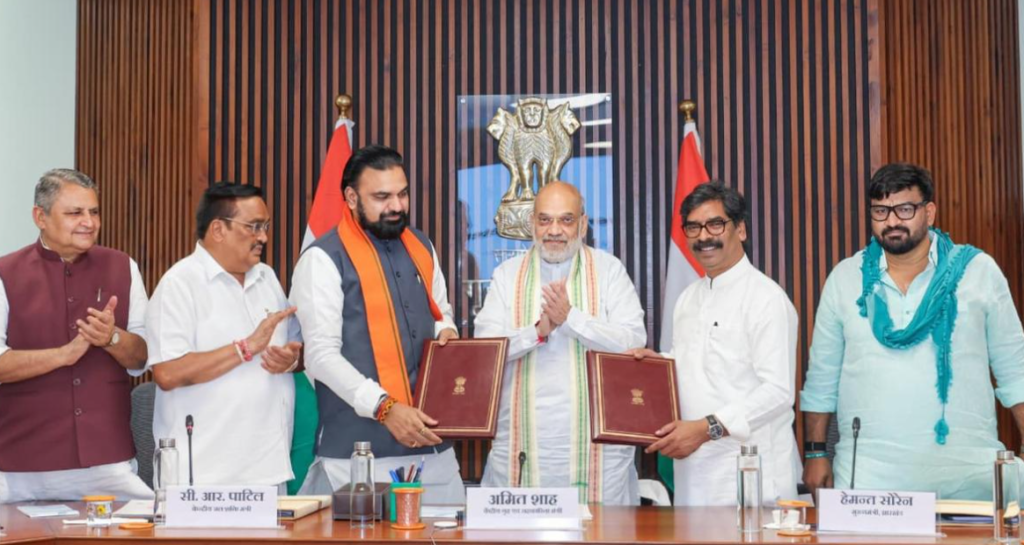
Context: Bihar and Jharkhand have signed an MoU to resolve their nearly 25-year-old dispute over sharing Sone River waters, settling the division of the 7.75 MAF share earlier allocated to undivided Bihar.
Key Highlights of the Sone Water-Sharing Agreement
• MoU & allocation: Signed on 31 August 2026, the agreement divides undivided Bihar’s 7.75 million acre-feet (MAF) allocation into 5.75 MAF for Bihar and 2 MAF for Jharkhand.
• Beneficiary regions: It will improve irrigation and drinking-water availability in Bhojpur, Buxar, Rohtas, Kaimur, Aurangabad, Arwal, Gaya and Patna in Bihar, besides Palamu, Garhwa and other regions of Jharkhand.
• Infrastructure: The settlement is expected to facilitate the long-pending Indrapuri Reservoir Project, which aims to strengthen irrigation across eight districts of Bihar.
• Fourth agreement in 2026: The agreement is the fourth major inter-State agreement of the year facilitated through the Centre’s dialogue-based approach:
- Narmada: One-time settlement of outstanding cost-sharing dues among Maharashtra, Gujarat, Rajasthan and Madhya Pradesh.
- Yamuna: Rajasthan–Haryana agreement to implement the Yamuna Water Project, including conveyance of about 580 MCM to Rajasthan.
- Kishau: Consensus among Himachal Pradesh, Uttarakhand, Delhi, Uttar Pradesh, Haryana and Rajasthan on the Kishau Multipurpose Project.
Sone River: Geography & Significance
• Origin & course: The Sone originates in the Amarkantak hills of the Maikal Range in Madhya Pradesh and flows through Madhya Pradesh, Uttar Pradesh, Jharkhand and Bihar before joining the Ganga near Patna. Its total length is about 784 km.
• Tributaries: Important tributaries include the Rihand, Kanhar, North Koel, Banas and Gopad.
• Ganga system: It is a major right-bank tributary of the Ganga, draining parts of the Peninsular Plateau before entering the Gangetic Plain.
• Irrigation importance: The river is important for agriculture in Bihar, particularly through the Sone Canal system, making its regulated use significant for the region’s irrigation and rural economy.
Understanding the Sone Water Dispute
• 1973 Bansagar Agreement: Madhya Pradesh, Uttar Pradesh and undivided Bihar agreed on sharing Sone waters and the cost of the Bansagar Dam.
- Of the 14.25 MAF, undivided Bihar was allocated 7.75 MAF, while Madhya Pradesh and Uttar Pradesh received 5.25 MAF and 1.25 MAF, respectively.
• Post-bifurcation issue: After Jharkhand’s creation in 2000, the 7.75 MAF allocation continued to relate to undivided Bihar, creating the unresolved question of how much should accrue to each successor State.
• Developmental deadlock: Jharkhand’s demand for a defined share was linked to its withholding assent to the Indrapuri Reservoir Project, contributing to the project’s prolonged delay.
• Path to settlement: The breakthrough came through the Eastern Zonal Council, followed by technical deliberations and a draft prepared/approved with the involvement of the Central Water Commission.
Significance of the Agreement
• Unlocks irrigation infrastructure: Clarity over water allocation can facilitate the Indrapuri Reservoir Project, strengthening irrigation across eight districts of Bihar.
• Improves water access: The settlement is expected to expand the availability of irrigation and drinking water across rural and drought-prone areas of Bihar and Jharkhand.
• Strengthens cooperative federalism: The settlement demonstrates the potential of inter-State dialogue, technical consultation and consensus-building in resolving long-pending resource disputes.
• Broader developmental gains: Improved water availability can support agriculture, rural development and drinking-water security, particularly in the plateau and drought-affected regions of the two States.
Why Inter-State Water Disputes Persist: Lessons from the Sone Case
• Legacy allocations may become contentious: The Sone case shows how an allocation made to an undivided State can generate fresh disputes following territorial reorganisation.
• Institutional processes can be prolonged: The Sone dispute remained unresolved for nearly 25 years, illustrating how the absence of an agreed settlement mechanism can delay resolution of inter-State resource claims.
• Water disputes have developmental costs: In this case, disagreement over allocation was linked to delays in the Indrapuri Reservoir, demonstrating how unresolved water claims can hold back irrigation infrastructure.
• Hydrological realities complicate sharing: River flows vary with rainfall and seasonal conditions, requiring water-sharing arrangements to be supported by credible hydrological data and effective monitoring, rather than relying only on static entitlements.
Way Forward
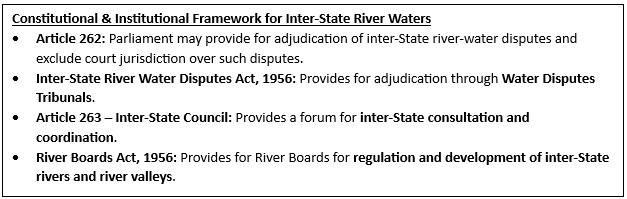
• Strengthen negotiated mechanisms: Use the Inter-State Council and Zonal Councils to facilitate early dialogue before water disputes become entrenched.
• Institutionalise data sharing: Develop jointly accepted systems for river-flow measurement, hydrological data sharing and monitoring to reduce disputes over actual availability.
• Integrate allocation with basin management: Water-sharing arrangements should be aligned with irrigation, drinking-water, ecological and groundwater requirements across the basin.
• Improve water-use efficiency: Expand micro-irrigation, watershed management and groundwater recharge to reduce pressure on surface-water resources.