
SYLLABUS
GS-2: Functions and responsibilities of the Union and the States, issues and challenges pertaining to the federal structure, devolution of powers and finances up to local levels and challenges therein.
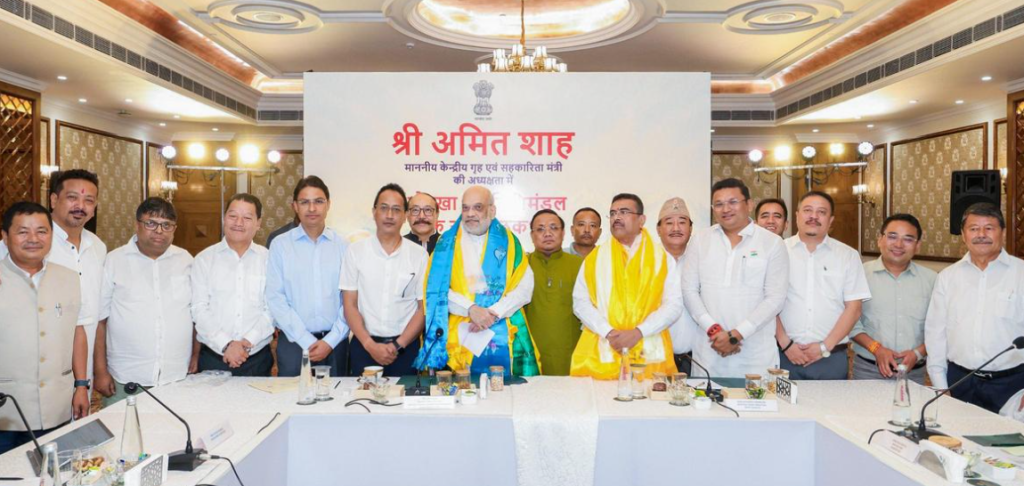
Context: The Union Ministry of Home Affairs (MHA) constituted a high-level committee to draft an agreement and finalise modalities for a permanent political solution to the long-standing Gorkha identity and self-governance demands in the Darjeeling hills and adjoining areas of Terai and Dooars.
About the Committee
• Chairperson: Pankaj Kumar Singh, former Deputy National Security Adviser and former Director General of the Border Security Force (BSF).
• Mandate: To examine all dimensions of the Gorkha issue, consult stakeholders and prepare the framework and modalities of a permanent political solution.
• It will examine issues concerning distinct identity, self-governance and recognition under the Constitution.
• It will also consider socio-economic development, financial assistance and a roadmap for granting Scheduled Tribe (ST) status to 11 major Gorkha communities.
• The committee follows earlier arrangements such as the Darjeeling Gorkha Hill Council (DGHC) and Gorkhaland Territorial Administration (GTA), which did not permanently resolve the political demand.
Historical Roots of the Demand
• 1907: The Darjeeling Hillmen’s Association, led by Sonam Wangel Laden La, petitioned the Minto-Morley Reforms Committee seeking separation of Darjeeling and Jalpaiguri from Bengal.
• 1929: Gorkha organisations presented their case before the Simon Commission, seeking an alternative administrative arrangement, including a Chief Commissioner’s Province.
• 1947: The undivided Communist Party of India (CPI) submitted a memorandum demanding “Gorkhasthan” to Jawaharlal Nehru and Liaquat Ali Khan.
• The demand has been strengthened by the region’s distinct linguistic, ethnic and cultural identity, as well as concerns over alienation and racial profiling faced by sections of the Nepali-speaking population.
Evolution of the Gorkhaland Movement
• GNLF Movement and DGHC: In the 1980s, Subhas Ghising, founder of the Gorkha National Liberation Front (GNLF), led a violent movement for a separate state and popularised the term Gorkhaland.
- The 1988 Gorkha Accord subsequently led to the creation of the Darjeeling Gorkha Hill Council (DGHC).
• GJM Movement and GTA: In 2007, Bimal Gurung formed the Gorkha Janmukti Morcha (GJM) and revived the statehood demand, leading to the establishment of the Gorkhaland Territorial Administration (GTA) in 2011 in place of the DGHC.
• 2017 Agitation: The movement witnessed its most intense recent phase in 2017, when a 104-day agitation and shutdown followed the controversy over Bengali language instruction in state-run schools, resulting in 11 deaths, violence and severe disruption of tourism and economic activity.
Key Issues in a Permanent Solution
• Limits of existing autonomy: The GTA was given responsibility over 59 subjects, but operates under West Bengal law and remains dependent on the State for key legislative, financial and administrative powers.
• Sixth Schedule and Article 244: Article 244(2) provides the constitutional framework for Tribal Areas under the Sixth Schedule.
- A Sixth Schedule-based council with greater law-making powers was proposed for the Darjeeling hills in 2005, but failed to progress amid political opposition and concerns over representation and land rights.
• Territorial question: The Gorkhaland claim extends beyond the three principal hill subdivisions to parts of the Terai and Dooars, where Gorkhas are not the only major community, making territorial reorganisation sensitive.
• Strategic considerations: Any settlement must consider the region’s proximity to Nepal, Bhutan and Bangladesh and its location near the Siliguri Corridor, the vital land link between mainland India and the Northeast.
Significance
• Political Resolution: A durable constitutional arrangement can address the long-standing demands for identity, self-governance and political recognition beyond the limited autonomy provided by earlier bodies.
• Peace and Stability: A credible settlement can help prevent repeated shutdowns, violence and political unrest that have periodically disrupted the Darjeeling hills.
• Inclusive Development: Greater political and financial stability can improve infrastructure, tourism, employment and socio-economic development in the hills, Terai and Dooars.
• National Security: Political stability in the region is strategically important because of its proximity to neighbouring countries and the Siliguri Corridor, India’s critical connection to the Northeast.
• Constitutional Federalism: The issue provides an important test of how India can accommodate regional identity and autonomy demands while protecting the rights of diverse communities and maintaining territorial integrity.