
SYLLABUS
GS-3: Awareness in the fields of Space; Achievements of Indians in science & technology; indigenization of technology and developing new technology.
Context: India observes its third National Space Day on 23 August 2026, commemorating the historic soft landing of Chandrayaan-3’s Vikram lander near the lunar south polar region in 2023 and highlighting India’s expanding capabilities in space science and technology.
About National Space Day
• National Space Day is observed every year on 23 August to commemorate the successful soft landing of the Vikram lander of Chandrayaan-3 on the Moon in 2023.
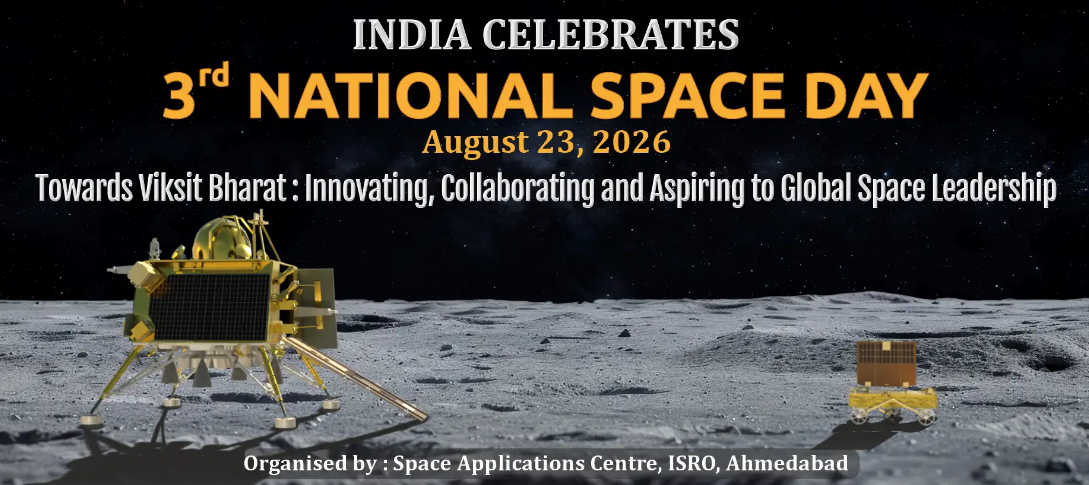
• India became the fourth country to achieve a soft landing on the Moon and the first to land near the lunar south polar region.
• The landing site was named Shiv Shakti Point, and Vikram subsequently deployed the Pragyan rover for scientific experiments.
• The theme of National Space Day 2026 is “Towards Viksit Bharat: Innovating, Collaborating and Aspiring to Global Space Leadership.” It reflects India’s focus on innovation, collaboration, self-reliance and greater participation in the global space ecosystem.
Space Sector in India
• Space Ecosystem: India opened the space sector to private participation in 2020 and introduced the Indian Space Policy 2023.
- IN-SPACe authorises and facilitates private-sector space activities, while NewSpace India Limited (NSIL) commercialises ISRO technologies and services.
- India had around 440 registered space start-ups in 2026.
- IN-SPACe has granted 113 authorisations to 52 Non-Government Entities, including 18 start-ups.
• Space Economy: India’s space economy was valued at around US$8.4 billion in 2023 and is projected to reach about US$44 billion by 2033.
• Launch Vehicles and Infrastructure: India operates PSLV, GSLV, LVM3 and SSLV for satellite launches, space science missions and commercial launches.
- The Next Generation Launch Vehicle (NGLV) and reusable launch vehicle technologies are under development.
- The third launch pad at Sriharikota and the Kulasekarapattinam spaceport in Tamil Nadu will expand launch capacity.
• NavIC and Space Applications: NavIC (Navigation with Indian Constellation) provides positioning, navigation and timing services across India and up to 1,500 km beyond its borders.
- Space technology supports agriculture, disaster management, weather forecasting, water-resource management, healthcare, education, communication and governance.
Space Missions in India
• Lunar Exploration:
- Chandrayaan-1 (2008): India’s first lunar mission; provided evidence of water molecules and hydroxyl on the Moon.
- Chandrayaan-2 (2019): Advanced lunar exploration through its orbiter and attempted a soft landing near the lunar south polar region.
- Chandrayaan-3 (2023): Achieved India’s first successful soft landing near the lunar south polar region.
- Chandrayaan-4: Planned to demonstrate lunar sample collection and return to Earth.
- LUPEX/Chandrayaan-5: India-Japan mission aimed at studying lunar polar regions and volatiles, including water.
• Interplanetary and Solar Missions:
- Mars Orbiter Mission (2014): Made India the first country to reach Mars orbit on its maiden attempt.
- Aditya-L1 (2023): India’s first dedicated solar mission, positioned around the Sun-Earth L1 point.
- Venus Orbiter Mission: Targeted for 2028 to study Venus’ atmosphere, surface and geological processes.
• Space Science and Advanced Technologies
- AstroSat (2015): India’s first dedicated multi-wavelength space observatory.
- XPoSat (2024): Strengthened India’s capability in X-ray polarisation astronomy.
- SpaDeX (2025): Demonstrated autonomous docking and undocking in space, making India the fourth country to demonstrate this capability.
• Human Spaceflight and Space Station:
- Gaganyaan aims to demonstrate India’s indigenous human spaceflight capability by carrying three astronauts to a 400-km orbit for up to three days and safely returning them to Earth.
- The Bharatiya Antariksh Station (BAS) is India’s planned five-module space station, targeted for operationalisation by 2035, and is intended to support long-duration human spaceflight and microgravity research.
About the Chandrayaan-3
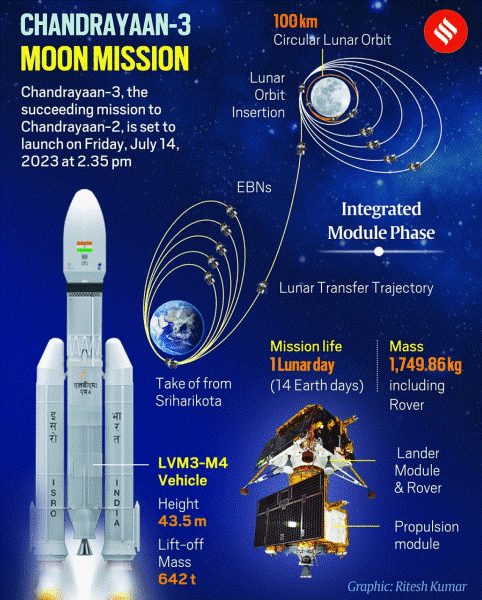
• Chandrayaan-3, launched on 14 July 2023 aboard LVM3-M4, comprised a Propulsion Module, Lander Module and Rover.
• Its three objectives were to:
- Demonstrate a safe and soft landing on the Moon.
- Demonstrate rover mobility.
- Conduct in-situ scientific experiments.
• On 23 August 2023, Vikram landed at Shiv Shakti Point and deployed the Pragyan rover.
• The mission studied the lunar surface, thermal properties, seismic activity, plasma environment and elemental composition. APXS detected sulphur near the landing site.
• The mission’s findings also supported the Lunar Magma Ocean hypothesis.
• Chandrayaan-3 strengthened India’s capabilities for lunar sample return, human spaceflight, space stations and future planetary exploration.