
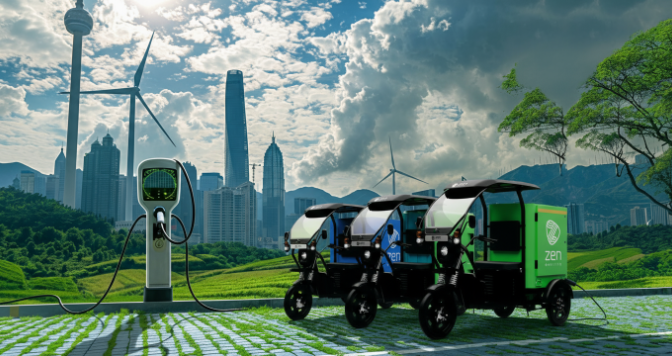
Electric Vehicles (EVs) are vehicles that are powered fully or partially by electrical energy. The development of EVs in India is an important step towards energy security, environmental protection, self-reliant manufacturing, technological innovation, and a green economy.
Electric Vehicles (EVs) strengthen India’s energy security, help address climate change, promote economic growth, and enhance technological competitiveness. They reduce dependence on crude oil imports, lower pollution and greenhouse gas emissions, promote domestic manufacturing under the ‘Make in India’ initiative, and encourage battery technology and innovation.
- Government Initiatives to Promote the Adoption of EVs in India:
- Initiatives for Policy and Increasing EV Demand:
- FAME India Scheme: To increase the demand for electric vehicles and promote charging infrastructure and manufacturing.
- National Electric Mobility Mission Plan (NEMMP), 2020: It provides a roadmap for the adoption of EVs.
- PM E-DRIVE Scheme: To promote the adoption of electric vehicles, develop charging infrastructure, and promote e-public transportation.
- Initiatives for EV Manufacturing:
- Production Linked Incentive (PLI) Scheme for Automobiles and Auto Components: It promotes electric vehicles and advanced automotive technologies.
- PLI Scheme for Advanced Chemistry Cell (ACC) Battery Storage: Its objective is to promote domestic battery manufacturing in the country.
- Initiatives for Infrastructure and Innovation:
- NITI Aayog’s India Electric Mobility Index (IEMI): It assesses the readiness of states for the adoption of electric vehicles.
- e-AMRIT Portal: It spreads awareness about electric vehicles and provides information about charging stations.
- Initiatives for Policy and Increasing EV Demand:
- Financial and State-Level Support:
- Electric vehicles attract only 5% GST.
- State EV Policies: As of December 2025, 29 States/Union Territories had notified EV policies providing financial and non-financial incentives.
- Major Achievements:
- Electric Vehicle Sales: Sales of electric vehicles have increased by approximately 46 times since 2016.
- Exports: The export value of electric vehicles increased from US$ 1.2 million in 2020 to US$ 84 million in 2024.
- Increase in EV Adoption: EV adoption increased from 0.08% in FY 2015-16 to 8.26% in FY 2025-26, meaning that approximately 8.26 out of every 100 vehicles sold were electric vehicles.
- Major Targets:
- India aims to achieve a 30% share of electric vehicles in total vehicle sales by 2030. This target is aligned with the global EV30@30 initiative.
- By 2030, approximately 1.32 million (13.2 lakh) EV charging stations are targeted to be established across India.
- India’s electric vehicle market is estimated to grow from US$ 3.71 billion in 2025 to US$ 191.04 billion by 2034, representing an estimated Compound Annual Growth Rate (CAGR) of approximately 55%.
- During the same period, the EV battery market is estimated to increase from US$ 2.71 billion to US$ 15.90 billion, with an estimated CAGR of approximately 21.70%.
Conclusion: The development of the electric vehicle ecosystem in India is not merely a transformation of the transport sector; it is also an important means of achieving energy security, green development, industrial self-reliance, and technological innovation. To achieve the targets for 2030, India needs to develop a strong EV ecosystem by integrating EV manufacturing + battery technology + charging infrastructure + renewable energy + skill development. This will enable India to move towards a clean, self-reliant, and sustainable transportation system.