
SYLLABUS
GS-3: Achievements of Indians in science & technology; indigenization of technology and developing new technology; Awareness in the fields of Space.
Context: India achieved a historic milestone in its space programme with the successful launch of Vikram-1, the country’s first privately developed orbital launch vehicle, by Skyroot Aerospace under Mission Aagaman.
More on the News
- Mission Aagaman successfully lifted off from the Satish Dhawan Space Centre (SDSC-SHAR), Sriharikota, and placed multiple technology demonstration payloads into a 450 km Low Earth Orbit (LEO) in about 15.5 minutes.
- With this achievement, India became the third country after the United States and China in the world to demonstrate orbital launch capability through a privately developed launch vehicle, highlighting the success of India’s space-sector reforms and growing private participation.
About Vikram-1
- Developer: Skyroot Aerospace (Hyderabad-based private space startup)
- Mission Name: Mission Aagaman (“Arrival”)
- Named After: Dr. Vikram Sarabhai, the father of India’s space programme.
- Launch Site: First Launch Pad, Satish Dhawan Space Centre (SDSC-SHAR), Sriharikota.
- Launch Authorisation: Indian National Space Promotion and Authorisation Centre (IN-SPACe).
- Specifications:
- Height: 22 metres (about seven storeys)
- Diameter: 1.7 metres
- Payload Capacity: Up to 350 kg to Low Earth Orbit (LEO)
- Target Orbit (Mission Aagaman): 450 km altitude with 60° inclination
- Flight Duration: Approximately 15.46 minutes
- Configuration:
- Three solid-fuel stages.
- Liquid-fuel Orbital Adjustment Module (OAM) as the fourth stage.
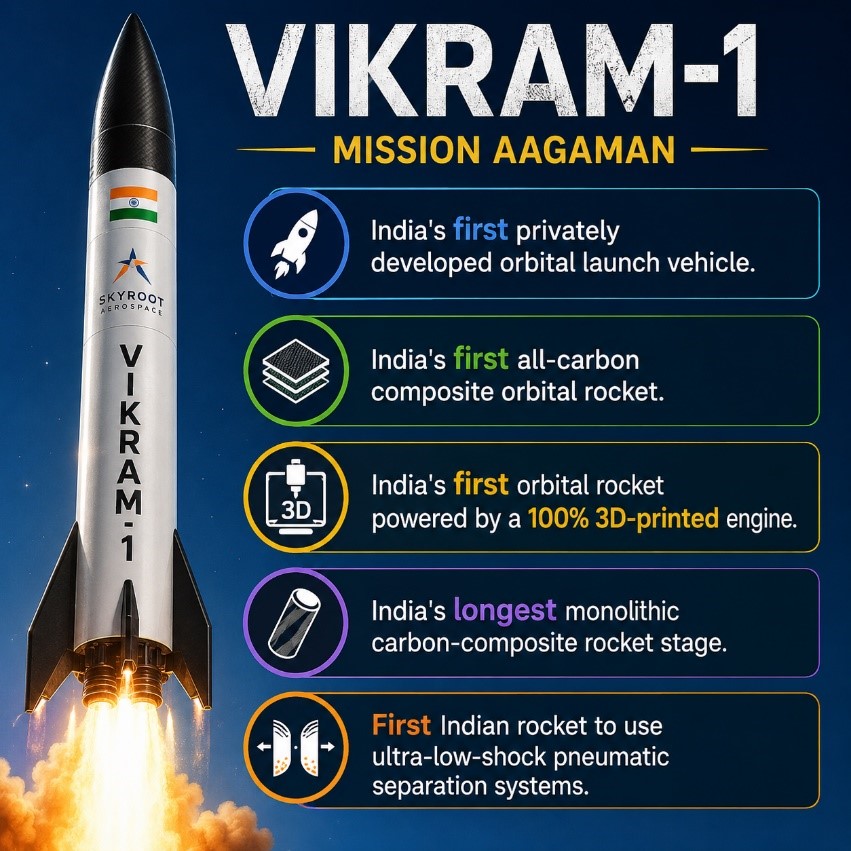
- Built using an all-carbon composite structure.
- Powered by indigenously developed propulsion systems, including high-thrust solid rocket motors and a 100% 3D-printed liquid rocket engine.
- Payloads Carried:
- SCOPE – Skyroot Aerospace.
- SOLARAS Satellite – Grahaa Space.
- Embrace – Cosmoserve Space (space debris capture technology).
- uD3PP & mD3RN – Germany’s DCUBED.
- Cosmic Bloom – Cosmos Diamonds.
- Micro Art Tribute featuring microscopic sculptures of C.V. Raman, Vikram Sarabhai and A.P.J. Abdul Kalam.
- Handwritten postcards, including one signed by the Prime Minister.
- Mission Objectives:
- Demonstrate successful lift-off and tower clearance.
- Validate propulsion, avionics, telemetry, guidance, navigation and control systems.
- Demonstrate stage separation and orbital injection.
- Collect real-flight data for future commercial launches.
- Establish a reliable, on-demand launch service for small satellites
Significance
- \Historic Milestone for India’s Private Space Sector: Vikram-1 became India’s first privately developed orbital launch vehicle to successfully place payloads into orbit, representing the next phase of India’s commercial space programme.
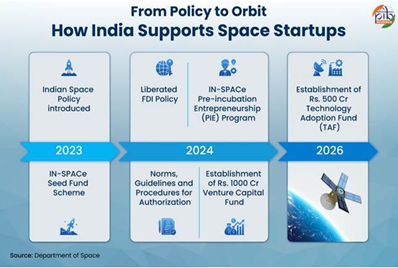
- Success of Space Sector Reforms: Demonstrates the impact of the Indian Space Policy 2023, liberalised private participation, and the role of IN-SPACe in enabling private launch companies.
- Strengthens India’s Commercial Launch Capability: Positions India to compete in the rapidly growing global small satellite launch market, where demand for dedicated launches continues to increase.
- Boosts Indigenous Technology: Validates advanced indigenous technologies including carbon-composite structures, 3D-printed rocket engines, indigenous propulsion systems, and advanced separation mechanisms.
- Supports India’s Space Economy: Reinforces the Government’s vision of expanding India’s space economy from about USD 8 billion today to USD 40–45 billion by 2030, with a long-term target of USD 100 billion by 2040 through greater private participation.
Sources:
The Hindu
PIB
Indian Express
Indian Express
New Indian Express
Space