
SYLLABUS
GS-3: Achievements of Indians in Science & Technology; Indigenization of Technology and Developing New Technology; Infrastructure: Railways.
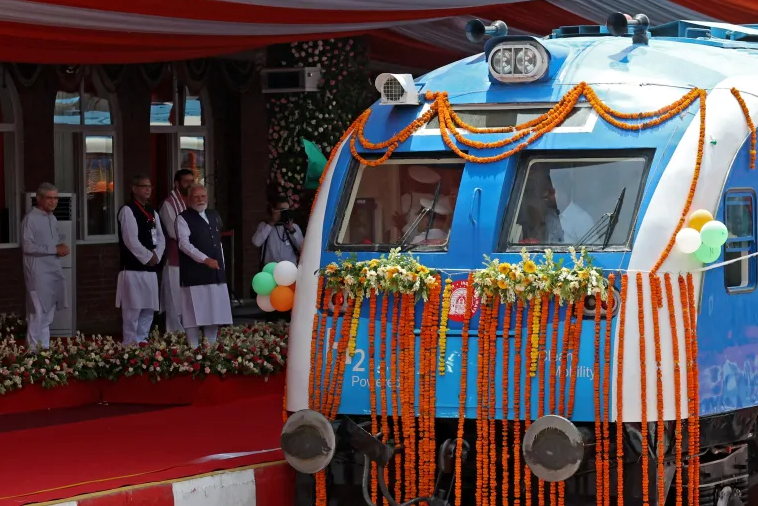
Context: Recently, the Prime Minister flagged off India’s first hydrogen fuel cell-powered train on the Jind–Sonipat section of Northern Railway in Haryana, marking a major milestone in the country’s transition towards clean, sustainable and hydrogen-based rail mobility.
More on the News
• The launch marks the successful completion of a pilot project, demonstrating the feasibility of hydrogen-powered passenger rail services and advancing the decarbonisation of Indian Railways.
• With this initiative, India joins a select group of nations that include Germany, Japan, China and the United States operating hydrogen-powered trains, reflecting its growing capabilities in clean mobility technologies.
• Developed indigenously under the Make in India initiative, the project is supported by an integrated ecosystem for green hydrogen production, storage and refuelling at Jind, advancing the objectives of the National Green Hydrogen Mission.
• As Indian Railways has already electrified over 99% of its Broad-Gauge network, hydrogen technology offers a sustainable solution for non-electrified routes where conventional electrification is challenging or uneconomical.
Understanding Hydrogen-Powered Trains
• A hydrogen-powered train uses fuel cells to generate electricity onboard through an electrochemical reaction between hydrogen and oxygen, producing water vapour as the only direct emission.
• The electricity generated powers the train’s traction motors, eliminating the need for diesel engines.
• Compared to conventional diesel trains, hydrogen-powered trains produce near-zero emissions at the point of operation, generate less noise, and offer greater energy efficiency.
• They are particularly suitable for non-electrified railway routes, where installing overhead electric lines is technically difficult or economically unviable.
• Their large-scale adoption, however, depends on the availability of green hydrogen, dedicated refuelling infrastructure and affordable fuel-cell technology.
Key Highlights of India’s First Hydrogen-Powered Train
• Indigenously developed: Designed, engineered and integrated in India, reinforcing the vision of Atmanirbhar Bharat and self-reliance in advanced railway technologies.
• World’s longest hydrogen trainset: Configured as a 10-coach passenger train comprising two Hydrogen Driving Power Cars (DPCs) and eight passenger coaches, with a carrying capacity of around 2,600 passengers.
• World’s most powerful hydrogen-powered passenger train: Equipped with two 1,200 kW Hydrogen Driving Power Cars (total installed power of 2,400 kW).
• Operational profile: The train will initially operate on the 89-km Jind–Sonipat route in Haryana, with an operational speed of 75 km/h and a design speed of 110 km/h.
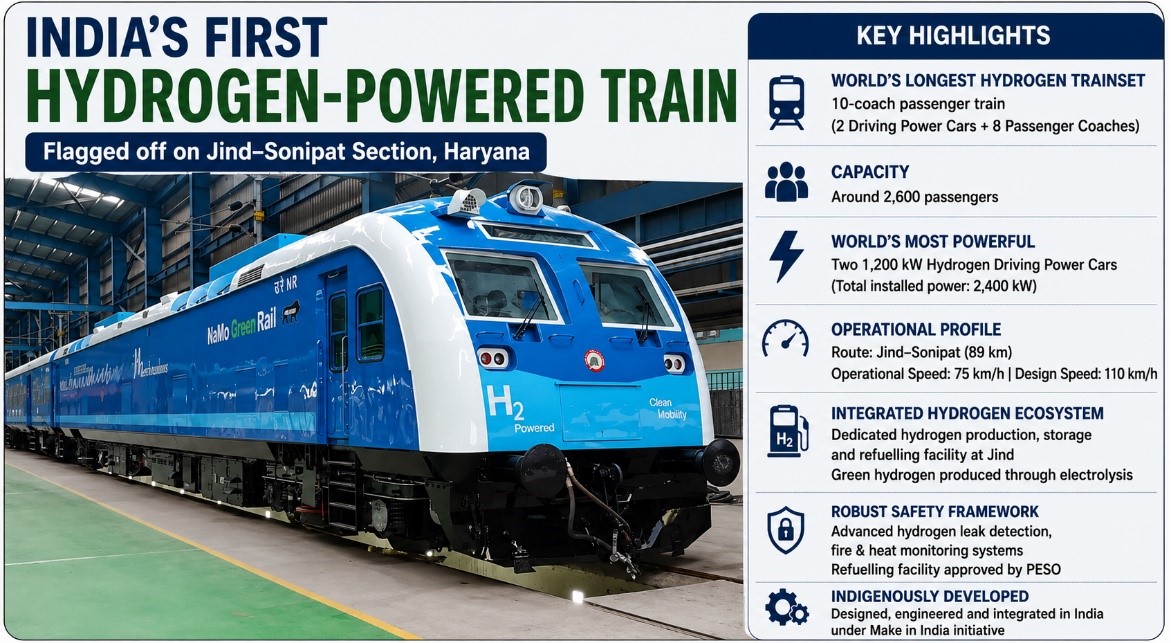
• Integrated hydrogen ecosystem: The project is supported by a dedicated hydrogen production, storage and refuelling facility at Jind, where green hydrogen is produced through electrolysis and supplied for train operations.
• Robust safety framework: The train and refuelling infrastructure incorporate advanced hydrogen leak detection, fire and heat monitoring systems, while the refuelling facility has received approval from the Petroleum and Explosives Safety Organisation (PESO).
Significance of India’s Hydrogen Rail Initiative
• Accelerating Green Rail Mobility: Provides a clean alternative for non-electrified rail corridors, supporting Indian Railways’ long-term decarbonisation strategy.
• Advancing the National Green Hydrogen Mission: Demonstrates the commercial application of green hydrogen in mass transportation and promotes the development of a domestic hydrogen economy.
• Strengthening Technological Self-Reliance: Showcases indigenous capabilities in hydrogen propulsion, fuel-cell integration, hydrogen storage and railway engineering under Make in India and Atmanirbhar Bharat.
• Positioning India as a Global Clean Mobility Leader: Places India among the few countries operating hydrogen-powered passenger trains and strengthens its standing in next-generation sustainable transport technologies.
Challenges to Wider Adoption
• High Cost of Green Hydrogen: Producing green hydrogen through electrolysis remains considerably more expensive than conventional fossil fuels.
• Infrastructure Requirements: Developing hydrogen production, storage, compression and refuelling infrastructure demands substantial capital investment.
• Storage and Transportation Challenges: Hydrogen is highly flammable and must be stored and transported under high pressure, requiring specialised infrastructure and stringent safety protocols.
• Technology Maturity: Hydrogen rail technology is still at an early stage globally, with limited large-scale operational experience and supply chains.
Way Ahead
• Scale up Green Hydrogen Production: Increase renewable energy-based hydrogen production to reduce fuel costs and improve commercial viability.
• Expand Deployment on Suitable Routes: Introduce hydrogen-powered trains on strategically selected non-electrified and environmentally sensitive rail corridors, where conventional electrification is difficult or uneconomical.
• Strengthen Indigenous Manufacturing: Promote domestic production of fuel cells, hydrogen storage systems and other critical components to reduce import dependence.
• Develop a Robust Hydrogen Ecosystem: Expand hydrogen production, storage and refuelling infrastructure through public-private partnerships while supporting continuous research and innovation to make hydrogen-powered rail transport safer, more efficient and affordable.