

SYLLABUS
GS-2: Government Policies and Interventions for Development in various sectors and Issues arising out of their Design and Implementation.
GS-3: Awareness in the fields of Bio-technology.
Context: NITI Aayog has released the report “Roadmap for Building India as a Leading Bioeconomy Powerhouse by 2035”, proposing a ₹50,000 crore BioEconomy Growth Fund and a mission-driven strategy to position India among the world’s top three biotechnology powers by 2035.
More on the News
- The report has been prepared by the NITI Frontier Tech Hub in consultation with government agencies, industry stakeholders, researchers, and domain experts to chart a long-term strategy for India’s biotechnology sector.
- The roadmap presents a mission-driven strategy to position India among the world’s top three biotechnology powers by 2035 while harnessing biotechnology as a catalyst for economic growth, innovation, sustainability, and strategic resilience.
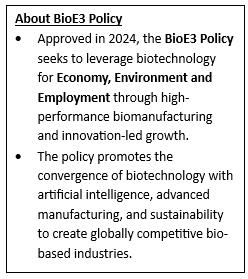
- The roadmap aligns with the BioE3 Policy (Biotechnology for Economy, Environment and Employment) and the broader vision of Viksit Bharat 2047.
Understanding India’s Bioeconomy
- The bioeconomy refers to economic activity based on the use of biological resources, biotechnology, and biomanufacturing to produce goods, services, and sustainable solutions across sectors such as healthcare, agriculture, industry, energy, and environmental management.
- Current Status of India’s Bioeconomy
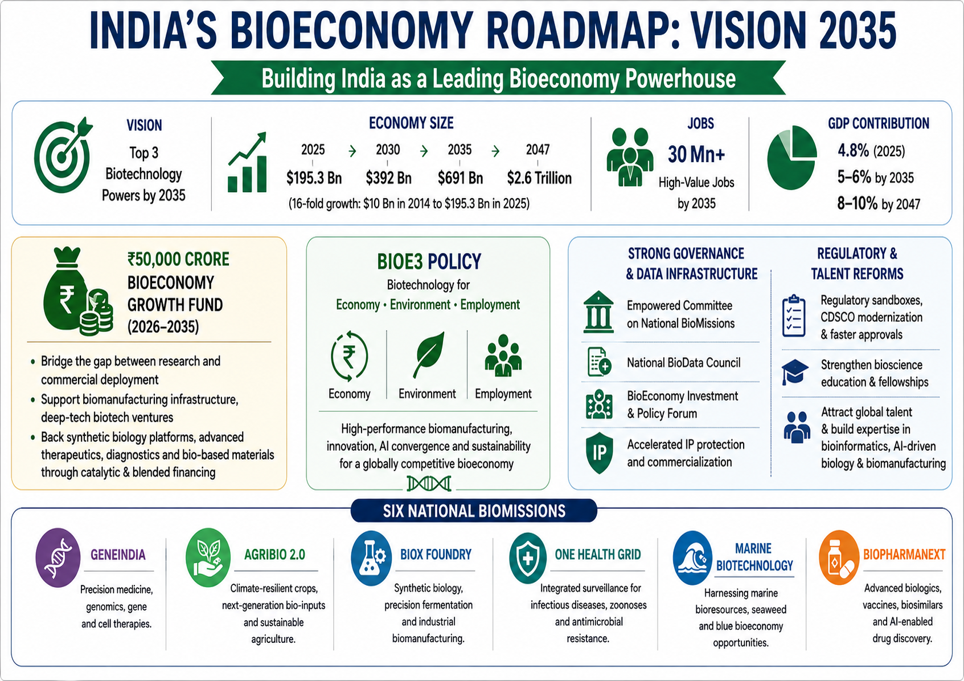
- India’s bioeconomy has expanded 16-fold, from $10 billion in 2014 to $195.3 billion in 2025, and now contributes 4.8% to the national GDP.
- The country hosts 10,000+ biotech startups, one of the world’s largest vaccine manufacturing ecosystems, and more than 700 USFDA-approved manufacturing facilities outside the United States.
- India has emerged as a global leader in affordable vaccines, biosimilars, generic medicines, and contract research and manufacturing services.
- Future Growth Targets
- The roadmap envisions expanding India’s bioeconomy to $392 billion by 2030, $691 billion by 2035, and $2.6 trillion by 2047.
- It also projects the creation of more than 30 million high-value jobs by 2035 and an increase in the bioeconomy’s contribution to GDP to 5–6% by 2035 and 8–10% by 2047.
Key Recommendations of the Roadmap
- National BioMissions for Mission-Mode Growth
- The roadmap proposes six flagship National BioMissions to build capabilities across healthcare, agriculture, industrial biotechnology, biosecurity, marine resources, and advanced therapeutics.
- These include:
- GeneIndia – Precision medicine, genomics, gene and cell therapies.
- AgriBio 2.0 – Climate-resilient crops, next-generation bio-inputs, and sustainable agriculture.
- BioX Foundry – Synthetic biology, precision fermentation, and industrial biomanufacturing.
- One Health Grid – Integrated surveillance for infectious diseases, zoonoses, and antimicrobial resistance.
- Marine Biotechnology – Harnessing marine bioresources, seaweed, and blue bioeconomy opportunities.
- BioPharmaNext – Advanced biologics, vaccines, biosimilars, and AI-enabled drug discovery.
- ₹50,000 Crore BioEconomy Growth Fund
- The report proposes a dedicated ₹50,000 crore BioEconomy Growth Fund (2026–2035) to bridge the financing gap between research and commercial deployment.
- The fund would support biomanufacturing infrastructure, deep-tech biotech ventures, synthetic biology platforms, advanced therapeutics, diagnostics, and bio-based materials through catalytic and blended financing mechanisms.
- Strengthening Governance and Data Infrastructure
- The roadmap recommends establishing an Empowered Committee on National BioMissions for cross-sectoral coordination and implementation oversight.
- It also proposes a National BioData Council, a BioEconomy Investment & Policy Forum, and a dedicated pathway for accelerating biotechnology-related intellectual property (IP) protection and commercialization.
- Regulatory and Talent Reforms
- The report calls for regulatory sandboxes, modernization of the Central Drugs Standard Control Organisation (CDSCO), and faster approval pathways for emerging biotechnology products.
- It further recommends strengthening bioscience education, expanding research fellowships, attracting global talent, and building expertise in bioinformatics, AI-driven biology, and advanced biomanufacturing.
Significance of the Roadmap
- Accelerating Economic Growth: By positioning biotechnology as a strategic growth sector, the roadmap can significantly enhance India’s GDP, exports, and global competitiveness while driving the transition towards a knowledge-based economy.
- Advancing Strategic and Technological Self-Reliance: Strengthening domestic capabilities in advanced therapeutics, industrial biotechnology, critical bio-inputs, and next-generation technologies can reduce import dependence and bolster strategic autonomy.
- Strengthening Healthcare and Food Security: Investments in precision medicine, genomics, climate-resilient agriculture, and bio-based inputs can improve healthcare outcomes and enhance agricultural resilience in the face of climate change.
- Boosting Biomanufacturing and Innovation: The focus on AI-enabled biotechnology, synthetic biology, biofoundries, and precision fermentation can accelerate innovation and help India emerge as a global hub for advanced biomanufacturing.
- Generating High-Value Employment: Expansion of research, entrepreneurship, manufacturing, and digital-biology ecosystems can create millions of skilled jobs and foster a globally competitive biotechnology workforce.