

SYLLABUS
GS-3: Indian Economy and issues relating to planning, mobilization of resources, growth, development and employment.
Context: The Ministry of Statistics and Programme Implementation (MoSPI) has released India’s first trial Index of Services Production (ISP) for 19 sub-sectors with 2024–25 as the base year, introducing the country’s first monthly indicator to measure short-term activity in the formal services sector.
Key Findings
- The inaugural ISP for April 2026 covers 19 services sub-sectors, representing about 60% of India’s services sector, with 14 sub-sectors recording double-digit year-on-year growth and almost all others registering positive growth.
- Accommodation & Food Services (37.2%), Retail Trade (30.8%), Administrative & Support Services (28.7%), and Real Estate Activities (27.7%) emerged as the top-performing sectors.
- Other major contributors included Telecommunications (22.8%), Repair Services (19.2%), Road Transport (18.5%), Warehousing & Support Activities for Transportation (18.2%), along with double-digit growth in Professional, Scientific & Technical Services, Arts & Entertainment, Insurance, Wholesale Trade, IT & Computer Related Services, and Banking.
- Air Transport was the weakest-performing sector, contracting by 13.9%, while Railway Transport recorded a marginal decline of 0.4%.
- MoSPI plans to expand the ISP by adding Health, Education, and Ownership of Dwellings, increasing coverage to 85–90% of the formal services sector, before releasing a composite overall Index of Services Production after evaluating the trial series.
About the Index of Services Production (ISP)
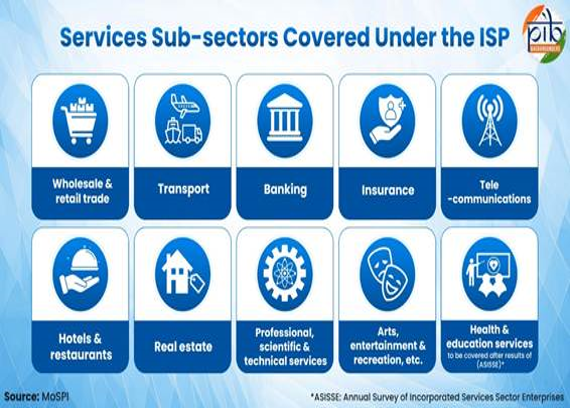
- It is a monthly high-frequency macroeconomic indicator that measures short-term changes in the volume of output (services produced) by India’s formal services sector.
- It tracks short-term changes in the volume of output produced by the formal services sector relative to a specified base year.
- It is the services-sector counterpart of the Index of Industrial Production (IIP), which measures production in manufacturing, mining and electricity.
- Objective: The ISP has been introduced to provide a timely monthly measure of services-sector activity, thereby strengthening India’s macroeconomic statistical framework.
- It enables policymakers, businesses and researchers to monitor short-term movements in the country’s largest economic sector.
- Base Year: 2024–25.
- Coverage: The present trial ISP covers 19 formal services sub-sectors, accounting for nearly 60% of India’s services sector.
- Scope: The ISP covers formal sector enterprises only, based primarily on GST and administrative datasets.
- Services related to core government functions; non-market activities and the informal sector are presently excluded.
- Data Sources: The ISP is compiled using GST data, Administrative Data, and the Annual Survey of Incorporated Services Sector Enterprises (ASISSE).
- The ISP will be released every month on the 29th.
- Initially, it is being published as an experimental (trial) series to assess data quality, test methodology, and incorporate stakeholder feedback.
Significance of the ISP
- Addresses a Major Statistical Gap: Fills the long-standing absence of a monthly production indicator for the services sector, which contributes about 56.4% of India’s Gross Value Added (FY26 First Advance Estimates).
- Strengthens Macroeconomic Indicators: Complements the Index of Industrial Production (IIP) by providing a regular high-frequency measure of services-sector output.
- Supports Evidence-Based Policymaking: Enables policymakers, businesses, investors and researchers to monitor monthly trends and make timely decisions.
- Improves GDP Estimation: Provides a reliable high-frequency indicator for estimating services-sector Gross Value Added (GVA), improving quarterly and annual GDP estimates.
- Supports Employment and Exports: The sector accounts for ~30% of total employment across India and generated ~40 million jobs over the past six years.
- India’s services exports maintained strong momentum in FY2026–27, and the Government aims to achieve a 10% share in global services exports by 2047.
- Promotes Data-Driven Governance: Integrates GST records, administrative databases and enterprise survey data to improve data quality while reducing reporting burden.