SYLLABUS
GS-3: Conservation, environmental pollution and degradation, environmental impact assessment.
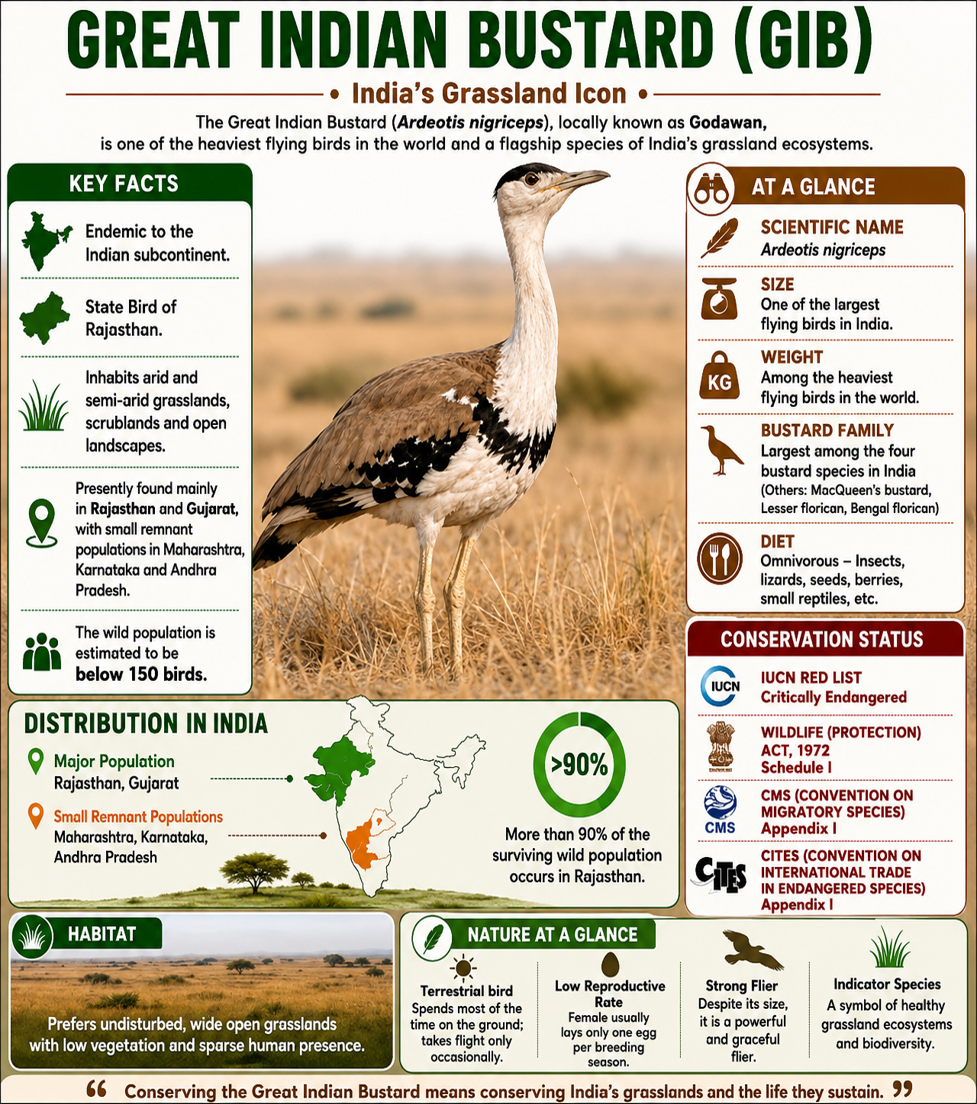
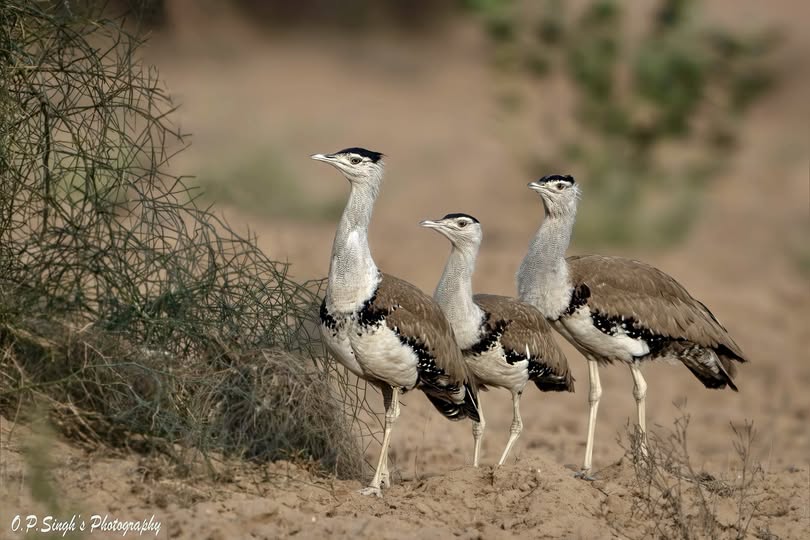
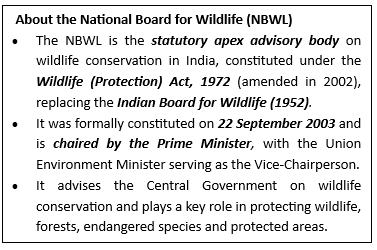
Context: The Wildlife Institute of India (WII) released the first official Great Indian Bustard (GIB) population assessment since 2017-18 and reviewed the progress of Project Great Indian Bustard at the 91st Standing Committee meeting of the National Board for Wildlife.
Key Findings
- Population Status: Estimated 130 (±21) GIBs remain in the wild.
- Population has remained broadly stable since the previous estimate of 128 (±19) during 2017-18.
- Trend analysis showed stable detections, encounter rate, abundance, and occupancy since 2017.
- Habitat Status: GIB occupies only about 16% of the surveyed landscape, despite the availability of larger suitable habitat.
- Most birds are confined to relatively undisturbed grasslands around the Desert National Park and Pokhran Field Firing Range.
- The species prefers flat to slightly undulating grasslands with sparse fallows and generally avoids agriculture and infrastructure.
- Major Threats: Habitat fragmentation due to expanding power transmission lines, agricultural fencing, roads, water sources, and solar plants.
- Increasing mortality from collisions with overhead power lines, as GIB has poor frontal vision and limited ability to avoid wires.
- Other threats include habitat loss, poaching, and egg predation.
- The report stressed that long-term survival requires stronger habitat protection, threat mitigation, habitat restoration, and conservation breeding.
- Other Observations: During the survey, 35 GIB flocks, 1,568 Chinkara herds, and 79 Desert foxes were recorded.
- Non-native species such as Nilgai, pigs, and free-ranging dogs were also observed.
- The Thar Desert remains the last viable landscape for large-scale recovery because of its extensive contiguous natural habitat.
About Project Great Indian Bustard (GIB)
- Launched by the Government of Rajasthan in 2013.
- A collaborative conservation programme involving the Government of India, Rajasthan Government, Gujarat Government, Wildlife Institute of India (WII) and international institutional cooperation.
- Objectives:
- Improve and restore GIB habitat.
- Protect eggs and nests.
- Manage predators.
- Mitigate threats from power transmission lines.
- Support captive breeding and rewilding.
- Captive Breeding Programme:
- Conservation breeding centres are located at Sam and Ramdevra in Jaisalmer, Rajasthan.
- 98 chicks have been produced in captivity.
- Wild eggs are collected, incubated, and chicks are reared under controlled conditions before planned release into the wild.
- The programme is now preparing to enter the rewilding phase, with infrastructure, monitoring systems, and management protocols being developed.
- Innovative Conservation Approaches:
- Artificial Insemination: Has emerged as a major contributor to successful breeding, accounting for the majority of chicks hatched during the current season.
- Jumpstart Intervention: Eggs are collected from wild nests for captive breeding, encouraging females to lay replacement eggs and thereby increasing both captive and wild populations simultaneously.
- Power-Line Mitigation: Bird diverters, rerouting, and undergrounding of transmission lines in critical habitats are being pursued to reduce collision-related mortality.