
SYLLABUS
GS-3: Achievements of Indians in science & technology; indigenization of technology and developing new technology.
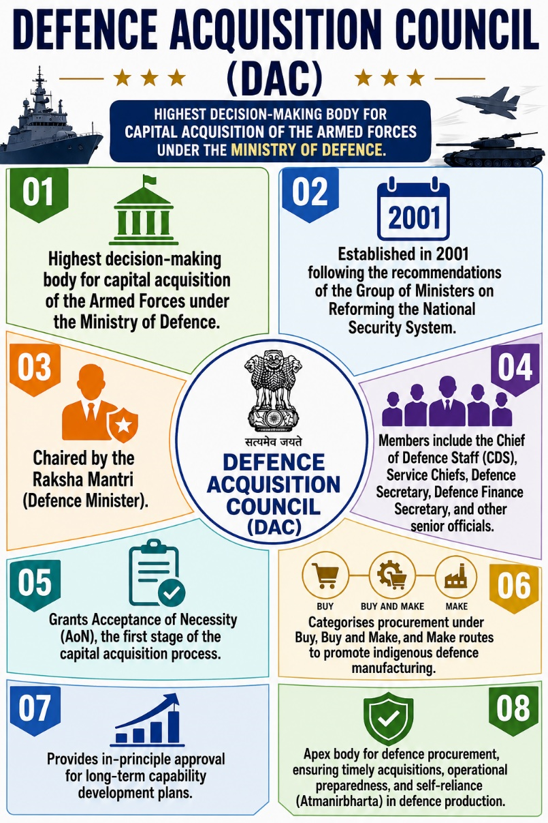
Context: The Defence Acquisition Council (DAC) has accorded Acceptance of Necessity (AoN) for capital acquisition proposals worth about ₹52,000 crore to strengthen the combat readiness and operational capabilities of the Indian Armed Forces.
More on the News
- The acquisitions cover a wide range of advanced defence systems for the Indian Army, Indian Navy
- and Indian Air Force, with a strong emphasis on indigenous and next-generation technologies.
- The approved systems include advanced air defence, anti-drone, anti-tank, electronic warfare, unmanned, surveillance and intelligence platforms aimed at addressing evolving aerial, mechanised and maritime threats.
- The Acceptance of Necessity (AoN) is the first stage of India’s capital acquisition process, providing in-principle administrative approval before procurement proceeds to tendering, technical evaluation, contract negotiations and final approval.
About the Key Defence Systems Approved
For the Indian Army:
- AKASH TARANG (Anti-UAV Electronic Warfare System): Designed to detect, track and neutralise hostile unmanned aerial vehicles (UAVs) using electronic warfare technologies.
- Provides effective anti-drone protection to Army formations by strengthening electronic warfare capabilities.
- Man Portable Anti-Tank Guided Missile (MPATGM): Indigenous third-generation fire-and-forget anti-tank guided missile.
- Enhances infantry capability to counter mechanised and armoured threats.
- Medium Range Surface-to-Air Missile (MRSAM) Weapon System: Provides medium-range air defence against stand-off aerial threats including aircraft, helicopters, cruise missiles and UAVs.
- Strengthens India’s layered air defence architecture.
- Very Short-Range Air Defence System (V-SHORADS): Equipped with multi-spectral sensing technology.
- Improves resilience against countermeasures and enhances short-range air defence capability.
- Active Protection System (APS) for Tanks: Detects and neutralises incoming anti-tank missiles and projectiles.
- Improves tank survivability and battlefield protection.
- Jet-Based Kamikaze Drone System: Loitering munition capable of precision strikes.
- Enhances electronic warfare capability with greater lethality, survivability and cost-effectiveness.
For the Indian Navy:
- Multi-Influence Ground Mine (MIGM): Smart naval mine that detects ships through magnetic, acoustic and pressure signatures.
- Enhances sea denial capability by restricting adversary freedom of manoeuvre.
- Naval Shipborne Unmanned Aerial System (NSUAS): Ship-launched UAV equipped with advanced sensors.
- Improves maritime surveillance, reconnaissance and situational awareness.
- Land-Based Testing Facility (LBTF) for Electric Propulsion Systems: Dedicated facility for testing motors and electric propulsion systems for future naval platforms.
- Supports the development of quieter and more efficient propulsion technologies.
For the Indian Air Force:
- Fixed-Wing High Altitude Pseudo Satellite (FW-HAPS): Long-endurance fixed-wing platform operating in the stratosphere.
- Provides persistent Intelligence, Surveillance and Reconnaissance (ISR), telecommunications and remote sensing capabilities.
- Bridges the capability gap between conventional UAVs and satellites by offering long-duration surveillance at lower cost.
Significance of the Approvals
- Strengthens the combat readiness and operational capabilities of the Army, Navy and Air Force across land, sea and air domains.
- Enhances India’s ability to counter emerging threats such as drones, loitering munitions, precision-guided weapons and mechanised warfare.
- Reinforces India’s layered air defence network through the induction of advanced anti-drone and missile defence systems.
- Improves persistent intelligence, surveillance, reconnaissance and electronic warfare capabilities for modern network-centric warfare.
- Supports the modernisation of the Armed Forces through the induction of advanced indigenous and next-generation defence technologies.
- Promotes self-reliance in defence manufacturing under the Aatmanirbhar Bharat initiative by encouraging indigenous defence production and reducing import dependence.