
SYLLABUS
GS-2: Government policies and interventions for development in various sectors and issues arising out of their design and implementation; Issues relating to poverty and hunger.
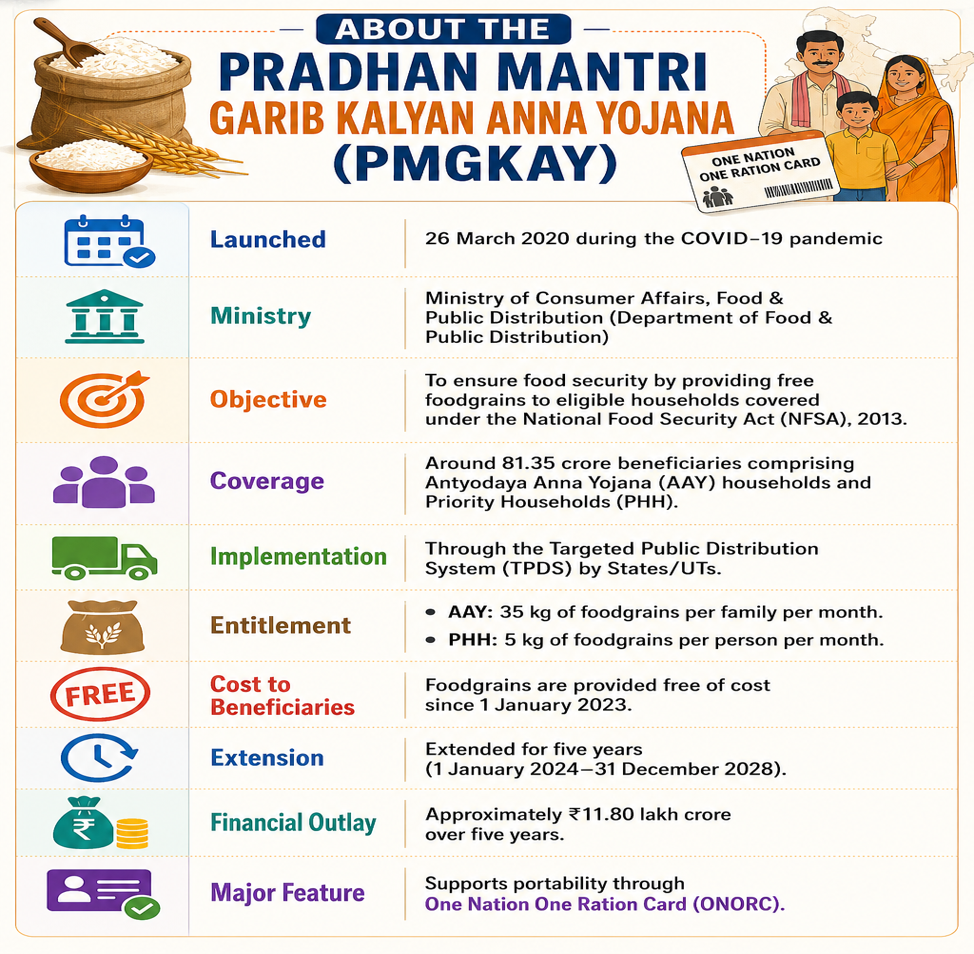
Context: The Cabinet Committee on Economic Affairs (CCEA) has approved revised rice quality specifications under the Pradhan Mantri Garib Kalyan Anna Yojana (PMGKAY) and other welfare schemes to provide better-quality rice to over 80 crore beneficiaries.
More on the News
- The Cabinet has revised rice quality standards under the Public Distribution System (PDS) for the first time in nearly three decades.
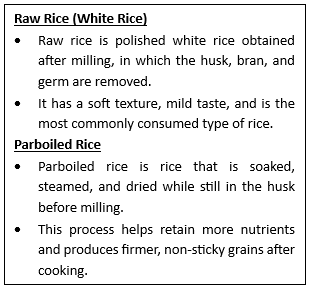
- The permissible broken grain content has been reduced from 25% to 10% for raw rice and from 16% to 5% for parboiled rice, while beneficiaries’ foodgrain entitlements remain unchanged.
- Procurement of improved-quality rice will begin immediately and will be implemented across procuring States in a phased manner by the Kharif Marketing Season (KMS) 2027–28.
- Distribution under PMGKAY and other welfare schemes will also be phased.
- The reform includes QR code tagging of rice bags for end-to-end traceability, productive utilisation of separated broken rice, and is expected to generate annual savings of about ₹2,161 crore through lower logistics, storage and packaging costs.
About the Pradhan Mantri Garib Kalyan Anna Yojana (PMGKAY)
Significance
- Improves Food Quality: Ensures beneficiaries receive rice with better grain integrity, appearance and consumer acceptability without reducing their entitlement.
- Strengthens Food Security: Moves beyond ensuring food availability to delivering higher-quality food grains under the NFSA framework.
- Enhances Efficiency: Productive utilisation of separated broken rice and direct auction from millers’ premises reduce wastage and improve resource utilisation.
- Reduces Fiscal Burden: Expected annual savings of about ₹2,161 crore through lower transportation, storage and packaging costs, along with additional revenue from the sale of broken rice.
- Promotes Transparency: QR-code tagging enables end-to-end traceability of rice bags, improving inventory management and reducing leakages in the Public Distribution System.