

Scientists Discover ‘Hyperparasite’ in Malaysia Borneo Jungle
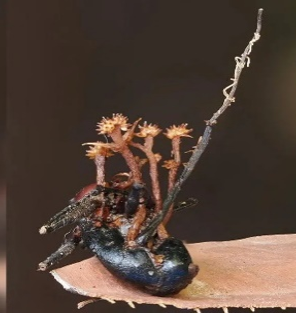
Context: Malaysian scientists discovered a new species of parasitic fungus, Pleurocordyceps cornusynnemata, in Borneo’s jungles.
More on the News
- The discovery was made by scientists from the University of Malaysia Sabah’s Institute for Tropical Biology and Conservation.
- The fungus belongs to the genus Pleurocordyceps and acts as a specialized hyperparasite.
- Pleurocordyceps cornusynnemata targets ants already infected by Ophiocordyceps, or “zombie fungus“.
- Ophiocordyceps manipulates the infected insect’s nervous system, makes it behave erratically, kills it, and bursts from its carcass.
- Rather than manipulating the insect itself, Pleurocordyceps infiltrates and feeds directly on the thriving Ophiocordyceps tissue inside the host, acting as a specialized hyperparasite.
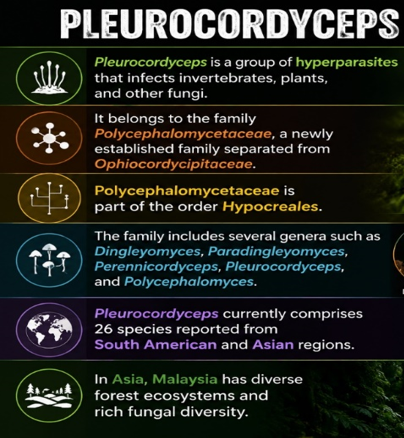
Significance
- The fungi include the world’s first known member of the genus Pleurocordyceps to exhibit a highly distinctive horn-shaped structure and show potential for next-generation antimicrobial drugs and agricultural pest biocontrol.
New Plant Pest-Hunting ‘Aphid Wasp’ Species Discovered
Context: Scientists from the Zoological Survey of India (ZSI) have discovered a new species of aphid wasp named Spilomena malabarica.
More on the News
- It is the 11th species of the genus Spilomena recorded in India and the 98th species known worldwide.
- The new species was discovered in Kozhikode district, Kerala.
- The specimen was collected from the historic Malabar region, after which the species was named (malabarica).
Key Features of Spilomena malabarica
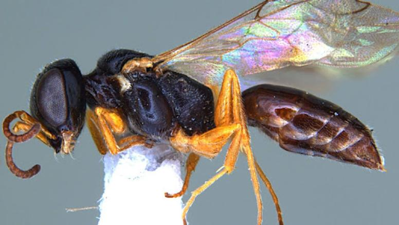
- Tiny insect measuring about 3.5 mm in length.
- Black-and-brown coloured aphid wasp.
- Possesses a single submarginal cell in the forewing, a rare wing-vein characteristic.
- Distinguished from its closest relative, Spilomena unus, by:
- A non-elongated head; Well-proportioned distance between the eyes and top of the head; A flatter (less convex) clypeus.
Scientific Significance
- The unique features of Spilomena malabarica blur the traditional taxonomic distinction between the genera Spilomena and Arpactophilus.
Cambaltica Patra
Context: Researchers have discovered a new microscopic species of fossilized leaf beetle, named Cambaltica patra, preserved in amber from the Kutch Basin in Gujarat.
More on the News
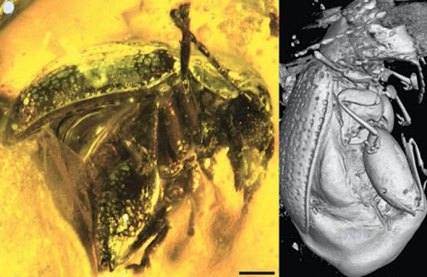
- The fossil dates back to the Middle Eocene Epoch, approximately 47.8–38 million years ago.
- The study was conducted by researchers from the DST Birbal Sahni Institute of Palaeosciences, Raja Ramanna Centre of Advanced Technology, and Christian-Albrechts University of Kiel, Germany.
About Cambaltica Patra
- The beetle belongs to the leaf beetle family (Chrysomelidae).
- The dark black beetle measures just 1.1 mm in length.
- It is only the second species ever identified from this genus.
- The new species differs from Cambaltica paleoindica by having a longer and narrower metatarsomere and a row of unusually long spines on the hind tibia.
- It also has a completely smooth pronotum with thicker front corners, and simple, straight claws without widening at the base.
First Global Map of Arbuscular Mycorrhizal Fungi
Context: A study published in the journal Science has produced the first global map of arbuscular mycorrhizal (AM) fungi, revealing the scale and distribution of Earth’s underground fungal networks.
How?
- Used machine learning and data from more than 16,000 soil cores.

Key Findings
- Topsoils worldwide contain about 110 quadrillion km of fungal hyphae.
- Equivalent to nearly 1 billion trips from the Earth to the Sun.
- AM fungal networks store around 300 million tonnes of carbon.
- This is 4–6 times the weight of the entire human population.
- AM fungi form symbiotic relationships with 70% of plant species.
- They sequester an estimated 4 billion tonnes of CO₂-equivalent annually, about 11% of human-related carbon emissions.
Where are the Major Hotspots
- Grasslands account for about 40% of the world’s AM fungal networks, including South Sudan, the Tibetan Plateau & India’s Banni Grasslands.
Threats
- Grasslands are being converted into farms four times faster than forests, putting these fungal networks at risk.
New ‘Western Trickle Frog’ Discovered
Context: Researchers from Australia’s Griffith University have discovered a new frog species, the western trickle frog (Ingerana occidens).
Where?
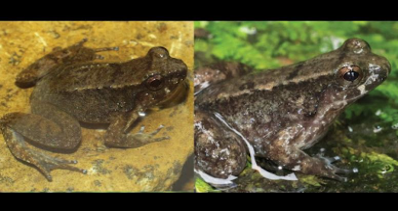
- The new species was found in the canopy-covered streams of the Garo and Khasi Hills in Meghalaya.
- Its habitat represents the westernmost known range of any species in the genus Ingerana.
How was it identified
- Compared the physical characteristics and DNA of frog populations found on opposite sides of the Brahmaputra River.
- Revealed an 18% difference in DNA between the southern frogs and the topotypic Ingerana borealis populations north of the river.
About Ingerana occidens
- Adult females reach about 26 millimetres in length.
- Features mostly smooth skin with only mild wrinkling.
- Possesses a distinct contrasting stripe along its side.
- Has a clearly visible protruding eardrum, known as a tympanum, topped by a strong fold of skin.
- Differs from its northern relative, which is more heavily wrinkled and has nearly invisible eardrums.