
![Viksit Bharat – Guarantee for Rozgar and Aajeevika Mission (Gramin) [VB-G RAM G] Act, 2025](https://currentaffairs.khanglobalstudies.com/wp-content/uploads/2026/07/1.png)
SYLLABUS
GS-2: Government policies and interventions for development in various sectors and issues arising out of their design and implementation.
GS-3: Indian Economy and issues relating to planning, mobilization of resources, growth, development and employment.
Context: The Viksit Bharat – Guarantee for Rozgar and Aajeevika Mission (Gramin) [VB-G RAM G] Act, 2025 came into force across India on 1 July 2026, replacing MGNREGA and expanding the statutory rural employment guarantee from 100 days to 125 days.
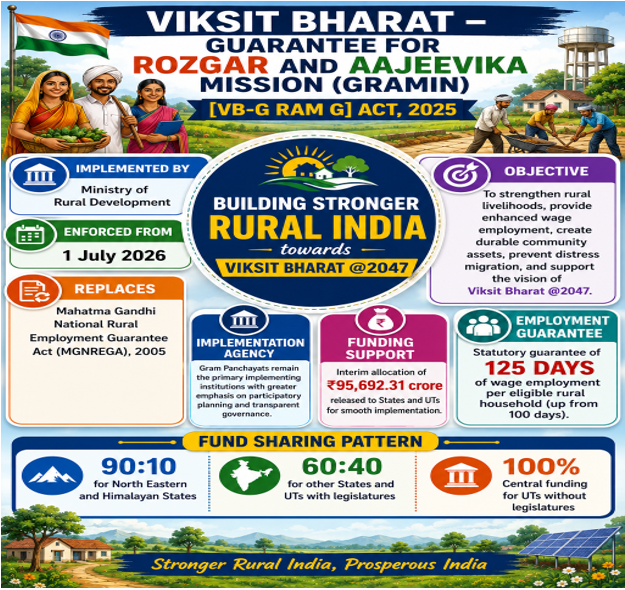
Key Features of the Act
• Enhanced Employment Guarantee: Statutory wage employment increased from 100 days to 125 days for every eligible rural household.
- Employment must be provided within 15 days of demand, failing which workers are entitled to unemployment allowance.
• Wage Payment and Compensation: Wages will continue through Direct Benefit Transfer (DBT) into bank or post office accounts.
- Payments must be made weekly or within 15 days after closure of the muster roll.
- Workers will receive delay compensation if wages are not paid on time.
• Unemployment Allowance: If employment is not provided within the stipulated period:
- Workers receive at least one-fourth of the wage rate for the first 30 days.
- At least one-half of the wage rate for the remaining period.
• National Wage Floor Introduced: A minimum wage of ₹300 per day has been notified across all States and UTs.
- National average wage increased to ₹327.4/day from ₹298.8/day.
• State-wise Wage Revision: Significant wage hikes (15–25%) in several historically low-wage States such as Uttar Pradesh, Bihar, Jharkhand, West Bengal, Assam, Arunachal Pradesh and Himachal Pradesh.
- Highest notified wage: ₹450/day in selected high-altitude Gram Panchayats of Sikkim and Haryana (₹409), Goa (₹406) and Kerala (₹401) among major States.
• Seamless Transition: Existing e-KYC verified job cards remain valid until new Gramin Rozgar Guarantee Cards are issued.
- Ongoing works continue without interruption.
• Timely Employment & Wage Payment: Employment to be provided within the prescribed period after demand.
- Transparent and technology-enabled wage payments.
- Face-recognition/mobile-based attendance continues for greater accountability.
• Gram Panchayat-Centric Implementation: Greater focus on:
- Natural resource management
- Water conservation
- Agriculture and allied activities
- Rural infrastructure
- Women’s empowerment through Self-Help Groups (SHGs)
- Convergence with flagship rural development programmes
• Technology-enabled Governance: Digital implementation through the VB-G RAM G software platform.
- Greater transparency through digital monitoring, e-KYC, and electronic records.
• Agriculture-friendly Design: Provision for identifying peak agricultural seasons (crop holidays) to avoid labour shortages during sowing and harvesting periods.
Significance of the Act
• Strengthens rural livelihood security by increasing the statutory employment guarantee to 125 days.
• Raises rural incomes through higher wage rates and a nationwide minimum wage floor of ₹300 per day.
• Creates durable rural assets by focusing on water conservation, natural resource management, agriculture, and rural infrastructure.
• Promotes women-led rural development through stronger integration of Self-Help Groups and livelihood initiatives.
• Improves transparency and efficiency through digital governance, e-KYC, software-based monitoring, and technology-enabled implementation.
• Supports sustainable rural development by encouraging participatory planning and convergence with other flagship programmes.
• Contributes to the vision of Viksit Bharat @2047 by fostering self-reliant, resilient, and prosperous rural communities.