
SYLLABUS
GS-2: Regional Groupings and Agreements involving India and/or affecting India’s interests.
GS-3: Issues of Buffer Stocks and Food Security; Conservation.
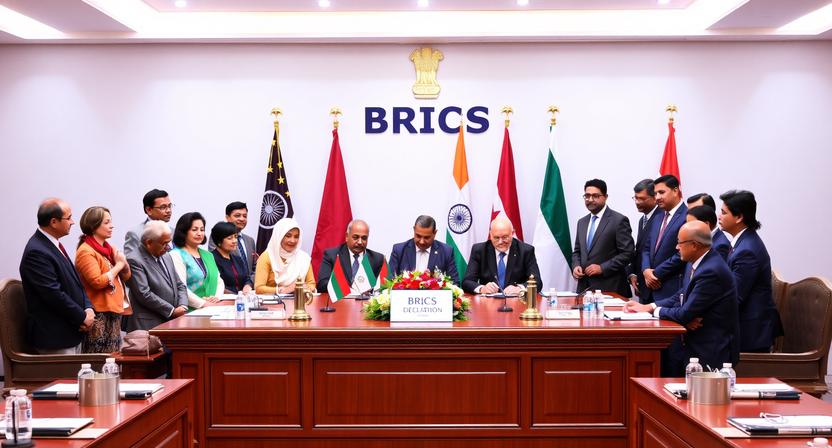
Context: The BRICS Indore Declaration was adopted at the 16th BRICS Agriculture Ministers’ Meeting held in Indore, Madhya Pradesh, under India’s BRICS Chairship 2026.
More on the News
- The Declaration was adopted against the backdrop of growing concerns relating to Food insecurity, Climate change, Supply-chain disruptions, and Geopolitical uncertainties affecting global agricultural systems.
- The Declaration is built around four key priorities:
- Farmers – improving farmers’ livelihoods, welfare, and access to innovation.
- Food Security – strengthening resilient and sustainable food systems.
- Climate – promoting climate-resilient and sustainable agricultural practices.
- Technology – leveraging digital technologies and innovation for agricultural transformation.
- The Declaration seeks to strengthen cooperation among BRICS countries in addressing food and nutrition security challenges, climate change, technological transformation, and sustainable agricultural development.
Key Highlights of the Declaration
- The Declaration supported continued discussions on establishing a BRICS Grain Exchange to improve market transparency, trade cooperation, and food-security coordination among member countries.
- It emphasised climate-resilient and sustainable agriculture, including cooperation on resource-efficient farming practices, adaptation strategies, and resilient food systems.
- It recognised the growing importance of digital technologies, innovation, and research collaboration in transforming agriculture and improving farmer welfare.
- It reaffirmed commitment to strengthening agricultural value chains, agri-food systems, food security, nutrition security, and South-South cooperation among BRICS countries.
Four New Institutional Initiatives
To operationalise the Declaration’s priorities, BRICS countries agreed to advance four key institutional initiatives:
- Centres of Excellence on Agro-Ecology and Regenerative Agriculture
- To promote sustainable, climate-resilient, and environmentally responsible agricultural practices.
- To facilitate research, capacity building, and exchange of best practices on agro-ecology and regenerative agriculture among BRICS countries.
- BRICS Network on Digital Agriculture
- To facilitate cooperation in digital agriculture, precision farming, Artificial Intelligence (AI), and data-driven agricultural solutions.
- To promote the exchange of technological innovations, digital tools, and best practices for enhancing agricultural productivity and efficiency.
- BRICS AgriN – Agro Input, Genetic Resources and Information Network
- To strengthen collaborative agricultural research, innovation, knowledge exchange, and technology transfer.
- India will coordinate the network, facilitating greater cooperation among research institutions across BRICS countries.
- Global Forum on Farmers’ Rights in Seed Systems
- To promote dialogue on farmers’ seed rights, seed sovereignty, and conservation of agricultural biodiversity.
- India will play a leading role in advancing discussions and cooperation under this initiative.
About the BRICS Agriculture Ministers’ Meeting
- The BRICS Agriculture Ministers’ Meeting is a sectoral cooperation mechanism that brings together member countries to discuss issues relating to:
- Agriculture,
- Food security,
- Rural development,
- Agricultural trade,
- Research and innovation.
- It serves as a platform for promoting South-South cooperation, sharing best practices, and coordinating efforts to address common agricultural challenges among BRICS countries.