

SYLLABUS
GS-3: Indian Economy and issues relating to planning, mobilization of resources, growth, development and employment.
Context: The Government of India has extended the validity of the Credit Guarantee Scheme for Microfinance Institutions-2.0 (CGSMFI-2.0) until 31 August 2026, or until guarantees worth ₹20,000 crore are issued, whichever is earlier.
About the Credit Guarantee Scheme for Microfinance Institutions-2.0 (CGSMFI-2.0)
- Introduced by the Central Government on 20 March 2026.
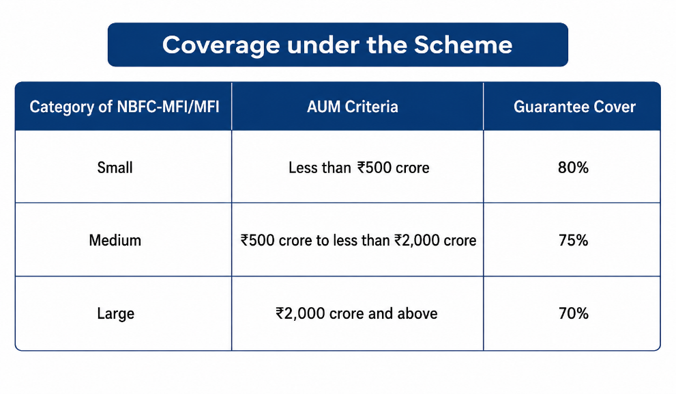
- Aims to provide credit guarantee support to Banks and Financial Institutions (FIs) for loans extended to NBFC-MFIs and MFIs for onward lending to small borrowers.
- The guarantee cover is provided through the National Credit Guarantee Trustee Company Limited (NCGTC).
- Target Beneficiaries: Existing and new small borrowers falling within the RBI’s regulatory definition of microfinance.
- Loans are channelled through Non-Banking Financial Company-Microfinance Institutions (NBFC-MFIs) and Microfinance Institutions (MFIs).
- Key Features:
- Total guarantee corpus: ₹20,000 crore.
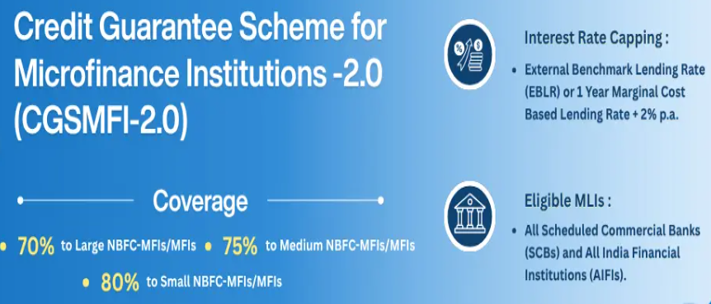
- Interest rate on loans by Member Lending Institutions (MLIs) capped at EBLR/MCLR + 2% per annum.
- MFIs/NBFC-MFIs must lend to final borrowers at an interest rate at least 1% below their average lending rate of the previous six months.
- Guarantee fee: 0.5% per annum on the sanctioned amount in the first year and on the outstanding amount thereafter.
- Maximum loan tenure: 3 years (1-year moratorium + 2 years repayment).
- Funds must be used for the creation of fresh microfinance loan assets within three months of disbursement.
- Recent Changes:
- Scheme validity extended till 31 August 2026 or issuance of guarantees worth ₹20,000 crore.
- Maximum loan amount for large-sized NBFC-MFIs/MFIs increased from ₹300 crore to ₹1,000 crore, subject to the overall ceiling of 20% of AUM.
- As of now, loans worth ₹770 crore have been sanctioned under the scheme.
Significance of the Scheme
- Enhances Credit Flow to the Microfinance Sector: Encourages banks and financial institutions to lend to MFIs by reducing credit risk through government-backed guarantees.
- Supports Financial Inclusion: Expands access to formal credit for low-income households, small borrowers, and underserved sections of society.
- Reduces Lending Risk: Guarantee cover of up to 80% protects lenders against expected losses and promotes greater participation in microfinance lending.
- Strengthens NBFC-MFIs and MFIs: Improved access to institutional funding enhances the lending capacity of microfinance institutions.
- Promotes Affordable Credit: Interest-rate caps ensure that the benefits of lower-cost funding are passed on to small borrowers.
- Boosts Rural and Micro-Enterprise Development: Facilitates credit access for self-employed individuals, micro-enterprises, women entrepreneurs, and rural households, supporting livelihood generation and economic activity.
- Improves Scheme Utilisation: The extension of validity and higher loan cap for large institutions are expected to improve uptake of the scheme and accelerate disbursement of the remaining guarantee corpus.