
SYLLABUS
GS-2: Government policies and interventions for development in various sectors and issues arising out of their design and implementation; Structure, organization and functioning of the Judiciary.
Context: The Supreme Court has directed the Union Government and the Central Board of Secondary Education (CBSE) to strengthen safeguards governing children’s personal data under the Automated Permanent Academic Account Registry (APAAR) scheme, reiterating that enrolment must remain voluntary and based on informed parental consent.
More on the News
- The Supreme Court, in Abhishek Baxi v. Union of India (2026), extended the safeguards prescribed by the Orissa High Court to all States and Union Territories and directed the Ministry of Education to amend the model APAAR consent form.
- It mandated an explicit ‘opt-out/refusal’ option, ensuring that parents or guardians can withhold their child’s Aadhaar details or decline APAAR enrolment without any adverse consequences.
- The Court directed that the collection, processing, storage, retention, use and sharing of children’s personal data, including Aadhaar information, must strictly comply with the Digital Personal Data Protection (DPDP) Act, 2023, and that such data should not be shared with third parties except in accordance with law.
- While disposing of the petitions challenging the APAAR scheme, the Court focused on strengthening procedural safeguards for consent and data protection, without adjudicating upon the constitutional validity of the scheme.
About APAAR
- APAAR (Automated Permanent Academic Account Registry) is a 12-digit unique lifelong student identifier developed under the ‘One Nation, One Student ID’ initiative.
- It serves as a digital academic identity (academic passport) for every learner, creating a unified academic profile throughout the educational journey.
- It integrates verified academic records across school education, higher education, skill development and lifelong learning, ensuring seamless continuity and mobility.
- Each APAAR ID is linked with the learner’s DigiLocker and Academic Bank of Credits (ABC) account, enabling secure storage, retrieval and sharing of academic credentials.
- It supports the objectives of the National Education Policy (NEP) 2020 by promoting secure, portable and verifiable academic records and facilitating flexible learning pathways.
Key Directions of the Supreme Court
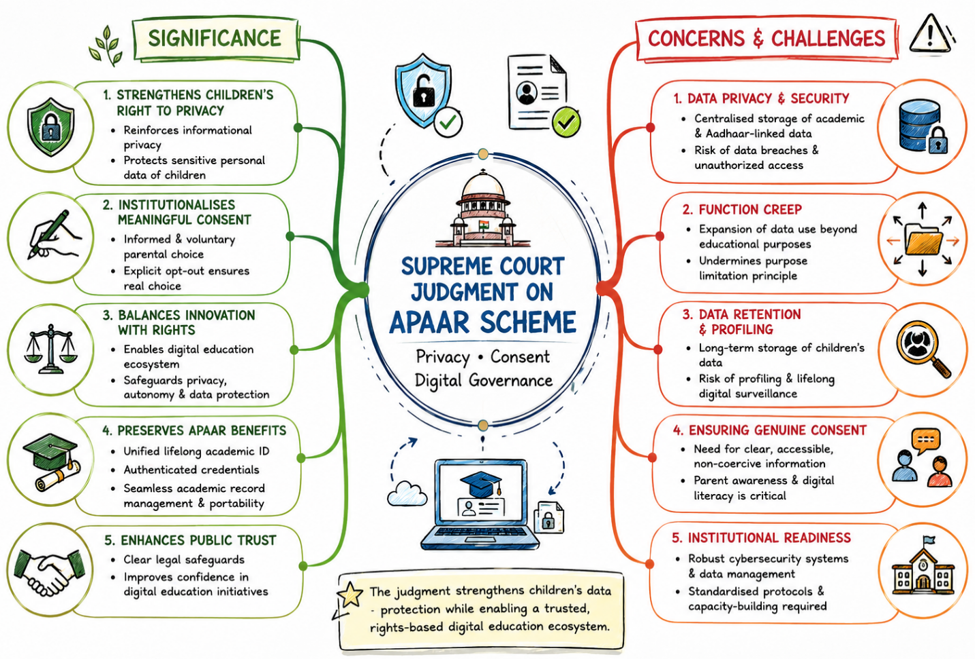
- Voluntary Enrolment: APAAR enrolment cannot be made compulsory; parents or guardians must have the freedom to refuse or opt out.
- Meaningful Informed Consent: The model consent form must provide a clear opt-out/refusal option, ensuring that parental consent is free, informed and unambiguous.
- Protection of Children’s Data: Aadhaar and other personal information of children shall not be shared with third parties except in accordance with law.
- Compliance with DPDP Act, 2023: The collection, processing, storage, retention, use and sharing of children’s personal data must comply with the provisions of the Digital Personal Data Protection Act, 2023.
- Nationwide Applicability: The safeguards directed by the Orissa High Court shall be implemented across all States and Union Territories.
Way Forward
- Strengthen the Consent Framework: Ensure informed, multilingual consent with a clear opt-out mechanism in line with the Supreme Court’s directions.
- Adopt Privacy-by-Design: Embed data minimisation, purpose limitation, encryption and secure data management in compliance with the DPDP Act, 2023.
- Enhance Institutional Capacity: Standardise implementation protocols, strengthen cybersecurity and build capacity across educational institutions.
- Strengthen Governance & Oversight: Establish periodic audits, effective grievance redressal and independent oversight to ensure accountability and public trust.