
SYLLABUS
GS-1 Prelims: Current events of national and international importance.
GS-3: Conservation, Environmental Pollution and Degradation.
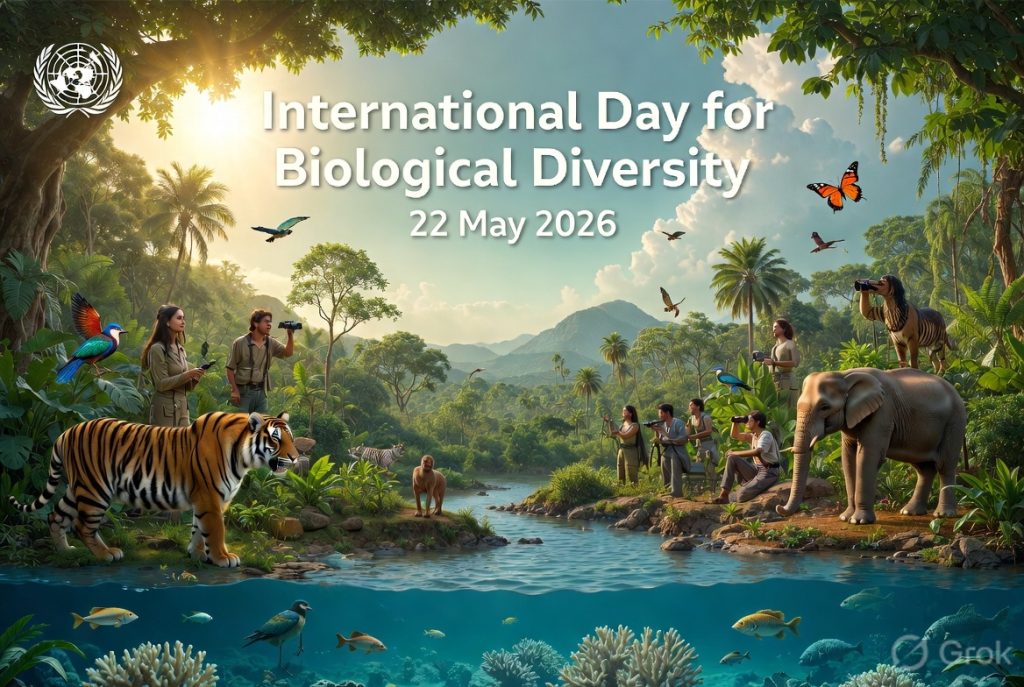
Context: Recently, the International Day for Biological Diversity (IDB) was observed on 22 May 2026.
About the International Day for Biological Diversity
- The International Day for Biological Diversity is observed annually on 22 May to promote awareness and action for the conservation and sustainable use of biodiversity.
- The day commemorates the adoption of the text of the Convention on Biological Diversity (CBD) on 22 May 1992 during the Nairobi Conference.
- It was proclaimed by the United Nations General Assembly in 2000 and is coordinated by the Secretariat of the Convention on Biological Diversity.
- The theme for the 2026 edition was “Acting locally for global impact”, emphasising the importance of local and community-led actions in achieving global biodiversity goals.
About the Convention on Biological Diversity (CBD)
- The Convention on Biological Diversity (CBD) is a legally binding international treaty adopted at the 1992 Rio Earth Summit for the conservation of biodiversity, sustainable use of biological resources, and fair and equitable sharing of benefits arising from genetic resources.
- The Convention entered into force in 1993 and currently has 196 Parties, making it one of the most widely supported international environmental agreements.
- The Conference of the Parties (COP) is the supreme decision-making body of the CBD, while its headquarters are located in Montreal, Canada.
- The CBD COP-15 adopted the Kunming–Montreal Global Biodiversity Framework (KMGBF) in 2022, which provides a global roadmap for biodiversity conservation till 2030 and the vision of “Living in Harmony with Nature” by 2050.
- The KMGBF establishes:
- 4 long-term global goals for 2050,
- 23 global targets for 2030, including the “30×30 target” for conserving 30% of global land and marine areas, ecosystem restoration, reduction of pollution, and halting species extinction.
India’s Biodiversity Conservation Efforts
- India recently submitted its 7th National Report to the CBD, assessing progress toward the 2030 biodiversity targets under the KMGBF.
- India has updated its National Biodiversity Strategy and Action Plan (NBSAP) and formulated 23 National Biodiversity Targets supported by 142 monitoring indicators.
- India’s forest and tree cover currently stands at 8,27,357 sq km (25.17% of geographical area), with an increase of 1,445 sq km between 2021 and 2023.
- Under the Bonn Challenge, India has pledged to restore 26 million hectares of degraded land by 2030, of which around 24.1 million hectares have already been restored or are under restoration.
- India continues to promote ecosystem restoration, sustainable lifestyles through LiFE (Lifestyle for Environment), mangrove conservation, agroforestry, and community-led biodiversity governance.