
SYLLABUS
GS-1: Indian Culture – Salient aspects of Art Forms, Literature and Architecture from ancient to modern times.
GS-2: Indian Constitution—Amendments, and Significant Provisions.
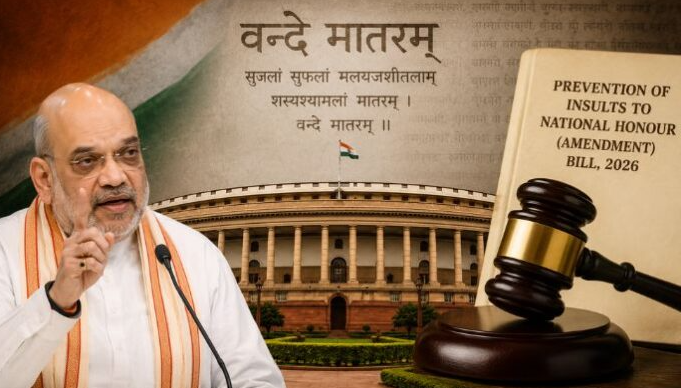
Context: The Government has introduced the Prevention of Insults to National Honour (Amendment) Bill, 2026 in the Rajya Sabha to amend the Prevention of Insults to National Honour Act, 1971.
More on the News
• The Bill seeks to extend the statutory protection to Vande Mataram, India’s National Song and seeks to place Vande Mataram on a legal footing similar to that of Jana Gana Mana (National Anthem) by bringing it within the ambit of the Act.
• The Bill follows the Government’s year-long commemoration of the 150th anniversary of Vande Mataram, recognising its historical role in India’s freedom struggle.
About Vande Mataram
• Origin: Vande Mataram was composed by Bankim Chandra Chattopadhyay in the 1870s, first published in the journal Bangadarshan (1875), and later incorporated into his novel Anandamath (1882).
• Freedom Movement: It was first sung at the 1896 session of the Indian National Congress by Rabindranath Tagore and emerged as a powerful symbol of anti-colonial nationalism during the Swadeshi Movement (1905).
• National Song: In 1937, the Indian National Congress resolved to use only the first two stanzas during its official functions, as later stanzas contained devotional references that some communities considered exclusionary.
• On 24 January 1950, the Constituent Assembly recognised Vande Mataram as the National Song while adopting Jana Gana Mana as the National Anthem, with both being accorded equal honour.
• Constitutional Position: Unlike the National Anthem, Vande Mataram has not been expressly covered under the Prevention of Insults to National Honour Act, 1971. The present Bill seeks to address this legislative gap.
About the Prevention of Insults to National Honour Act, 1971
• The Act was enacted to preserve the dignity of India’s key national symbols by prohibiting acts of disrespect towards:
- The National Flag
- The Constitution of India
- The National Anthem
• The Act currently contains:
- Section 2: Penalises insults to the National Flag and the Constitution.
- Section 3: Penalises intentionally preventing the singing of the National Anthem or causing disturbance to an assembly engaged in such singing.
• The punishment under Section 3 may extend to three years’ imprisonment, or fine, or both, with a minimum imprisonment of one year for second and subsequent convictions.
Key Provisions of the Amendment Bill
• Extends Section 3 to the National Song: The Bill expands the scope of Section 3 of the Prevention of Insults to National Honour Act, 1971, to include Vande Mataram, thereby extending to it the same statutory protection currently available to the National Anthem.
• Punishable Acts: It criminalises:
- intentionally preventing the singing of Vande Mataram; or
- causing disturbance to an assembly engaged in singing the National Song.
• Same Penal Provisions: Offences relating to the National Song will attract the same punishment, including the enhanced penalty for repeat offenders, as prescribed under Section 3 of the Act.
• Parity with National Anthem: The amendment places the National Song on the same legal footing as the National Anthem with respect to offences relating to disruption or obstruction during its rendition.
Concerns & Constitutional Issues
• Conflict with Fundamental Rights: Criminalising acts related to the National Song may raise constitutional concerns regarding freedom of speech and expression under Article 19(1)(a) and freedom of religion and conscience under Article 25, particularly where refusal to sing is based on genuine religious beliefs.
• Judicial Precedent: In Bijoe Emmanuel v. State of Kerala (1986), the Supreme Court held that citizens cannot be compelled to sing the National Anthem if their refusal is based on a genuine religious belief, provided they show due respect. Similar constitutional questions may arise regarding the National Song.
• Definitional Ambiguity: Terms such as “disturbance” or “intentional prevention” require careful interpretation to avoid arbitrary enforcement and ensure legal certainty.
• Balancing Patriotism and Liberty: While respect for national symbols is a constitutional value under Article 51A(a), criminal sanctions must remain proportionate and consistent with fundamental rights.
Way Forward: Balancing National Honour with Constitutional Freedoms
• Provide Legal Clarity: Clearly define terms such as intentional prevention and disturbance to minimise ambiguity and prevent arbitrary enforcement.
• Promote Civic Awareness: Public awareness programmes highlighting the historical and cultural significance of Vande Mataram can encourage voluntary respect rather than relying solely on penal measures.
• Adopt a Balanced Approach: Respect for national symbols should be reinforced through a combination of legal safeguards, constitutional values and civic education, thus preserving both national honour and democratic freedoms.