SYLLABUS
GS-2: Indian Constitution—Significant Provisions; Functions and Responsibilities of the Union and the States, Issues and Challenges Pertaining to the Federal Structure; Statutory, Regulatory and various Quasi-judicial Bodies.
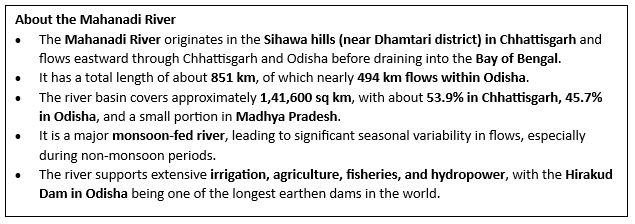
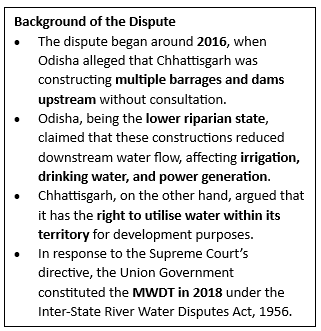
Context: The long-standing dispute between Odisha and Chhattisgarh over the sharing of waters of the Mahanadi River has recently intensified, with the Mahanadi Water Disputes Tribunal (MWDT) issuing a final opportunity to both states for amicable resolution.
More on the News
- The MWDT has given both states a final deadline (May 2026) to arrive at a mutually acceptable settlement, failing which it will deliver a binding verdict.
- The tribunal has also criticised both states for repeated delays and adjournments, emphasising the need for cooperation and timely resolution.
- Despite earlier indications of an amicable settlement, both states have been unable to agree on a water-sharing formula, bringing the dispute closer to final adjudication.
- The Centre has extended the tribunal’s tenure to allow additional time for resolution, reflecting the complexity of the issue.
Key Issues in the Dispute
- Upstream–Downstream Conflict: Odisha contends that upstream projects reduce water flow during non-monsoon periods, while Chhattisgarh asserts its right to utilise water within its territory for development needs.
- Water Availability and Utilisation Disputes: Disagreement persists over mean annual flow (MAF), current usage, and future demand projections, which are critical for determining equitable water sharing.
- Data Sharing and Trust Deficit: Lack of credible and mutually accepted hydrological data has stalled negotiations, reflecting a deep trust deficit between the states.
- Federal and Governance Challenges: The prolonged nature of the dispute highlights issues of delayed adjudication, coordination failures, and implementation uncertainty, even after tribunal awards.
Legal and Institutional Framework for Inter-State River Water Disputes
- Constitutional Provisions
- Under Article 262, Parliament is empowered to adjudicate inter-state river water disputes and may exclude the jurisdiction of courts in such matters.
- Under it, the Parliament has enacted the Inter-State River Water Disputes (ISWD) Act, 1956.
- Inter-State River Water Disputes Act, 1956
- The Act provides for the constitution of ad-hoc tribunals such as the MWDT to resolve disputes between states.
- Tribunal awards are final and binding, and under Article 262(2) and Section 11 of the Act, the jurisdiction of the Supreme Court and High Courts is barred.
- Although a permanent tribunal mechanism was proposed in theInter-State River Water Disputes (Amendment) Bill, 2019, the bill got lapsed in 2024 with the dissolution of the 17th Lok Sabha, and thus the existing system of case-specific tribunals continues.