

FIU-India, I4C Sign MoU for Fight Against Cyber Fraud and Financial Crimes
Context: In a significant step towards strengthening India’s fight against cyber-frauds and financial crimes, the Financial Intelligence Unit-India (FIU-IND) and the Indian Cyber Crime Coordination Centre (I4C) signed a comprehensive Memorandum of Understanding (MoU) to enhance information sharing and coordination.
Key Highlights of MoU
- The MoU establishes a framework for enhanced information sharing and coordination between FIU-IND and I4C to tackle cyber fraud more effectively.
- It aims to develop operational intelligence and support investigative agencies in preventing financial crimes, protecting digital transactions, and enabling asset recovery.
- The agreement provides for robust feedback mechanisms to strengthen fraud detection protocols at the national level.
About Financial Intelligence Unit-India (FIU-IND)
- Established in November 2004 under the Ministry of Finance, FIU-IND is the central national agency responsible for receiving, analysing, and disseminating information related to suspicious financial transactions.
- It plays a key role in combating money laundering and financing of terrorism by coordinating with domestic and international agencies.
- The unit also acts as a repository of financial intelligence and supports enforcement agencies in financial investigations.
About Indian Cyber Crime Coordination Centre (I4C)
- Launched in 2020 by the Ministry of Home Affairs under the Indian Cyber Crime Ecosystem (ICCE), I4C serves as a national hub for cybercrime coordination, reporting, and response.
- It facilitates real-time intelligence sharing and coordination among law enforcement agencies, banks, and financial institutions through platforms such as the National Cybercrime Reporting Portal.
- The Centre also focuses on capacity building, research, and technological support to strengthen India’s cybercrime response ecosystem.
Exercise Cyclone-IV
Context: The Indian Army contingent is participating in the Exercise Cyclone-IV, which is currently being held at Anshas, Egypt, from 9 to 17 April 2026.
About Exercise Cyclone-IV
- The Exercise Cyclone-IV is the fourth edition of the joint military exercise between the Special Forces of India and Egypt.
- The exercise is a continuation of the growing military cooperation between India and Egypt and follows the successful conduct of the third edition (Cyclone-III) hosted in India at Mahajan Field Firing Ranges.
- The exercise aims to enhance joint mission planning capabilities and improve interoperability through the exchange of best practices in special operations.
- The participating troops will undertake a series of training activities focused on special operational tactics, techniques and procedures in desert and semi-desert terrain.
World Health Day 2026
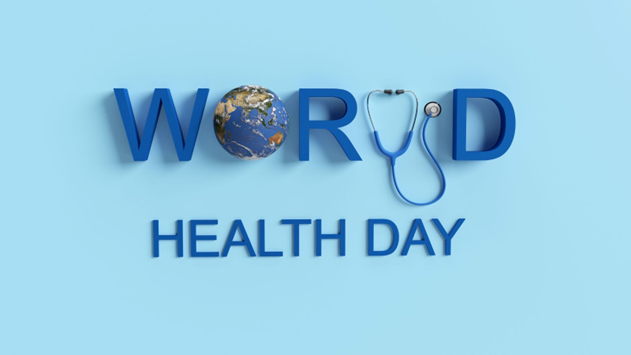
Context: World Health Day 2026, observed on 7 April, is being marked under the theme “Together for health. Stand with science”, highlighting the importance of scientific evidence and collaboration in improving global health outcomes.
More on the News
- The campaign launches a year-long global initiative promoting science-driven solutions and strengthening trust in public health through the One Health approach, integrating human, animal, plant, and environmental health.
- It emphasizes scientific collaboration and multilateral partnerships, highlighted by key events such as the International One Health Summit (France, 7 April) and the Global Forum of WHO Collaborating Centres (7–9 April), involving ~800 institutions from 80+ countries.
- The campaign urges stakeholders to engage with evidence-based knowledge, rebuild trust in science, and support science-led solutions, while encouraging public participation through global awareness initiatives.
- It also encourages global participation through awareness activities, storytelling, and digital engagement using hashtags like #StandWithScience and #WorldHealthDay.
About World Health Day
- World Health Day is celebrated annually on 7 April to draw global attention to pressing health issues affecting people worldwide.
- The date marks the founding of the World Health Organization (WHO) in 1948, following the decision taken during the First World Health Assembly.
- The observance aims to promote better health standards, awareness, and international cooperation, aligning with the broader goals of the United Nations to ensure improved living conditions, global well-being, and health security for all.
World Homoeopathy Day 2026
Context: World Homoeopathy Day 2026 was observed on 10 April to commemorate the birth anniversary of Samuel Hahnemann, the founder of Homoeopathy.
More on the News
- The theme for 2026 is “Homoeopathy for Sustainable Health”, focusing on promoting holistic, affordable, and patient-centric healthcare.
- The campaign stresses evidence-based expansion, scientific research, and interdisciplinary collaboration to enhance global credibility and effectiveness of homoeopathy.
- India has one of the largest homoeopathy ecosystems, with over 3.45 lakh practitioners, ~300 institutions, and extensive research infrastructure, supporting its integration into public healthcare.
- Key initiatives include strengthening the AYUSH ecosystem through digital platforms (Ayush Grid), improved training, regulatory reforms, and research-based validation.
- New digital tools, certification courses, and research publications were launched to improve accessibility, knowledge dissemination, and quality standards in homoeopathy.
About World Homoeopathy Day
- World Homeopathy Day is celebrated annually to honour the work of German physician and chemist Dr Samuel Hahnemann on his birth anniversary – April 10.
- Dr Samuel Hahnemann is famously known as the founder of homoeopathy.
- In 1997, the Government of India declared April 10th as World Homoeopathy Day to honour Dr Hahnemann’s remarkable contributions to the field of medicine.
- Since then, this day has been observed annually.
- It serves as a platform to promote awareness about homoeopathy’s gentle, non-invasive approach to healing and its potential to address a wide range of health conditions.
What Is Homeopathy?
- Homoeopathy, also known as homoeopathic medicine, is a medical system that was developed in Germany more than 200 years ago.
- Homoeopathy is a holistic system of medicine that uses highly diluted natural substances to stimulate the body’s self-healing mechanisms and focuses on treating the individual rather than just the disease.
- It’s based on two unconventional theories:
- “Like cures like”—the notion that a disease can be cured by a substance that produces similar symptoms in healthy people.
- “Law of minimum dose”—the notion that the lower the dose of the medication, the greater its effectiveness. Many homoeopathic products are so diluted that no molecules of the original substance remain.
Poshan Pakhwada 2026
Context: Recently, the Government of India launched POSHAN Abhiyaan, aiming to improve nutritional outcomes for women and children through a comprehensive and convergence-based approach.
More on the News
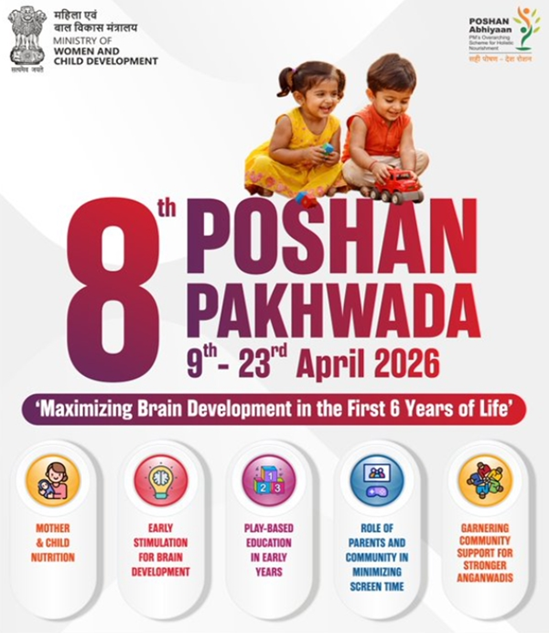
- As part of this larger mission, Poshan Pakhwada 2026 (8th edition) is being observed from April 9 to April 23, 2026, with the theme “Maximizing Brain Development in the First Six Years of Life.”
- The initiative reflects the government’s continued push to transform nutrition into a Jan Andolan (people’s movement) involving communities, institutions, and families.
- The campaign is being led by the Ministry of Women and Child Development, with participation from multiple ministries, States/UTs, and grassroots institutions like Anganwadi Centres.
About the Poshan Pakhwada
- It is an annual nutrition awareness and community mobilization campaign under POSHAN Abhiyaan, designed to intensify efforts toward improving nutritional indicators across the country.
- It serves as a platform for awareness, behavioural change, and community participation in tackling malnutrition.
- The 2026 theme emphasizes that early childhood, especially the first 1,000 days (from conception to 2 years), is the most critical period for brain development, physical growth, and lifelong health outcomes.
- Scientific evidence highlights that over 85% of brain development occurs by the age of six, making early nutrition, care, and stimulation crucial.
Significance
- Critical Window of Development: The emphasis on the first 1,000 days recognises this period as a “magic window” where proper nutrition, healthcare, and emotional care shape lifelong physical and mental well-being.
- Holistic Approach to Nutrition: The initiative goes beyond food intake by integrating nutrition, healthcare, early learning, and caregiving, ensuring comprehensive child development rather than isolated interventions.
- Technology-Driven Governance: Digital tools like Poshan Tracker enable real-time monitoring of beneficiaries, improving transparency, efficiency, and evidence-based policymaking.
- Addressing Dual Burden of Malnutrition: The campaign tackles both undernutrition (stunting, anemia) and emerging issues like childhood obesity, promoting balanced diets and healthy lifestyles.
Arogya Van’ Initiative
Context: The National Highways Authority of India (NHAI) has launched a new initiative titled ‘Arogya Van’ to integrate ecological sustainability into National Highway development.
About the ‘Arogya Van’ Initiative
- The ‘Arogya Van’ initiative involves the development of thematic medicinal tree plantations on vacant land parcels along National Highways, aimed at strengthening ecosystem resilience.
- In the first phase, an action plan has been formulated covering 17 land parcels across 62.8 hectares, where around 67,462 medicinal trees will be planted across states such as Madhya Pradesh, Haryana, Delhi-NCR, Andhra Pradesh, Gujarat, Karnataka, Odisha, Tamil Nadu, Rajasthan, Maharashtra and Chhattisgarh.
- Nearly 36 medicinal tree species—including Neem, Amla, Jamun, Imli, Lemon, Gular and Maulsari—have been identified and will be planted according to agro-climatic suitability.
- The plantations will be prioritized near toll plazas, wayside amenities, interchanges and major highway stretches to maximize visibility and public outreach.
- Additionally, around 188 hectares of vacant land has been earmarked for plantation during the monsoon season to ensure higher survival rates and long-term sustainability.
- The initiative also aligns with the government’s efforts to promote traditional systems of medicine such as Ayurveda, while conserving indigenous medicinal flora.
Significance
- Biodiversity Enhancement: The plantation of medicinal species strengthens roadside ecosystems by supporting pollinators, birds and microfauna, thereby improving ecological resilience.
- Creation of Green Corridors: The initiative transforms National Highways into green corridors that integrate infrastructure development with environmental conservation.
- Promotion of Traditional Medicine: By focusing on medicinal plants, the programme promotes Ayurveda and preserves India’s traditional knowledge systems.
- Educational and Awareness Value: The plantations act as living repositories that increase public awareness about medicinal plants and their relevance in modern life.