

SYLLABUS
GS-3: Achievements of Indians in science & technology; indigenization of technology and developing new technology and awareness in the fields of IT and Computers.
Context: Under the National Quantum Mission (NQM), India has successfully demonstrated a 1,000 km quantum communication network within two years of launch.
More on the News
- This milestone has been achieved ahead of schedule against the target of 2,000 km secure quantum communication over 8 years.
- The network is based on Quantum Key Distribution (QKD) and developed using indigenous technology by QNu Labs.
- The 1,000 km network is among the longest QKD deployments globally, marking a landmark advancement in secure quantum communication.
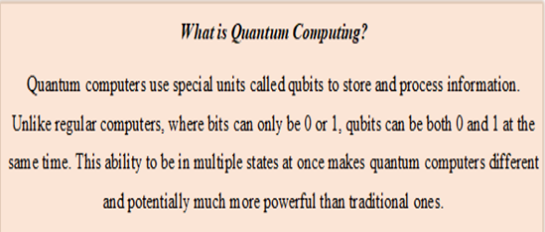
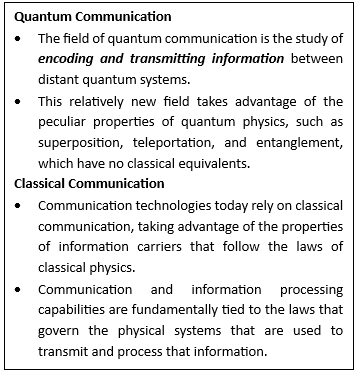
- It enables data transmission using quantum principles, replacing classical binary systems (0s and 1s).
Significance
- Strengthens secure communication infrastructure for defence, financial systems, and critical sectors.
- Demonstrates rapid progress in indigenous quantum capability, reducing dependence on foreign technologies.
- Enhances India’s position in the global quantum technology race.
- Contributes to building a secure digital ecosystem against cyber threats.
- Expanding startup participation and R&D funding reflects growing industry interest and ecosystem development.
About the National Quantum Mission (NQM)
- It was approved by the Union Cabinet on 19 April 2023 with a financial outlay of ₹6003.65 crore for the period 2023–24 to 2030–31.
- It is one of the nine initiatives under the Prime Minister’s Science, Technology and Innovation Advisory Council (PMSTIAC).
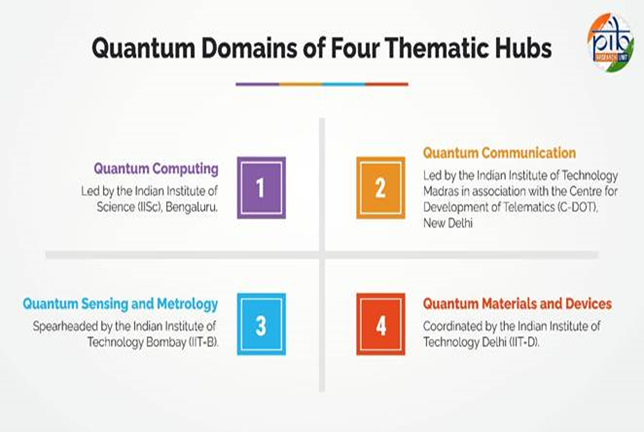
- It focuses on advancing quantum computing, communication, sensing, and materials.
- The mission aims to seed, nurture, and scale quantum technologies in the country while fostering a vibrant ecosystem of R&D, startups, and skilled human resources.
- It seeks to accelerate quantum-led economic growth, enhance technological self-reliance, and position India at the forefront of next-generation technologies.
- Core Objectives:
- Quantum Computing Development: Build quantum computers with 20–50 qubits (3 years), 50–100 qubits (5 years), and up to 1000 qubits (8 years) across superconducting and photonic platforms.
- Satellite-Based Quantum Communication: Enable quantum-secured communication over 2000 km and expand for international connectivity.
- Inter-City QKD Network: Develop 2000 km quantum communication networks using optical fibre infrastructure with trusted nodes.
- Multi-Node Quantum Networks: Establish scalable quantum networks (2–3 nodes) using entanglement swapping and quantum repeaters.
- Quantum Sensing & Atomic Clocks: Develop ultra-sensitive sensors and high-precision clocks for navigation, communication, and defence applications.
- Quantum Materials & Devices: Develop advanced materials like superconductors and topological materials for quantum devices and photon systems.
- Implementation Strategy:
- Four Thematic Hubs (T-Hubs) have been established across India.
- These hubs bring together 14 Technical Groups across 17 states and 2 Union Territories.
- Focus areas include technology innovation, skill development, entrepreneurship, industry partnerships, and global collaborations.
- Participation of women scientists is actively encouraged.
- Hub-Spoke-Spike Model: Each T-Hub follows a Hub-Spoke-Spike structure.
- Hubs: Central institutions coordinating research.
- Spokes: Thematic research projects.
- Spikes: Individual research groups.
Initiatives under the National Quantum Mission (NQM)
- Quantum-Safe Ecosystem Framework: A concept paper outlines a strategic roadmap to secure India’s digital infrastructure against quantum threats.
- Defence Research and Development Organisation (DRDO): DRDO is developing and testing quantum-resilient security schemes along with quantum-safe symmetric and asymmetric cryptographic algorithms.
- Society for Electronic Transactions and Security (SETS): SETS is advancing PQC research and has implemented it in FIDO authentication systems and IoT security applications.
- Centre for Development of Telematics (C-DoT): C-DoT has developed solutions such as QKD, PQC frameworks, and quantum secure video IP phones.