
SYLLABUS
GS 3: Achievements of Indians in science & technology; indigenisation of technology and developing new technology; Security challenges and their management in border areas.
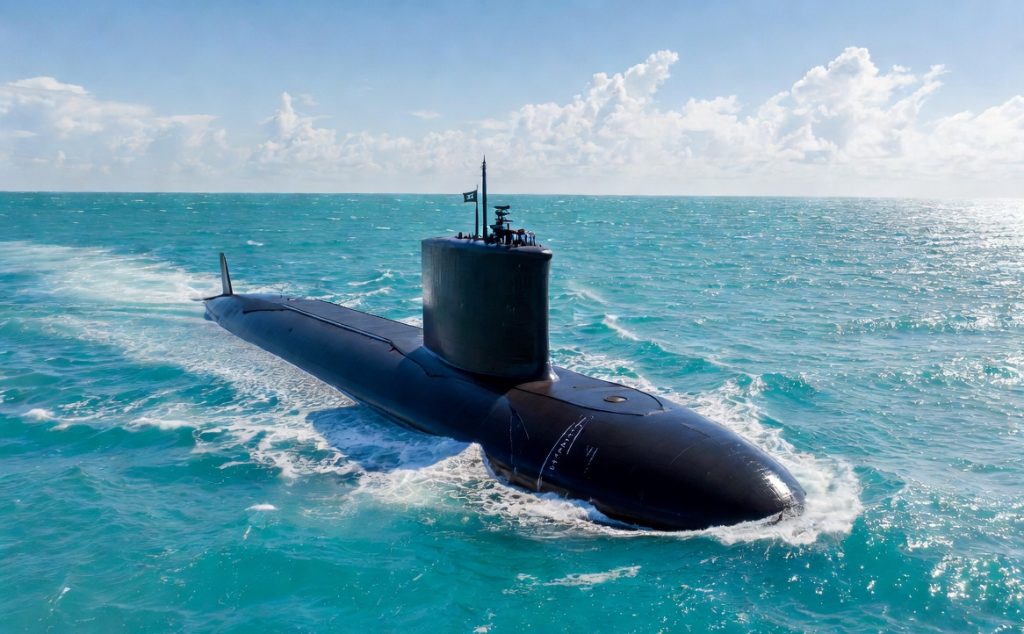
Context: Recently, India commissioned its third indigenous nuclear-powered ballistic missile submarine (SSBN), named INS Aridhaman (S4), in Visakhapatnam.
More on the News
- INS Aridhaman is the third nuclear-powered ballistic missile submarine (SSBN) in a row after INS Arihant (commissioned in 2016) and INS Arighaat (commissioned in August 2024).
- The fourth SSBN, codenamed S4* (which may be named Arisudan) is currently undergoing sea trials.
- SSBN stands for ship submersible ballistic nuclear or nuclear-powered ballistic missile submarines.
- These developments are part of the classified Advanced Technology Vessel (ATV) project, launched in the 1980s.
- INS Aridhaman significantly upgrades India’s “second-strike” capability, completing a critical phase of the nation’s ‘nuclear triad’, meaning India can launch a nuclear weapon from air, land and under the sea.
- With Aridhaman’s induction, India joins a select group of nations, including the United States, Russia, the United Kingdom and China, that operate a full-fledged nuclear triad backed by nuclear-powered submarines.
- India’s nuclear assets are managed by the Strategic Forces Command (SFC); within this tri-level system, the sea-based component is considered the most secure, primarily due to the stealth capabilities and mobility of submarines.
- India is also strengthening its attack submarine fleet by preparing to induct ‘Chakra III’, a Russian-built Akula-class nuclear-powered attack submarine (SSN), expected to be commissioned around 2027–28.
- Unlike SSBNs, which are designed for strategic deterrence, attack submarines -Ship Submersible Nuclear (SSNs) are tasked with hunting enemy vessels and protecting naval assets.
Key Features of INS Aridhaman (S4)
- Displacement: Approximately 7,000 tonnes submerged (about 1,000 tonnes heavier than earlier models).
- Propulsion: Powered by an upgraded 83 MW Compact Light Water Reactor (CLWR) developed by the Bhabha Atomic Research Centre, which offers lower acoustic signatures for enhanced stealth.
- Indigenous Content: About 70%, advancing India’s self-reliance goals.
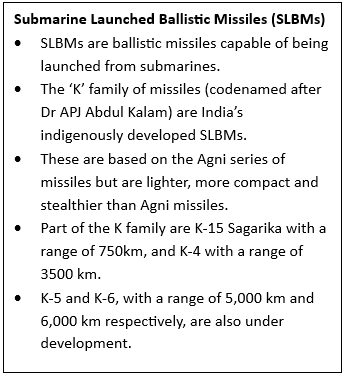
- Missile Capability: It features eight launch tubes, doubling the missile capacity of Arihant and Arighaat.
- Missile Payloads: Its eight vertical launch tubes can carry up to 24 K-15 Sagarika short-range missiles (~750 km range) or eight K-4 nuclear-capable submarine-launched ballistic missiles (SLBM) (~3,500 km range).
- Endurance: Capable of months-long submerged operations without surfacing, making it far more stealthy than conventional submarines.
- Stealth capabilities: It is considered a game-changer due to its cutting-edge communication, navigation, sensor, and weapon-control systems, which enable precision strikes.
Strategic Importance of INS Aridhaman
- Strengthening the Nuclear Triad: It contributes to India’s nuclear triad, providing the ability to launch nuclear weapons from land, air, and sea.
- Enhanced Nuclear Deterrence: As a nuclear-powered submarine with ballistic missile capabilities, it can survive a nuclear strike and still retaliate, thus bolstering India’s “No First Use” policy and maintaining a Credible Minimum Deterrence (CMD).
- Strategic Maritime Advantage: Given China’s deployment of nuclear submarines in the Indian Ocean Region, India’s capacity building on nuclear-powered submarines is crucial for nuclear deterrence.
- Boost to India’s Naval Power: It enhances India’s naval strength with two nuclear-powered submarines in the Indo-Pacific, providing strategic leverage and deterring nations like China.
- Operational Flexibility and Regional Security: The induction of INS Aridhaman enhances India’s maritime security architecture by ensuring a more stable ‘continuous at-sea’ deterrence posture, thereby strengthening regional deterrence and stability.