

SYLLABUS
GS-2: Important aspects of governance, transparency and accountability, e-governance- applications, models, successes, limitations, and potential; citizens charters, transparency & accountability and institutional and other measures.
GS-3: Challenges to internal security through communication networks, role of media and social networking sites in internal security challenges, basics of cyber security; money-laundering and its prevention.
Context: The report “Rising Repression Meets Global Resistance: Internet Shutdowns in 2025” released by Access Now and the #KeepItOn campaign, highlights the rising trend of internet shutdowns globally.
About the Report
- The report is part of the #KeepItOn campaign launched in 2016 at RightsCon to end internet shutdowns globally.
- The campaign has grown to include 366+ organisations from 106 countries, including civil society, research bodies, and media groups.
- The data is based on technical monitoring and contextual sources such as news reports and field accounts.
- The dataset is dynamic and may be updated, as some shutdowns may remain unreported.
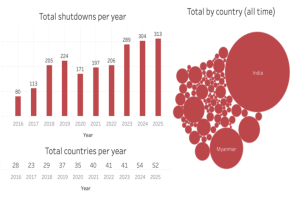
- It recorded 313 shutdowns across 52 countries in 2025, the highest ever, while India reported 65 shutdowns, its lowest since 2017, but still among the highest globally.
Key Findings
- Record High Global Shutdowns: Internet shutdowns reached a historic high of 313 incidents in 2025 across 52 countries.
- Not a single day of 2025 passed without at least one shutdown somewhere in the world.
- The number of affected countries has increased significantly from 28 in 2016 to 52 in 2025.
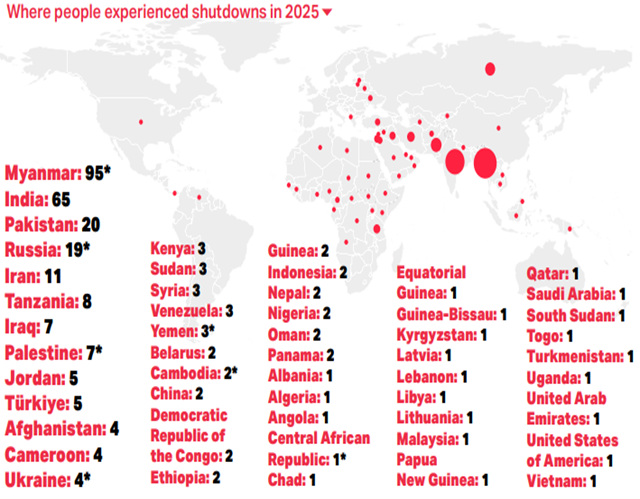
- Regional Concentration of Shutdowns: The Asia-Pacific region accounted for 195 shutdowns, the highest globally.
- Myanmar recorded the highest number of shutdowns (95), driven by military repression.
- Eastern Europe and Central Asia recorded 29 shutdowns, with Russia and Belarus using shutdowns during elections and security situations.
- India’s Continued High Usage: India recorded 65 shutdowns in 2025, the lowest since 2017, but still ranked second globally.
- These shutdowns affected 12 states and Union Territories.
- They were primarily imposed during protests, communal violence, conflicts, and religious events.
- India remains the highest globally in cumulative shutdowns (920 since 2016).
- The report highlights concern over the normalisation of shutdowns in a democratic setup.
- Conflict as the Primary Trigger: Conflict remained the leading cause, accounting for 125 shutdowns (around 40%).
- Shutdowns were used as tools of warfare to disrupt communication and conceal atrocities.
- They were frequently imposed in conflict zones to isolate populations and control information.
- Political Instability and Protests: Protests and political instability led to 64 shutdowns across 19 countries.
- Governments used shutdowns to suppress dissent and control public narratives.
- Election-related shutdowns were recorded in multiple countries to influence political outcomes.
- Human Rights Concerns: Around 70 shutdowns were linked to human rights abuses.
- Shutdowns were used to hide violence, restrict information flow, and prevent documentation of abuses.
- They disrupted emergency services, humanitarian aid, and access to essential information.
- Expansion of Digital Restrictions: Authorities increasingly targeted VPNs and circumvention tools to prevent bypassing restrictions.
- There was a rise in blocking of social media platforms such as Facebook, WhatsApp, Telegram, and Instagram.
- New trends included the disruption of LEO satellite internet services, indicating expansion of control over alternative connectivity.
- Cross-Border Shutdowns: At least 18 shutdowns were imposed by external actors across different regions.
- These included methods such as cyberattacks, infrastructure disruption, and interference with communication systems.
- Such actions intensified the impact of conflicts and crises.
- Normalisation of Shutdowns as Governance Tool: Shutdowns are increasingly being used as a default response to unrest, elections, and security concerns.
- This reflects a growing trend of using digital restrictions as tools of governance and control.
- The report warns that such normalisation is incompatible with democratic principles.
- Growing Global Resistance: There is increasing resistance from civil society and legal institutions against shutdowns.
- Courts and international organisations have begun recognising shutdowns as violations of rights.
- Efforts are underway globally to ensure accountability and prevent the normalisation of such practices.
Sources:
Indian Express
Access Now
The Wire