
SYLLABUS
GS-3: Infrastructure: Energy and Airports.
Context: The Union Cabinet approved a one-time budgetary support of up to ₹10,000 crore to Oil Marketing Companies (OMCs) for providing Aviation Turbine Fuel (ATF) Price Stabilization Support to Scheduled Indian Airlines, amid unprecedented fuel price volatility caused by the ongoing West Asia crisis.
About the ATF Price Stabilization Fund
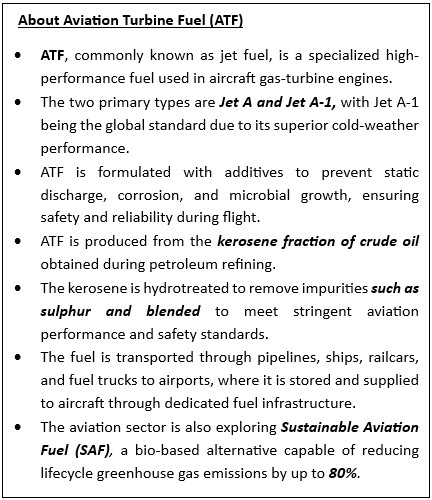
- The ATF Price Stabilization Fund is a temporary support mechanism designed to provide stable and predictable ATF prices to Indian airlines while protecting passengers from sudden airfare increases.
- Key Features
- Corpus: Up to ₹10,000 crore.
- Nature of Support: Interest-free advance from the Government to OMCs through the Ministry of Petroleum and Natural Gas.
- Coverage: Available to all willing Scheduled Indian Airlines for both domestic and international operations.
- Fixed-Price Arrangement: Airlines can procure ATF at a stable price, reducing exposure to global fuel price spikes.
- Recovery Mechanism: When international ATF prices decline, the support amount will be recovered from OMCs and returned to the Consolidated Fund of India.
- Exclusive Procurement: Participating airlines will procure ATF only from OMCs under an MoU arrangement.
- Duration: 36 months, subject to annual review or until the entire support amount is recovered.
- Monitoring: A committee comprising representatives of the Ministry of Civil Aviation, Ministry of Petroleum & Natural Gas, and Department of Expenditure will oversee implementation, audits, and settlement.
Reasons Behind the Fund
- Sharp Rise in Global ATF Prices: International ATF prices increased nearly 2.5 times, from ₹60.5/litre (March 2026) to ₹142/litre (May 2026) due to the West Asia conflict.
- High Fuel Cost Burden on Airlines: ATF constitutes around 40% of airline operating costs under normal conditions. During extreme volatility, it can rise to 60% of total operating expenditure.
- Losses to Oil Marketing Companies: Domestic ATF prices were capped to protect passengers, leading to under-recoveries for OMCs. State-run OMCs were reportedly incurring significant losses on ATF supplied to domestic carriers.
- Higher Costs Due to Pakistan Airspace Closure: Indian airlines have been forced to take longer routes to Europe, North America, and Central Asia. Longer flight paths have increased fuel consumption and operational expenses.
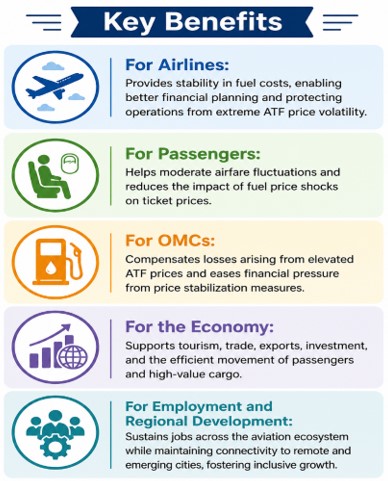
- Protecting Passengers: Without intervention, airlines would have passed on higher fuel costs through substantial airfare increases.
Significance of the Fund
- Ensures Stability in the Aviation Sector: The mechanism provides predictability in fuel costs, enabling airlines to undertake better financial and operational planning.
- Maintains Domestic and International Connectivity: It helps sustain critical air links within India and with major international destinations despite elevated operating costs.
- Supports India’s Aviation Growth: The initiative strengthens the resilience of the aviation sector and aligns with the vision of Viksit Bharat 2047 through improved connectivity and ease of flying.
- Creates a Self-Sustaining Framework: The recovery and true-up mechanism ensures that government support is eventually returned once fuel prices normalize.
- Protects Strategic Aviation Infrastructure: The measure helps maintain utilization of airports developed under initiatives such as the UDAN Scheme and safeguards the broader aviation ecosystem.
Sources :
PIB
PIB
The Hindu
Economic Times