

SYLLABUS
GS-2: Issues relating to development and management of Social Sector/Services relating to Health, Education, Human Resources.
Context: India’s maternal mortality ratio in 2023 has reduced by nearly 80 per cent since 1990, according to a new global analysis published in The Lancet Obstetrics, Gynaecology, and Women’s Health journal.
About the Report
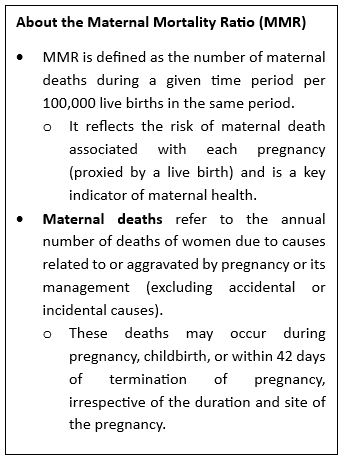
- The findings are based on the Global Burden of Disease (GBD) Study 2023, published in The Lancet Obstetrics, Gynaecology & Women’s Health, which provides a comprehensive assessment of maternal mortality trends across 204 countries and territories from 1990 to 2023.
- The study uses advanced modelling techniques (CODEm) and multiple data sources such as vital registration systems, household surveys, censuses, and maternal mortality audits to estimate maternal deaths and maternal mortality ratio (MMR) for women aged 10–54 years.
- It also evaluates progress toward SDG 3.1, which aims to reduce the global MMR to below 70 deaths per 100,000 live births by 2030, while capturing the impact of disruptions such as the COVID-19 pandemic.
Key Findings
Global Scenario:
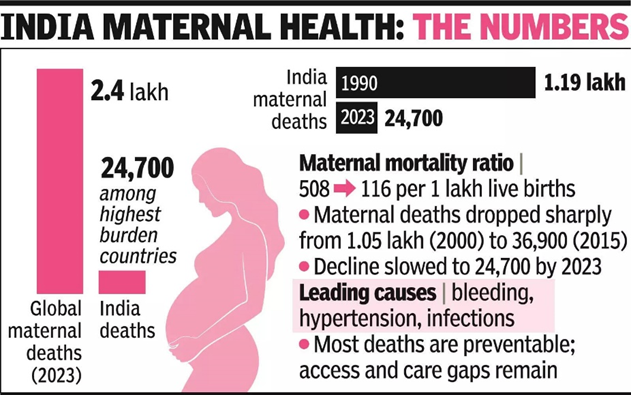
- Around 2.4 lakh maternal deaths were recorded globally in 2023, with a global MMR of ~190 per 1 lakh live births, declining from 321 in 1990.
- Maternal deaths account for 5.5% of total deaths among women aged 10–54 years.
- 104 out of 204 countries have not yet achieved the SDG target of MMR below 70.
- Progress has slowed or reversed in many regions after 2015, compared to faster improvements during 2000–2015.
- The COVID-19 pandemic (2020–21) caused a temporary rise in maternal deaths due to disruption in health services.
India’s Performance:
- India recorded 24,700 maternal deaths in 2023, with an MMR of 116 per 1 lakh live births.
- According to the Sample Registration System (SRS) 2021–23, India’s MMR is estimated at 88 per 1 lakh live births, indicating continued improvement.
- Maternal mortality has declined sharply from 508 in 1990 to 116 in 2023 (around 80–86% reduction), exceeding the global average decline.
- Despite progress, India remains among high-burden countries alongside Nigeria, Pakistan, and Ethiopia.
Trends and Regional Disparities:
- The steepest decline occurred between 2000 and 2015, driven by expansion of institutional deliveries, improved antenatal care, and government health interventions
- However, progress has slowed post-2015, indicating structural and systemic challenges.
- Significant inter-state disparities persist in better-performing states: Kerala, Tamil Nadu and high-burden states: Uttar Pradesh, Bihar, Madhya Pradesh.
Causes of Maternal Mortality:
- Most maternal deaths are due to preventable causes, including haemorrhage (severe bleeding), hypertensive disorders of pregnancy, infections (sepsis) and complications from pre-existing conditions.
- Contributing factors include:
- Delays in accessing care
- Poor quality of healthcare services
- Inequitable access, especially among low-income populations
Way Forward
- Strengthening public health systems and quality of care.
- Expanding access to antenatal, emergency obstetric, and postnatal services.
- Addressing regional inequalities and high-risk pregnancies.
- Improving data quality and monitoring systems.
- Sustained investments and policy focus to meet SDG 2030 targets.
Government Initiatives to Reduce Maternal Mortality Ratio (MMR)
- India has achieved its National Health Policy (2017) target of reducing MMR below 100 per 1,00,000 live births and is committed to achieving the SDG target of 70 by 2030.
- The National Health Mission (NHM) implements the RMNCAH+N strategy through state-specific plans to reduce maternal and neonatal mortality.
- Janani Suraksha Yojana (JSY) promotes institutional deliveries among poor and vulnerable women to reduce maternal and neonatal deaths.
- Pradhan Mantri Matru Vandana Yojana (PMMVY) provides conditional cash incentives to support nutrition and health-seeking behaviour of pregnant women.
- Janani Shishu Suraksha Karyakaram (JSSK) ensures free delivery, transport, drugs, diagnostics, and care for pregnant women and sick infants in public facilities.
- Surakshit Matritva Aashwasan (SUMAN) guarantees free, respectful, and quality maternal and newborn healthcare with zero tolerance for service denial.
- Pradhan Mantri Surakshit Matritva Abhiyan (PMSMA) provides free, quality antenatal care on a fixed day each month, with special focus on high-risk pregnancies.