
SYLLABUS
GS-3: Awareness in the fields of Space and Science and Technology- developments and their applications and effects in everyday life.
Context: Recently, NASA unveiled a major overhaul of its Moon-to-Mars strategy by scrapping plans for a lunar-orbit space station to build a surface base on the Moon, while also advancing plans for a nuclear-powered spacecraft to Mars.
More on the News
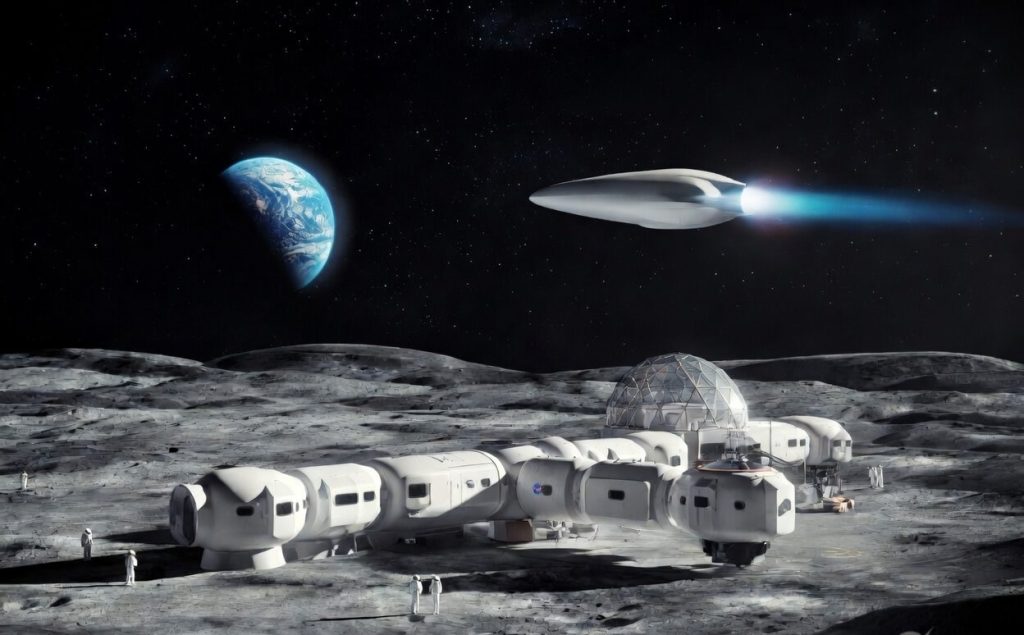
- NASA has restructured its Artemis Program by pausing the Lunar Gateway and redirecting its components toward building a $20 billion lunar base over the next seven years, reflecting a transition from orbital infrastructure to surface-based habitation.
- This shift comes amid intensifying global space competition, particularly with China aiming for a crewed Moon landing by 2030, thereby accelerating strategic urgency in lunar exploration.
- Alongside this, NASA unveiled plans to launch a nuclear-powered spacecraft, Space Reactor-1 Freedom, by 2028, integrating lunar missions with future Mars exploration and signalling a dual focus on habitation and propulsion technologies.
Nuclear Spacecraft and Deep-Space Architecture
- The Space Reactor-1 Freedom mission represents a major step toward nuclear electric propulsion, a technology capable of enabling long-duration and energy-efficient deep-space missions where solar power becomes less viable.
- Unlike conventional chemical rockets, nuclear propulsion offers sustained thrust and significantly reduced travel time, making crewed missions to Mars safer and more feasible.
- It also outperforms solar-electric systems in deep space, where diminishing sunlight limits energy generation, thereby positioning nuclear systems as a reliable backbone for interplanetary travel.
- The spacecraft is expected to support advanced exploration capabilities, including deployment of aerial systems such as helicopters, while validating technologies essential for future Mars missions.
- In parallel, NASA plans to deploy small nuclear reactors on the Moon to ensure uninterrupted power for habitats, rovers, life-support systems, and in-situ resource utilisation, particularly during the 14-day-long lunar night.
- Together, these developments mark a transition toward a deep-space logistics architecture, where nuclear-powered systems function as critical enablers of sustained human and robotic presence beyond Earth orbit.
About the Lunar Base
- The proposed lunar base is designed to enable continuous human presence by transitioning from short-duration missions to long-term habitation through a phased development strategy.
- The first phase (Build–Test–Learn) focuses on robotic missions under initiatives like Commercial Lunar Payload Services to test mobility, communication, and power technologies.
- The second phase (Early Infrastructure) involves establishing semi-habitable systems, logistical support, and recurring astronaut missions with contributions from partners such as Japan Aerospace Exploration Agency.
- The final phase (Permanent Presence) envisages deployment of heavy infrastructure and cargo-capable landing systems, enabling long-duration human stay with support from agencies like Italian Space Agency and the Canadian Space Agency.
- Robotic precursor missions will play a crucial role in site preparation, system validation, and gradual infrastructure development before sustained habitation.
Implications
- The shift toward a permanent lunar base, combined with advances in nuclear propulsion, intensifies the emerging space race and positions the Moon as a strategic geopolitical frontier, particularly in U.S.–China competition.
- It accelerates technological innovation in propulsion, energy systems, and reusable mission architectures, with direct spillover benefits for Mars and deep-space exploration.
- The growing role of private players signals the expansion of a commercial space economy, driven by service-based and scalable mission models.
- The cancellation of the Lunar Gateway introduces uncertainty for traditional partners like the European Space Agency, while simultaneously opening new opportunities in surface infrastructure and logistics.
- At the same time, a permanent lunar base enhances scientific research through continuous experimentation, resource utilisation, and deeper understanding of lunar geology, while nuclear propulsion lays the foundation for sustained interplanetary connectivity.
International Legal Framework Related to the Moon
- Outer Space Treaty (1967): Establishes that the Moon shall be used only for peaceful purposes, prohibits sovereignty claims, and mandates that activities benefit all humankind with due regard to other states.
- Liability Convention (1972): Makes the launching state absolutely liable for damage on Earth and fault-based liable for damage in space, including on the Moon.
- Registration Convention (1976): Requires states to register space objects with the UN to ensure transparency and accountability in space activities.
- Moon Agreement (1979): Declares the Moon and its resources as the common heritage of humankind and calls for international regulation of resource exploitation, though it has limited acceptance.
- 1992 UN Nuclear Power Principles: Provide non-binding guidelines ensuring safe, transparent, and consultative use of nuclear power sources in outer space missions.
- Artemis Accords (2020): Promote transparency, interoperability, safety zones and responsible resource utilisation through a non-binding coalition-based framework.
- India: India is a signatory to the Outer Space Treaty and Artemis Accords (2023) but not the Moon Agreement, and follows a balanced approach through independent missions like the Chandrayaan programme while remaining open to cooperation.