SYLLABUS
GS 3: Infrastructure: Energy, Ports, Roads, Airports, Railways, etc.; Conservation, environmental pollution and degradation.
Context: Recently, the Union Cabinet approved the Small Hydro Power (SHP) Development Scheme for the period of 2026-27 to 2030-31, giving a boost to the clean energy initiative and investment in remote and rural areas.
Key Highlights of the Scheme
- The Scheme provides an outlay of about ₹2,584 crore for the installation of Small Hydro Power (SHP) Projects with a total estimated capacity of 1,500 MW across the country.
- The scheme will support the development of small hydro projects with capacities between 1 MW and 25 MW, especially in the North Eastern region and other hilly areas.
- The projects will be developed as run-of-river projects without constructing dams and displacing people.
- North Eastern states and districts along international borders will get higher central financial assistance of up to ₹3.6 crore per MW or 30% of the project cost (whichever is lower), subject to a maximum of ₹30 crore per project.
- For other states, assistance will be capped at ₹2.4 crore per MW or 20% of the project cost (whichever is lower), with a maximum limit of ₹20 crore per project.
- The scheme also focuses on creating a pipeline of future hydro projects by supporting the preparation of detailed project reports (DPRs).
Small Hydro Power Projects
- These are run-of-the-river or canal-based systems that generate electricity using natural water flow without large reservoirs.
- Capacity: Up to 25 MW
- Types: Micro, Mini, and Small hydro
- Potential:
- In India, small hydro power projects have a total capacity of 21,000 MW with 7,133 sites.
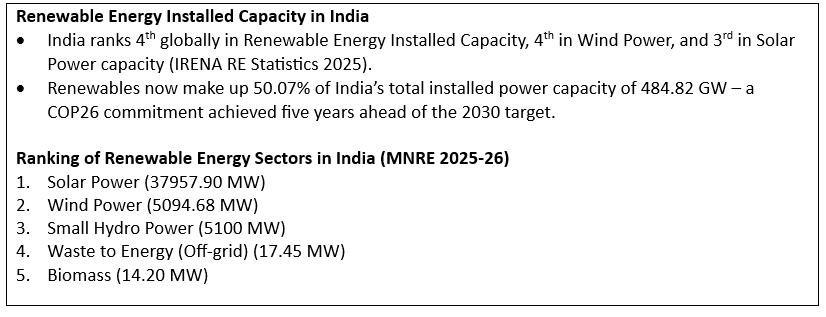
- At present, 5,100 MW of small hydro power projects are operational at 1,196 sites in the country.
- Run of the River projects: These projects generate electricity by harnessing a river’s natural flow and elevation drop, typically using little to no water storage or large reservoirs.
Significance of Small Hydro Projects
- Renewable and Clean Energy Source: These projects contribute to India’s non-fossil fuel targets and climate commitments with minimal greenhouse gas emissions compared to thermal power.
- Decentralised Energy Generation: Suitable for remote and off-grid areas and reduces transmission losses as power is consumed locally.
- Rural Development and Livelihoods: They support irrigation, agro-processing, and small industries, and employment generation during the project construction.
- Low Environmental Footprint: They require less land and avoid large-scale displacement with minimal deforestation and rehabilitation issues.
Other Initiatives to Promote Small Hydro Power Projects
- Small Hydro Power Programme: It is a program of the Ministry of New and Renewable Energy (MNRE), aimed at encouraging state government entities and Independent Power Producers (IPPs) to establish new small hydropower projects, so that the full potential of 21,000 MW can be achieved in a phased manner.
- State-Level Renewable Energy Initiatives: Some states have established agencies like the Agency for New and Renewable Energy Research and Technology (Kerala) to promote site identification, implementation of SHPs and local capacity building.
- National Action Plan on Climate Change: Indirectly promotes SHPs for low-carbon growth, sustainable energy mix, etc.
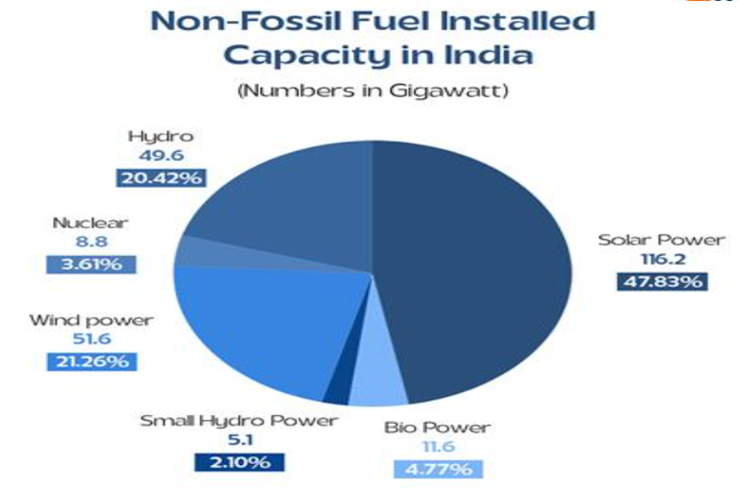
- Renewable Energy Targets: Ambitious targets set for the future, including a goal of 500 GW from non-fossil sources by 2030, and net-zero emissions by 2070.
Challenges in Small Hydro Development
- Financial and economic barriers—including substantial upfront investment and long gestation periods—as well as difficulties in securing Power Purchase Agreements (PPAs).
- Infrastructure bottlenecks, such as a lack of transmission networks, road access, and delays in project execution due to remote locations
- Environmental concerns like cumulative ecological impact in fragile zones (e.g., the Himalayas).
- Local opposition due to the disruption of traditional water systems and the lack of adequate benefit-sharing mechanisms.