

SYLLBUS
GS-2: Government Policies and Interventions for Development in various sectors and Issues arising out of their Design and Implementation.
GS-3: Infrastructure: Energy; Conservation, environmental pollution and degradation.
Context: Recently, the Ministry of New and Renewable Energy expanded the Approved List of Models and Manufacturers (ALMM) framework by introducing ALMM List-III for solar ingots and wafers.
More on the News
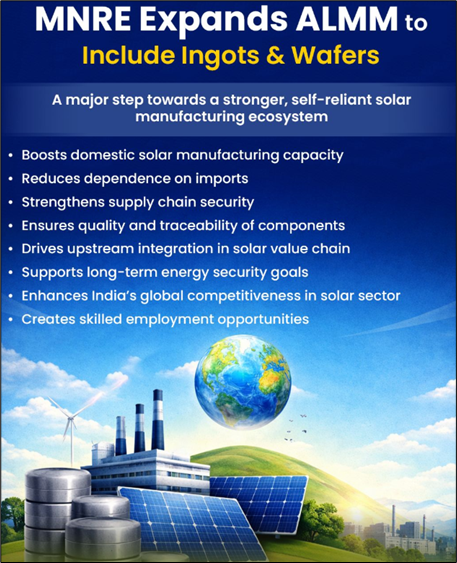
- The new provisions will come into effect from 1 June 2028 and extend mandatory domestic sourcing across the solar value chain.
- The amendment builds upon the ALMM Order, 2019, which ensures quality and reliability in solar manufacturing.
- The decision aims to promote domestic production and reduce dependence on imports.
- The ALMM LIST-I consists of specifying models and manufacturers of Solar PV Modules, and LIST-II specifies models and manufacturers of Solar PV Cells.
Key Provisions of the Expansion
- The government has fixed 1 June 2028 as the effective date from which all applicable solar projects must use ALMM-listed wafers.
- Wafers (List-III):
- Wafers are intermediate components used in the manufacturing of solar cells.
- Projects commissioned after the effective date must source wafers from approved domestic manufacturers.
- Ingots (Upstream Integration):
- Ingots are the raw crystalline material used to produce wafers.
- Manufacturers must have equivalent ingot manufacturing capacity to be eligible for ALMM List-III for wafers.
- Wafers (List-III):
- ALMM List-III will be issued only when at least three independent manufacturers with a combined capacity of 15 GW are available.
- The policy applies to projects under net metering, open access and those awarded under the Electricity Act, 2003.
- Projects bidding after the notified cut-off date must mandatorily use ALMM-listed wafers.
- After the effective date, ALMM List-I modules must use ALMM-listed cells and wafers, ensuring complete value chain compliance.
- The amendment does not dilute existing Domestic Content Requirement (DCR) provisions under the existing MNRE schemes.
- The policy includes grandfathering provisions to protect ongoing projects.
Exemptions and Transitional Provisions
- Projects with bids submitted on or before the cut-off date are exempt from using ALMM-listed wafers.
- Projects with pre-signed PPAs or bids before the cut-off date will continue to enjoy this exemption.
- Net metering and open access projects commissioned before 1 June 2028 are exempt from wafer requirements.
- Government captive projects will follow phased compliance based on their commissioning timeline.
- Thin-film solar modules manufactured in integrated units are treated as compliant with wafer and cell requirements.
Significance of the Move
- The policy promotes domestic value addition across the solar manufacturing chain.
- The measure reduces dependence on imported wafers and ingots.
- The framework enhances supply chain resilience and quality assurance.
- The policy encourages investment and generates employment in upstream manufacturing.
- The initiative supports India’s target of achieving 500 GW of non-fossil fuel capacity by 2030.