

SYLLABUS
GS-3: General awareness in the fields of IT, Space, Computers, Robotics, Nanotechnology, bio-technology.
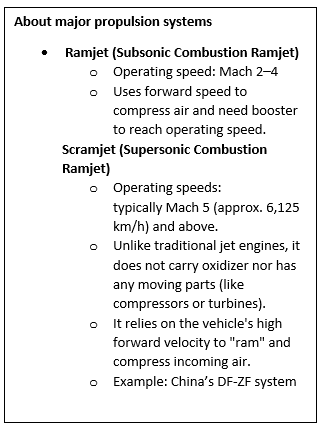
Context: India achieved a major breakthrough in hypersonic missile technology with a successful long-duration ground test of a full-scale actively cooled scramjet engine.
Key highlights of the test
- The test was conducted by the Defence Research and Development Organisation (DRDO) through its Hyderabad-based Defence Research and Development Laboratory (DRDL).
- The DRDL successfully carried out a long-duration ground test of an actively cooled full-scale scramjet combustor on 9 January 2026.
- The engine was tested for over twelve minutes at the Scramjet Connect Pipe Test Facility which validated sustained supersonic combustion.
- The test builds upon an earlier successful subscale scramjet test conducted in April 2025 and marks a significant advancement in hypersonic propulsion.
- The combustor and the testing facility were indigenously designed by DRDL and developed with the support of Indian industry partners.
- The achievement demonstrates the effectiveness of air breathing propulsion systems for long-duration hypersonic flight.
Defence Research & Development Laboratory (DRDL)
- DRDL is India’s premier multi-disciplinary laboratory established in 1961, under the DRDO, dedicated to the design and development of missile systems.
- DRDL serves as the core “design and development house” for tactical and strategic missile systems.
- Specialisation: Aerodynamics, airframe design, computational fluid dynamics, and propulsion (solid, liquid, ramjet, and scramjet).
- Core Legacy: DRDL led the Integrated Guided Missile Development Programme (IGMDP), which birthed the Prithvi, Agni, Akash, Trishul, and Nag missiles.
Significance of the Test
- Strategic Deterrence: Hypersonic weapons can penetrate advanced air defence systems, enhancing India’s credible minimum deterrence.
- Foundation for India’s hypersonic cruise missile programme: The successful test strengthens India’s capability to develop hypersonic cruise missiles that can travel at more than five times the speed of sound for extended durations.
- Aatmanirbhar Bharat in Defence: India’s indigenous mastery over one of the most complex propulsion technologies reduces dependence on foreign Rocket Propulsion and next-generation long-range weapons.
- Entry into the Hypersonic Elite Club: Only a few countries (US, Russia, China) have demonstrated operational scramjet-based hypersonic capability.