
SYLLABUS
GS-2: Indian Constitution—Historical Underpinnings, Evolution, Features, Amendments, Significant Provisions & Basic Structure; Government policies and interventions for development in various sectors and issues arising out of their design and implementation.
Context: Union Home Minister Amit Shah has announced that UCC will be introduced in all 21 NDA-ruled States before the 2029 Lok Sabha elections, signalling a State-led push for the long-pending reform.
More on the News
- Presently, Uttarakhand is the only State among the recent UCC initiatives where the law is in force, while Gujarat, Assam and Madhya Pradesh have passed UCC legislation and are awaiting the subsequent assent/notification process.
- The Union Government is pursuing a State-by-State approach rather than bringing a single UCC legislation before Parliament, with State-level laws serving as models for wider implementation.
- The emerging State frameworks broadly cover marriage, divorce, inheritance and succession, polygamy and live-in relationships, while providing exemptions for certain tribal communities and customary practices.
Why the State Route for UCC?
- Concurrent legislative field: Matters including marriage and divorce, adoption, wills, intestacy and succession, joint family and partition fall under Entry 5 of the Concurrent List, giving both Parliament and State Legislatures legislative competence.
- Role of Article 254: Where a State law is repugnant to a Parliamentary law on a Concurrent List subject, the Parliamentary law ordinarily prevails. A State law reserved for the President and receiving Presidential assent can, however, prevail in that State, subject to Parliament subsequently overriding it.
- Scope for experimentation: The State route allows governments to test common civil-law frameworks, identify implementation issues and assess social responses before any possible nationwide framework.
- Accommodation of diversity: Personal and customary practices vary considerably across India, particularly among tribal communities and in the Northeast. State-level legislation allows greater consideration of such variations and constitutionally protected practices.
- Political feasibility: A nationwide UCC would have to reconcile a much wider range of personal laws, customs and political positions. State-level models provide legislative experience and working examples before any broader move.
Understanding the Uniform Civil Code
- Meaning: UCC refers to a common framework of civil rules governing specified matters such as marriage, divorce, adoption, maintenance, inheritance and succession, irrespective of religion.
- Personal Laws: India has historically followed different statutory, customary and religiously based frameworks for several family-related matters, including the Hindu Marriage Act, 1955 and the Muslim Personal Law (Shariat) Application Act, 1937.
- What UCC seeks: It seeks uniformity in specified civil matters, rather than uniformity in religious beliefs, worship or theological practices.
- Constitutional position: Article 44, a Directive Principle of State Policy, directs the State to endeavour to secure a UCC throughout India. It is non-justiciable and does not itself create an enforceable UCC.
- Existing model: Goa’s common civil-law framework, inherited from the Portuguese Civil Code, is frequently cited in the UCC debate as an existing example of common civil rules within India.
Constitutional & Historical Evolution of the UCC Debate
- Colonial roots: The 1835 Law Commission supported uniform codification of areas such as criminal law, evidence and contracts while leaving personal laws largely outside this framework.
- B.N. Rau Committee: Constituted in 1941, it examined the reform and codification of Hindu personal laws and submitted its report in 1947.
- Constituent Assembly: Rather than making a UCC immediately enforceable, the Constitution placed the objective under Article 44 in the Directive Principles, leaving its realisation to future legislative action.
- Post-Independence reform: The Hindu Code Bills of 1955–56 introduced substantial reforms in Hindu personal law, illustrating a gradual, community-specific approach to personal-law reform.
- Judicial evolution:Shah Bano (1985) and Sarla Mudgal (1995) highlighted the desirability of a UCC in the context of maintenance and personal-law misuse.
- In Shayara Bano (2017), the Supreme Court invalidated instant triple talaq, reinforcing constitutional scrutiny of discriminatory personal-law practices.
- Law Commission: The 21st Law Commission’s 2018 Consultation Paper on Reform of Family Law stated that a UCC was “neither necessary nor desirable at this stage” and favoured reforming discriminatory aspects of personal laws.
- The 22nd Law Commission reopened the issue in 2023 by seeking fresh views from the public and religious organisations.
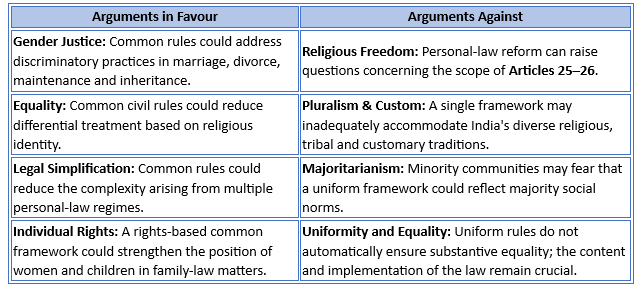
Arguments For and Against UCC
Way Ahead
- Evidence-based rollout: Assess the experience of Uttarakhand and the implementation of the other State frameworks before extending UCC further.
- Rights-based reform: Ensure that common civil rules advance equality, gender justice and individual dignity while remaining consistent with constitutionally protected religious freedom.
- Protect legitimate diversity: Provide clearly defined safeguards for tribal and constitutionally protected customary practices, while addressing practices that violate fundamental rights.
- Inclusive law-making: Undertake structured consultation with States, religious and tribal communities, women’s groups and legal experts, followed by legislative scrutiny, to build a legally durable and socially acceptable framework.