

India Assumes Chairship of International IDEA
Context: India has been invited for the first time to chair the International Institute for Democracy and Electoral Assistance in 2026.
More on the News
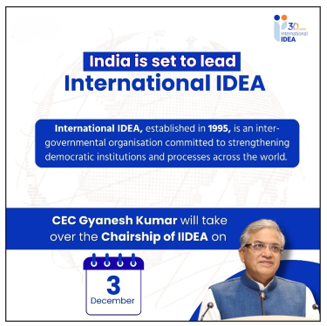
- Chief Election Commissioner Gyanesh Kumar has taken charge as the Chair of International IDEA at Stockholm (Sweden), on behalf of India.
- As the world’s largest democracy with more than 90 crore electors, India will leverage its extensive experience in electoral administration when it assumes the Chairship of International IDEA for 2026, contributing to the strengthening of Election Management Bodies across the world.
About International IDEA
- International IDEA, established in 1995, is an inter-governmental organisation with a current membership of 35 countries and the United States and Japan as Observers.
- International IDEA holds an Observer Status in the United Nations General Assembly since 2003.
- India is a founding member of International IDEA and has participated actively in governance processes and collaborated on electoral research, capacity building and training programmes.
Bnei Menashe Jews
Context: Recently, Israel has approved a plan to complete the immigration of the Bnei Menashe Jews from Northeast India over the next five years.
More on the News
• Israel has approved a wide-scale initiative to bring all remaining 5,800 members of the Bnei Menashe community from Northeast India by 2030.
• The decision includes 1,200 members already cleared for immigration in 2026.
• It will be the first time that The Jewish Agency will manage the entire pre immigration process from eligibility interviews to absorption in Israel.
- The Jewish Agency is an Israel-based international organisation that acts collectively to strengthen Israel and the Jewish people worldwide by advancing Aliyah as a core value.
• The plan requires a special budget of 90 million shekels, which will support flights, conversion classes, housing and Hebrew lessons.
• A large delegation of rabbis will visit India soon to interview the first half of the community.
• The resettlement will continue in towns in northern Israel, including Nof Hagalil (a City in Israel), which has become a major centre for the community.
About the Bnei Menashe Communit
- The Bnei Menashe identify themselves as descendants of the biblical tribe of Menashe, which is one of the ten tribes exiled by the Assyrians about 2,700 years ago.
- In 2005, the then Chief Rabbi of the Sephardi community, Rabbi Shlomo Amar, recognised them as descendants of Israel, which created the path for their immigration to Israel.
- Around 2,500 members of the community already live in Israel, and many young members serve in combat units of the Israel Defence Forces.
- The early waves of immigration saw members being settled mainly in the West Bank.
ALIMCO Marks 53rd Foundation Day
Context: Artificial Limbs Manufacturing Corporation of India (ALIMCO) celebrated its 53rd Foundation Day on 30th November, with a renewed commitment to inclusion, dignity and technological excellence.

More on the News
- The occasion was commemorated by the unveiling of ALIMCO’s new corporate logo and the launch of two advanced mobility solutions — the 3-Wheeler EV Scooter for Divyangjan and Senior Citizens and the Clip-on Motorised Wheelchair.
About the Artificial Limbs Manufacturing Corporation of India (ALIMCO)
- ALIMCO is a Central Public Sector Enterprise under the Department of Empowerment of Persons with Disabilities.
- It is a Schedule ‘C’ and Mini-Ratna Category II company established in 1972.
- It is registered under Section 8 of the Companies Act, 2013, which reflects its charitable and social service mandate.
- It manufactures affordable and high-quality aids and appliances for persons with disabilities across India.
- It works with government ministries, research institutions and start-ups to advance the availability of modern assistive technologies.
TARAGIRI
Context: Taragiri, the fourth ship of Nilgiri Class under Project 17A and the third built by Mazagon Dock Shipbuilding Ltd, was delivered to the Indian Navy.
More on the News
- The design was prepared by the Warship Design Bureau, and the construction was supervised by the Warship Overseeing Team in Mumbai.
- The ship was built using the integrated construction philosophy and was delivered within the planned timelines.
- The delivery marks a major milestone in achieving self-reliance in warship design and construction.
Taragiri: Key Features
- Taragiri is a reincarnation of the earlier INS Taragiri, which served the nation for 33 years from 1980 to 2013.
- The name “Taragiri” comes from a hill range in the Garhwal Himalaya.
- This state-of-the-art frigate reflects a quantum leap in naval design, stealth, firepower, automation and survivability, and is a symbol of Aatmanirbharta in warship building.
- With an indigenisation content of 75%, the project has involved over 200 MSMEs and has enabled employment generation of approximately 4,000 personnel directly and more than 10,000 personnel indirectly.
- These ships are configured with Combined Diesel or Gas (CODOG) propulsion plants, comprising a diesel engine and a gas turbine that drive a Controllable Pitch Propeller (CPP) on each shaft, and a state-of-the-art Integrated Platform Management System (IPMS).
- The potent weapon and sensors suite comprises BrahMos SSM, MFSTAR and MRSAM complex, 76mm SRGM, and a combination of 30 mm and 12.7 mm close-in weapon systems, along with rockets and torpedoes for anti-submarine warfare.
- The construction period was reduced to 81 months because of the experience gained from earlier ships in the class.
World Skills Asia Competition (WSAC) 2025
Context: India ranked 8th among 29 countries in its first appearance at the WorldSkills Asia Competition (WSAC) 2025.
More on the News
- The third edition of the prestigious continental competition witnessed participation from 500+ competitors across 44 skill categories, representing around 29 Asian member and guest countries.
- The Indian team comprised 23 competitors who participated in 21 traditional and tech-driven skill categories, winning 1 silver medal, 2 bronze medals, and 3 medallions for excellence.
- Women competitors contributed significantly to India’s medal tally, highlighting their growing leadership in the country’s skilling ecosystem.
Key Features of the WSAC 2025
- WorldSkills Asia is a non-profit organization that unites Asian countries to elevate technical and vocational education and training (TVET) through biennial skills competitions.
- WSAC promotes skills development, education enrichment, international cooperation, and innovation, fostering peace and collaboration among educators, policymakers, and industry.
- The organization comprises 26 member countries and offers programs such as expert exchanges, scholarships, and virtual training in emerging sectors like IT security and robotics.
- WSAC 2025 provided a platform for promoting economic growth, tourism, and international exchange while focusing on high-demand skills.
Project Gaja-Lok
Context: Recently, the Indian National Trust for Art and Cultural Heritage (INTACH) announced the “Project Gaja-Lok: Elephant Lands and their Cultural Symbolism in Asia”.
About the Project Gaja Lok
• Purpose & Theme: Project Gaja-Lok is a transnational “culture-nature” initiative dedicated to documenting and exploring the deep and enduring connections surrounding the Asian elephant, encompassing culture, history, ecology, and climate resilience across Asia.
• Scope & Approach:
- The exhibition showcases artefacts and representations of elephants from across Asia — from ancient Indus-Valley seals and Bharhut railings to temple sculptures and Southeast Asian heritage (e.g. Thai, Cambodian).
- The project seeks to trace how elephants have shaped human civilization: spiritually, artistically, politically, from ancient times (religion, mythology) to their contemporary ecological role.
- Beyond cultural documentation, Gaja-Lok aims to open dialogue on human–elephant interactions, ecological challenges, ethics of coexistence, habitat conservation, and cross-border heritage collaboration.
• Significance of the Elephant: Through this project, the Asian elephant is positioned not just as a wildlife species, but as a “living emblem of ecological resilience” and a “revered cultural icon.”
• Long-Term Goals: The initiative aims to build a pan-Asian understanding of elephant heritage — bridging art, environment, history, and conservation, which could guide future collaborative heritage conservation and ecological efforts across countries.
About the INTACH
- INTACH non-profit organization founded in 1984 that works to protect and conserve India’s natural, built, and cultural heritage.
- It identifies and records unprotected heritage sites and cultural assets across India, creating databases that guide conservation planning and policymaking.
- Through awareness programmes, exhibitions, and its heritage education division, INTACH promotes public understanding and appreciation of India’s diverse cultural legacy.
- The organization provides expert advice to governments and institutions, helping shape heritage laws, conservation guidelines, and professional best practices.
Three Loan Agreements with the ADB
Context: India and the Asian Development Bank (ADB) have signed three loan agreements worth over 800 million US dollars for projects in Maharashtra, Madhya Pradesh and Gujarat.
About the Loan Agreements
- The agreements include a $500 million loan for the Maharashtra Power Distribution Enhancement Programme for Agricultural Solarization, over $190 million for the Indore Metro Rail Project, and around $110 million for the Gujarat Skills Development Programme.
- In Maharashtra, the ADB-backed initiative seeks to upgrade rural power systems, expand distributed renewable energy, and enhance agricultural productivity.
- The Indore Metro loan will fund an 8.62-km underground corridor with seven stations, improving connectivity between congested city areas and the airport.
- The Gujarat Skills Development Programme aims to provide industry-focused, advanced training to strengthen the employability of the state’s workforce in high-growth sectors.
- An additional $1 million Technical Assistance grant was signed to support implementation of the upcoming Sustainable Wetland and Integrated Fisheries Transformation Project in Assam.
About the Asia Development Bank (ADB)
- Established in 1966, it is owned by 69 members, of whom 50 are from within Asia and the Pacific and 19 outside.
- It aims for a prosperous, inclusive, and sustainable Asia and Pacific while working to eliminate extreme poverty in the region.
- ADB supports its member countries and partners by offering loans, technical assistance, grants, and investments to encourage social and economic development.
IPC signs MoUs for Drug and Medical Device Safety in North-East
Context: The Indian Pharmacopoeia Commission (IPC) has signed three Memoranda of Understanding (MoU) with the Nagaland Medical Council, the Nagaland State Drugs Control Administration (NSDCA) and the Nagaland State Pharmacy Council to strengthen drug and medical device safety in the North-East region.
More on the News
- MoU signed with Nagaland Medical Council is the first MoU with any State Medical Council in India to promote pharmacovigilance & materiovigilance programmes and strengthen patient safety up to primary health centres.
About the MoUs
- The MoUs advance patient safety initiatives in Nagaland through the use of the National Formulary of India (NFI) as a standard reference and facilitate annual observance of the National Pharmacovigilance Week in collaboration with IPC.
- MoU will promote capacity building to all stakeholders, including healthcare professionals involved in pharmacovigilance and materiovigilance practices, and scientific personnel involved in quality control of medical products.
- It facilitates the use of Indian Pharmacopoeia Reference Substances and Impurity Standards in NSDCA drug-testing laboratories to ensure quality and safety.
- The MoU is expected to enhance professional engagement, encourage wider participation in ADR reporting through the establishment of ADR monitoring centres/Medical Device Monitoring centres, and reinforce medicine safety surveillance mechanisms in the region.
About the Indian Pharmacopoeia Commission (IPC)
- IPC, headquartered in Ghaziabad, is an autonomous institution under the Ministry of Health and Family Welfare, which is responsible for setting standards of drugs in the country.
- The Commission has become fully operational from 1st January 2009.
- Its mandate includes regularly revising and publishing the Indian Pharmacopoeia and the National Formulary of India, providing IP Reference Substances, and training stakeholders on pharmacopoeial standards.
- The Indian Pharmacopoeia (IP) is a book of official standards for drugs in India, published by the IPC to fulfill the requirements of the Drugs and Cosmetics Act, 1940.
- The Secretary, Ministry of Health and Family Welfare, is the Chairperson of the Commission.