
SYLLABUS
GS-2: Statutory, Regulatory and various Quasi-judicial Bodies; Functions and Responsibilities of the Union and the States, Issues and Challenges Pertaining to the Federal Structure, devolution of powers and finances up to local levels and challenges therein.
Context: The Union Home Minister chaired the 28th meeting of the Western Zonal Council in Panaji, Goa, on 7 September 2026, focusing on inter-State coordination, development, public welfare and internal security.
More on the News
- The meeting was attended by the Chief Ministers of Goa, Gujarat and Maharashtra, the Administrator of Dadra and Nagar Haveli and Daman and Diu, and senior officials of the Centre, States and UT.
- The meeting reflected the evolving role of Zonal Councils as platforms for monitoring welfare and development outcomes, including child malnutrition, Aadhaar penetration, Ayushman Bharat coverage, PACS computerisation, cybercrime and coastal security.
- Home Minister described the Western Region as the “WEST Engine” of India’s growth—Wealth & Finance, Exports & Ports, Start-ups & Semiconductors, and Tourism & Blue Economy.
Understanding Zonal Councils
- Genesis and Nature
- The idea of Zonal Councils was mooted by Prime Minister Jawaharlal Nehru in 1956, during the debate on the States Reorganisation Commission’s report, to promote cooperative working among States.
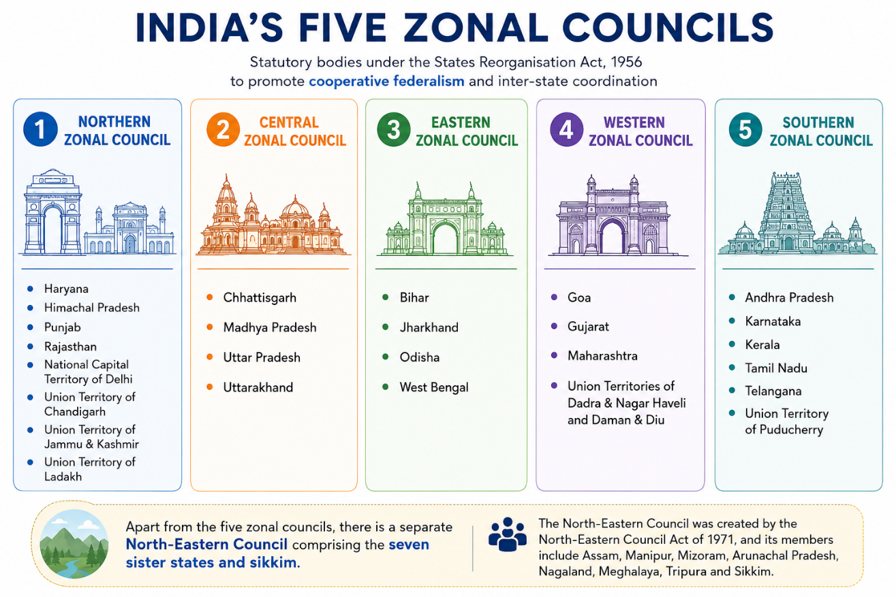
- Subsequently, five Zonal Councils were established under Part III of the States Reorganisation Act, 1956.
- They are statutory and advisory bodies comprising the Northern, Central, Eastern, Western and Southern Zonal Councils.
- The North Eastern Council (NEC) functions separately under the North-Eastern Council Act of 1971.
- Composition
- The Union Home Minister is the Chairman of all five Zonal Councils, while Chief Ministers of member States serve as Vice-Chairmen by rotation for one year.
- Each State is represented by its Chief Minister and two Ministers; Union Territories have two representatives.
- Each Council also has a Standing Committee of Chief Secretaries for preliminary examination of issues.
- The Inter-State Council Secretariat under the Ministry of Home Affairs acts as the nodal body for organising and coordinating Zonal Council meetings.
- Functions of Zonal Councils: Under the States Reorganisation Act, Zonal Councils discuss and make recommendations on:
- Economic and social planning and matters of common regional interest;
- Inter-State issues, including border disputes, linguistic minorities and inter-State transport;
- Matters connected with the reorganisation of States; and
- Other issues referred to them for promoting coordination and cooperation among member States.
Significance of Zonal Councils in Indian Federalism
- Institutionalised Dialogue & Consensus: Provides a regular platform for Centre–State and inter-State consultation, enabling regional issues to be addressed through dialogue and consensus rather than adversarial mechanisms.
- Policy Coordination & Best Practices: Facilitates coordinated implementation of national programmes, convergence among States and sharing of effective governance practices.
- Regional Development & Security: Enables coordinated responses to common challenges such as Left Wing Extremism (LWE), cybercrime, disaster management, infrastructure gaps and regional disparities.
- National Integration & Cooperative Governance: Regular political and administrative interaction strengthens national integration, while the growing focus on monitoring welfare and development outcomes is expanding Zonal Councils from discussion and dispute-resolution forums into more action-oriented platforms for cooperative governance.