

SYLLABUS
GS-3: Conservation, environmental pollution and degradation, environmental impact assessment.
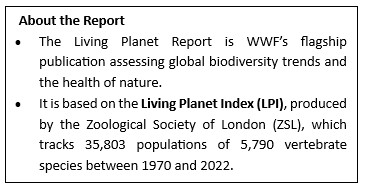
Context: The World-Wide Fund for Nature (WWF) released the Living Planet Report 2026: The Science of Hope, reporting a 73% decline in the average size of monitored wildlife populations globally between 1970 and 2022.
Key Findings of the Report
Global Biodiversity Trends:
- Wildlife population decline: The average size of monitored wildlife populations declined by 73% between 1970 and 2022. This represents the average change in population sizes, not the percentage of individual animals lost.
- Ecosystem-wise decline: Freshwater populations recorded the steepest decline (85%), followed by terrestrial (69%) and marine populations (59%).
- Regional decline: Latin America and the Caribbean recorded a 95% decline, followed by Africa (80%) and Asia-Pacific (49%).
- Signs of recovery: Nearly half of the monitored populations were stable or increasing, demonstrating the potential for wildlife recovery through sustained conservation efforts.
Major Drivers of Biodiversity Loss:
- Habitat loss and degradation: The most frequently reported threat, driven largely by agricultural expansion.
- Other threats: Overexploitation, climate change, pollution, invasive species and disease.
- Systemic drivers: Unsustainable food production and consumption, energy systems dependent on fossil fuels, and financial flows supporting activities that damage nature.
- Harmful financial flows: In 2023, approximately US$7.3 trillion flowed into activities harmful to nature, compared with US$220 billion for nature protection and restoration.
India’s Conservation Achievements and Challenges
- Tigers: India’s tiger population was estimated at 3,682 in the 2022 All India Tiger Estimation.
- Greater one-horned rhinoceroses: The population exceeded 3,300.
- Asiatic lions: Their population increased from 674 in 2020 to 891 in 2025.
- Snow leopards: India’s first nationwide assessment estimated 718 individuals.
- Common leopards: Their estimated population was 13,874.
- Ganges river dolphins: The first range-wide assessment estimated 6,324 dolphins across the surveyed range.
- Challenges: Species such as the Great Indian Bustard and Indian wolf need stronger conservation strategies, particularly outside protected areas.
- Poaching and increasing human–wildlife conflict also remains concerns.
Positive Tipping Points and Nature Recovery:
- A positive tipping point occurs when a system crosses a critical threshold, triggering self-reinforcing changes towards a healthier state.
- Energy: A positive tipping point has been reached, with solar power becoming the cheapest source of new electricity generation in most countries.
- Food and agriculture: Early signs of transformation include nature-positive production, sustainable consumption, healthier diets and reduced food loss and waste.
- Finance: Financial systems need to redirect investments away from harmful activities, recognise nature-related risks and close the annual biodiversity finance gap.
- Conservation success: Recoveries among tigers, green turtles, bluefin tuna and some southern African elephant populations demonstrate that sustained conservation can deliver results.
Key Recommendations
- Transform food systems: Promote nature-positive agriculture, sustainable diets and reduced food loss and waste.
- Accelerate clean energy: Expand renewable energy and speed up the transition away from fossil fuels.
- Reform financial systems: Redirect investments from nature-damaging activities towards conservation and ecosystem restoration.
- Strengthen wildlife conservation: Protect and restore habitats, tackle poaching and develop strategies for threatened species, including those outside protected areas.
- Promote community-led conservation: Involve local communities in wildlife management and enable them to benefit from sustainable natural resource use.
- Address human–wildlife conflict: Develop effective coexistence strategies that protect both wildlife and communities.
- Implement international commitments: Translate the goals of the Kunming–Montreal Global Biodiversity Framework and the Paris Agreement into concrete action.