SYLLABUS
GS-3: Conservation, environmental pollution and degradation, environmental impact assessment
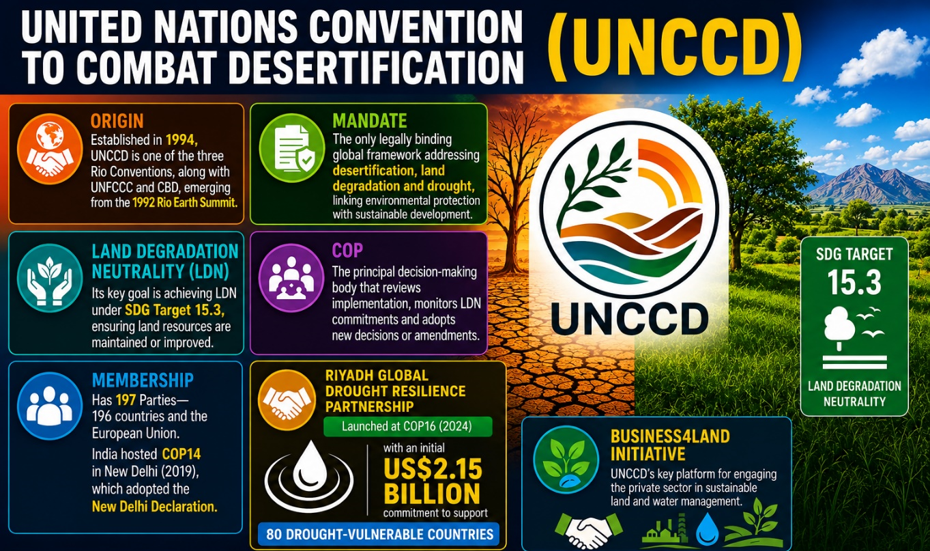
Context: The 17th Conference of Parties (CoP17) to the United Nations Convention to Combat Desertification (UNCCD) was held in Ulaanbaatar, Mongolia, from 17 to 28 August 2026, under the theme “Restoring Land. Restoring Hope.”
Key Highlights of UNCCD COP17
- International Year of Rangelands and Pastoralists: COP17 coincided with the UN International Year of Rangelands and Pastoralists (IYRP) 2026, championed by Mongolia, creating an opportunity to promote rangeland restoration, conservation and sustainable management while highlighting the needs of pastoralist communities.
- Global Land Crisis: The Convention noted that up to 40% of the world’s land surface was degraded, threatening water availability and economic stability.
- Mongolia’s Initiative: With nearly 77% of its land degraded, Mongolia highlighted its “Billion Trees” campaign, launched in 2021, targeting one billion trees by 2030.
- Drought Finance: COP17 announced US$1.3 billion land-restoration and drought-resilience finance portfolio was also announced across 23 countries and five continents, including US$644.5 million in new finance.
- Nature-Based Solutions (NbS): COP17 promoted Ecosystem-based Adaptation (EbA) and financing for nature-based solutions in national planning and infrastructure development.
- Drought Resilience Index (DRI): The world’s first comprehensive technical tool, using AI-powered analytics and vulnerability mapping to assess drought preparedness and support data-driven investments.
- Drought Resilience Investment Facility (DRIF):The first global catalytic financing platform dedicated to drought resilience.
- DRIF will use public capital to reduce investment risks and unlock much larger flows of institutional and private finance for projects that strengthen water security, sustainable agriculture, nature-based solutions and land restoration.
- Global Drought Treaty: Governments again failed to agree on a global drought framework, despite worsening droughts and a $278 billion annual resilience finance gap.
- Negotiators agreed to continue discussions on proactive drought management at COP18 in Sharm El-Sheikh, Egypt, building on progress at COP16 and COP17.
India’s Position at UNCCD COP17
- Community-Led Restoration of Rangelands: India emphasised the critical role of rangelands in sustaining pastoralist communities, conserving biodiversity and regulating water and carbon cycles.
- Shift from Drought Response to Drought Resilience: India called for a fundamental shift in the global approach to drought—from reactive relief to proactive, technology-enabled resilience.
- India’s First Guide to Grasslands and Other Open Natural Ecosystems: India launched its first-ever Guide to Grasslands and Other Open Natural Ecosystems (ONEs) of India at COP17 to the UNCCD.