

SYLLABUS
GS-3: Indian Economy and issues relating to planning, mobilization of resources, growth, development and employment.
Context: Recently, the Union Cabinet approved the Startup India Fund of Funds 2.0 (FoF 2.0) with a total corpus of ₹10,000 crore to mobilize venture and growth capital for India’s startup ecosystem.
About Startup India Fund of Funds 2.0
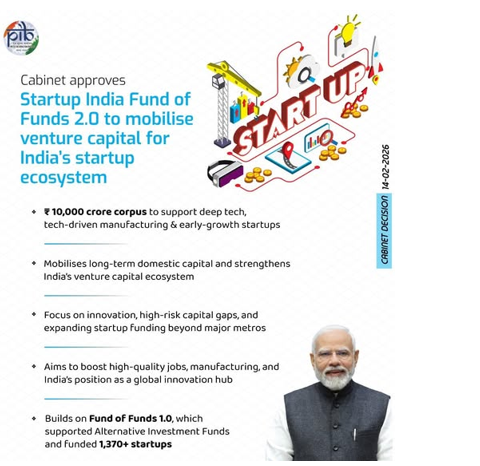
- The scheme builds upon the success of the Fund of Funds for Startups (FFS 1.0) launched in 2016 under the Startup India Action Plan, which addressed funding gaps and catalysed domestic venture capital.
- Startup India FoF 2.0 is a government-backed funding mechanism aimed at strengthening India’s startup ecosystem through structured investment in SEBI-registered Alternative Investment Funds (AIFs).
- Key Features
- Corpus: ₹10,000 crore
- Duration: Spread across 16th and 17th Finance Commission cycles.
- Investment Route: Contribution to AIFs, which in turn invest in startups.
- Implementation Agency: Small Industries Development Bank of India (SIDBI), along with an additional domestic agency.
- Nodal Department: Department for Promotion of Industry and Internal Trade.
- Investment Structure: The scheme adopts a segmented approach targeting four priority areas:
- Deep Tech Startups – High R&D, long gestation innovations
- Early Growth Stage Startups – Supported via smaller AIFs (micro-VCs)
- Tech-driven Manufacturing Startups – Aligned with “Make in India”
- Sector/Stage Agnostic Startups – Broad-based innovation support
- Operational Mechanism:
- Investments are made indirectly via AIFs, not directly into startups.
- AIFs raise additional capital and invest in startups in tranches.
- Post-investment, AIFs provide mentorship and support.
- Governance & Monitoring:
- Venture Capital Investment Committee (VCIC): Screens and recommends AIFs
- Empowered Committee (EC): Monitors implementation and performance
- DPIIT: Will issue operational guidelines including eligibility, reporting, and disbursal mechanisms
- Additional Features
- Co-investment framework with institutional investors
- Operational flexibility for long-duration and capital-intensive sectors.
- Up to 5% of returns earmarked for ecosystem development (capacity building, mentorship, etc.).
- Returns are deposited back into the Consolidated Fund of India (CFI).
- Building on Fund of Funds for Startups (FFS 1.0): FoF 2.0 follows the strong performance of FFS 1.0 (2016), which was launched to address funding gaps and catalyse domestic venture capital.
- ₹10,000 crore corpus committed to 145 Alternative Investment Funds (AIFs) .
- Over ₹25,500 crore invested in 1,370+ startups.
- Coverage across sectors: agriculture, AI, robotics, automotive, clean tech, e-commerce, fintech, healthcare, manufacturing, space tech, biotechnology, etc.
- FFS 1.0 played a pivotal role in nurturing first-time founders, crowding in private capital, and building a strong foundation for India’s venture capital ecosystem.
Significance of Startup India FoF 2.0
- Strengthening Domestic Capital Base: Reduces dependence on foreign venture capital and encourages a long-term domestic investment ecosystem.
- Boost to Deep Tech and Manufacturing: Focus on high-tech sectors with long gestation periods and support strategic sectors critical for economic and technological sovereignty.
- Support for Early-Stage Startups: Addresses early-stage funding gaps and provides a safety net to reduce startup failures.
- Inclusive Startup Growth: Encourages investments beyond major metros and strengthens smaller funds and regional innovation ecosystems.
- Enhancing Innovation-led Growth: Promotes the development of globally competitive technologies and products and aligns with national goals like Viksit Bharat @ 2047.
- Economic Impact: Boosts job creation (high-quality employment), manufacturing capabilities, and economic resilience.
- Ecosystem Development: Promotes mentorship, capacity building, and regulatory support and strengthens the overall startup ecosystem infrastructure.