
SYLLABUS
GS-2:Salient features of the Representation of People’s Act. Appointment to various Constitutional posts, powers, functions and responsibilities of various Constitutional Bodies.
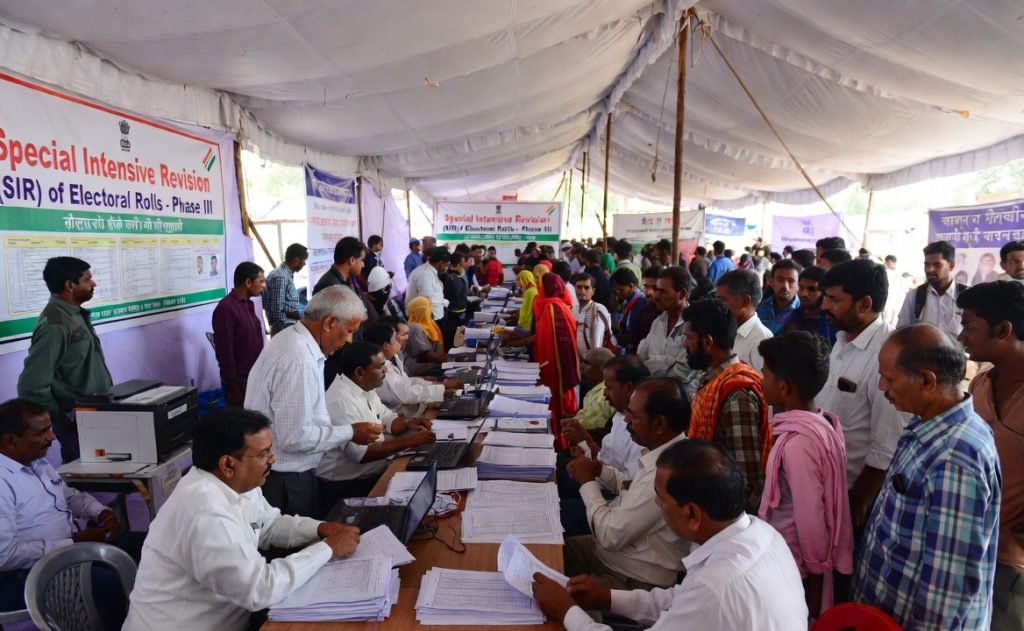
Context: The Election Commission of India has announced the schedule for Phase-III of the Special Intensive Revision (SIR) of electoral rolls across 16 States and 3 Union Territories to ensure updated and accurate voter lists ahead of future elections.
More on the News
- Phase-III of the SIR will cover 16 States and 3 UTs, including Delhi, Maharashtra, Karnataka, Telangana, Odisha, Punjab, and Uttarakhand.
- Over 3.94 lakh Booth Level Officers (BLOs) will conduct house-to-house verification for nearly 36.73 crore electors, assisted by 3.42 lakh Booth Level Agents (BLAs) appointed by political parties.
- Electors will have to submit Enumeration Forms during the verification process, while documents may be sought later only in doubtful cases.
- The final electoral rolls under Phase-III will be published between September and December 2026.
- With this phase, the SIR exercise will cover the entire country except Himachal Pradesh, Jammu & Kashmir, and Ladakh.
- The SIR exercise has been criticised by Opposition parties as a possible “backdoor NRC”, and the matter is currently under challenge before the Supreme Court.
About Special Intensive Revision (SIR)
- The electoral rolls are prepared by the Election Commission of India under the Representation of the People Act, 1950.
- Under the Registration of Electors Rules, 1960, electoral rolls may be revised intensively or summarily as directed by the ECI.
- In an intensive revision, electoral rolls are prepared afresh through field verification, while summary revision involves updating the existing rolls.
- India had not conducted a nationwide intensive revision since the early 2000s after the digitisation of electoral rolls.
- SIR has already been done 8 times from 1951 to 2004.
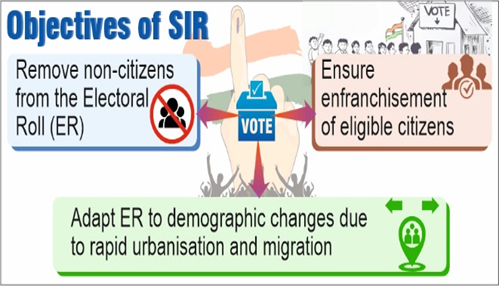
- The ECI cited rapid urbanisation, migration, duplication, and demographic changes as reasons for conducting the SIR.
- Constitutional Provisions:
- Article 324: It vests the superintendence, direction, and control of elections in the Election Commission of India.
- Article 326: It provides for elections based on universal adult suffrage for citizens above 18 years of age.
- Statutory Provisions:
- Section 16 of the RP Act, 1950: It bars non-citizens from being enrolled in electoral rolls.
- Section 21 of the RP Act, 1950: It deals with preparation and revision of electoral rolls.
- Section 21(3) of the RP Act, 1950: It empowers the ECI to order special revision of electoral rolls.
Need for SIR
- Remove Ineligible Voters: The exercise seeks to identify and remove duplicate, deceased, shifted, and non-citizen voters from electoral rolls.
- Uphold “One Person, One Vote”: By correcting duplication and inaccuracies, the SIR strengthens political equality and electoral integrity.
- Improve Accuracy of Electoral Rolls: The revision helps address demographic changes caused by migration, urbanisation, and newly eligible young voters.
- Strengthen Electoral Credibility: Updated and verified voter lists enhance public confidence in the electoral process.
Concerns and Challenges
- Risk of Exclusion: Migrants, elderly citizens, Persons with Disabilities (PwDs), and economically weaker sections may face difficulties in documentation and verification.
- Alleged NRC Linkage: Critics argue that the SIR could become a “backdoor NRC” due to emphasis on citizenship verification.
- Aadhaar-Related Concerns: Since Aadhaar is accepted only as proof of identity and not citizenship, many vulnerable citizens may face difficulties.
- Politicisation of the Exercise: Opposition parties have raised concerns regarding possible misuse of state machinery and arbitrary deletion of voters.
Way Forward
- Build Political Consensus: Wider consultation with political parties can improve trust, transparency, and acceptance of the SIR process.
- Leverage Technology: AI-enabled verification systems, multilingual platforms, and voter helplines can reduce exclusion errors and improve accessibility.
- Relax Documentation Norms: Flexible documentation requirements and provisional certifications can help vulnerable groups participate effectively.
- Institutionalise Periodic SIRs: Conducting SIR exercises regularly in a phased manner can improve preparedness and reduce politicisation.
- Strengthen Voter Awareness: Public awareness campaigns should educate citizens regarding eligibility, documentation, and timelines of the revision process.
Sources:
PIB
News On Air
Indian Express