
SYLLABUS
GS-3: Conservation, Environmental Pollution and Degradation, Environmental Impact Assessment.
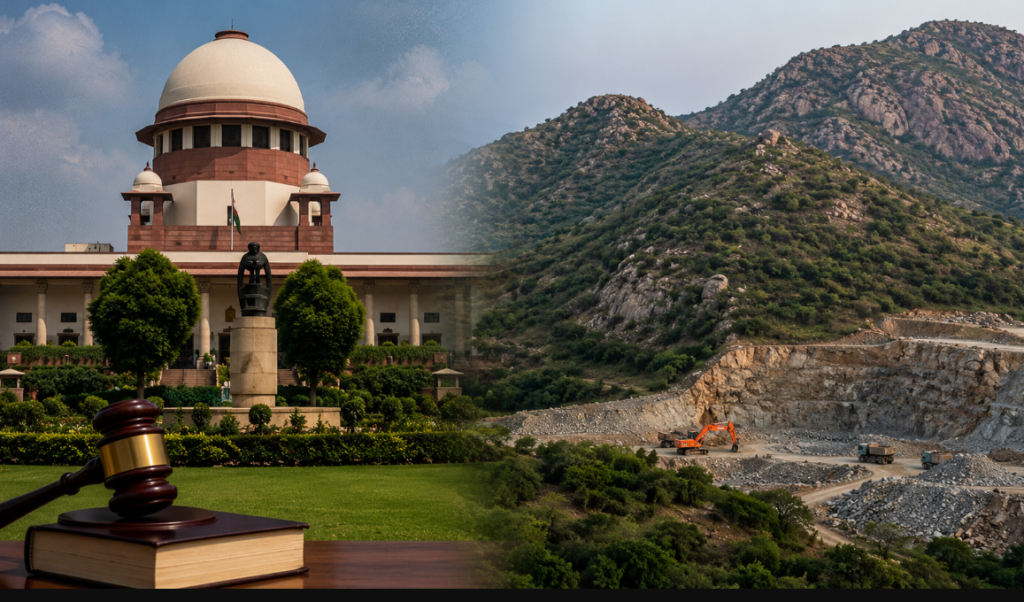
Context: Recently, the Supreme Court constituted a High-Powered Expert Committee (HPEC) to undertake a fresh scientific review of the definition of the Aravalli Hills and Ranges.
More on the News
• The Supreme Court has constituted a five-member High-Powered Expert Committee, headed by Kanchan Devi (DG, ICFRE), to undertake a fresh scientific review of the definition of the Aravalli Hills and Ranges.
• The move follows concerns that the Court-approved elevation-based definition may exclude ecologically significant portions of the Aravalli ecosystem and weaken environmental protection.
• The Court has stayed its November 2025 judgment accepting the Centre’s uniform definition of the Aravallis pending the Committee’s review.
• Further, restrictions on fresh mining leases and lease renewals in the Aravalli region will continue until a scientifically robust framework is evolved.
Background of the Issue
• The Aravalli Range, one of the world’s oldest fold mountain systems, extends across Gujarat, Rajasthan, Haryana and Delhi and has long faced threats from illegal mining, urbanisation and ecological degradation.
• In May 2024, the Supreme Court directed the formulation of a uniform definition of the Aravallis across four states to address regulatory ambiguities, particularly in the context of mining activities.
• Acting on the Court’s directions, a MoEFCC-appointed committee proposed a standardised definition based on an elevation threshold and spatial proximity criteria, which was accepted by the Supreme Court in November 2025.
• Subsequently, the Centre imposed restrictions on new mining leases and directed ICFRE to identify additional ecologically sensitive areas and prepare a Management Plan for Sustainable Mining (MPSM).
• Following objections from environmental experts, scientists and civil society groups, the Supreme Court took suo motu cognisance of the matter, stayed its earlier order and constituted a High-Powered Expert Committee for a fresh review.
Why Has the Earlier Definition Become Controversial?
• The earlier framework defined an Aravalli Hill as a landform rising at least 100 metres above local relief and an Aravalli Range as two or more such hills located within 500 metres of each other.
• Critics argued that the definition relied excessively on elevation criteria while overlooking crucial ecological and geological parameters such as landscape continuity, biodiversity, hydrology and geomorphology.
• Concerns were amplified by reports of the Forest Survey of India that only 8.7% of the 12,081 mapped hills satisfied the prescribed 100-metre threshold, raising fears that several ecologically important formations could lose protection.
• Analyses further suggested that nearly half of the currently protected Aravalli landscape could become vulnerable to mining and developmental pressures if the definition were implemented in its existing form.
• The Supreme Court consequently expressed concerns about a potential “structural paradox”, wherein a definition intended to conserve the Aravallis could inadvertently exclude substantial portions of the ecosystem from protection.
Significance of the Supreme Court’s Intervention
• Scientific and Ecological Governance: The decision promotes evidence-based environmental policymaking and can strengthen protection of the Aravallis’ ecological functions, including desertification control, groundwater recharge, biodiversity conservation and dust mitigation.
• Advancing Environmental Jurisprudence: The intervention reflects the judiciary’s continued commitment to constitutional environmentalism and principles such as sustainable development, precautionary principle, public trust doctrine and inter-generational equity.
• Promoting Cooperative and Sustainable Resource Governance: The review provides an opportunity to develop uniform conservation standards across four states while balancing ecological protection with sustainable mining, infrastructure development and local livelihood requirements.
Concerns / Challenges
• Scientific and Regulatory Challenges: Arriving at a scientifically accepted definition of the Aravalli ecosystem remains difficult due to variations in geology, topography and ecological characteristics, leading to uncertainty in land-use planning and environmental regulation.
• Conservation–Development Conflict: Reconciling ecological protection with mining interests, infrastructure expansion and local economic considerations may generate resistance from multiple stakeholders.
• Weak Enforcement Mechanisms: Persistent illegal mining, encroachments and fragmented interstate regulatory frameworks continue to undermine effective conservation of the Aravalli landscape.
Way Forward
• Adopt a Landscape-Based Approach: Develop a multi-parameter definition incorporating geology, geomorphology, hydrology, biodiversity and ecological connectivity to ensure comprehensive protection of the Aravalli ecosystem.
• Strengthen Institutional and Conservation Frameworks: Consider establishing an Aravalli Conservation Authority, operationalising the MPSM and scaling up afforestation, watershed restoration and groundwater recharge programmes through active community participation.
• Leverage Technology for Monitoring: Deploy GIS mapping, remote sensing, drones and AI-based surveillance systems to improve boundary demarcation, monitoring and enforcement against illegal mining activities.